












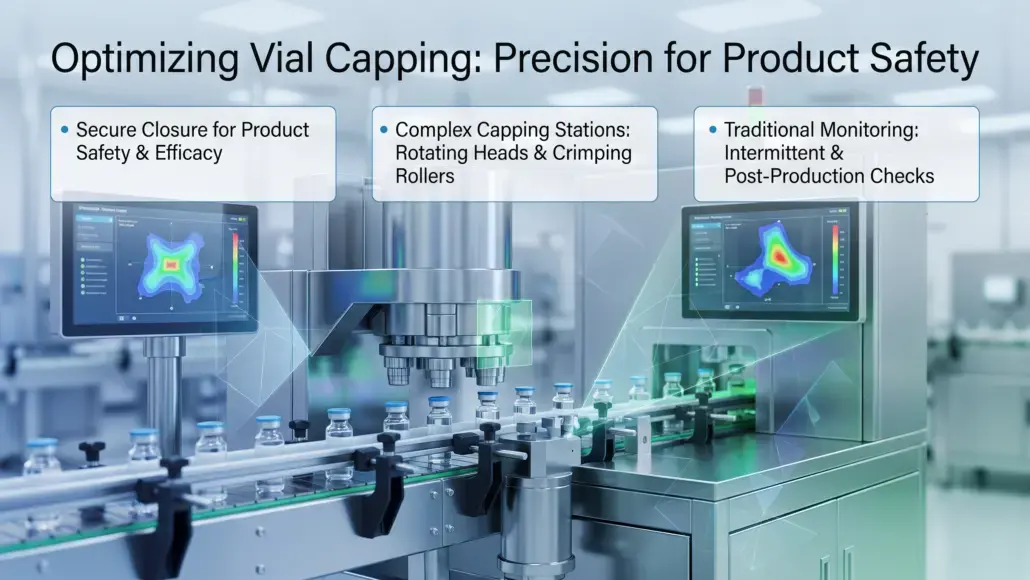
The final stage of the parenteral fill finish process is the securement of the closure system, a mechanical operation that must be executed with high precision to ensure the safety and efficacy of the medicinal product. In a modern aseptic production suite, the capping station is a complex assembly of rotating heads, pressure blocks, and crimping rollers. Traditionally, the performance of these machines was monitored through intermittent mechanical checks and post production inspections. However, the introduction of real-time force mapping has revolutionized how engineers visualize and control the forces applied during the capping cycle. This technology provides a continuous, high resolution digital representation of the stresses exerted on the vial and its components, allowing for instantaneous adjustments and a much deeper understanding of the capping dynamic. The capability to see the force distribution across the entire surface of the vial neck as the cap is being formed is a significant improvement over the static measurements of the past.
Dynamics of Vertical Compression and Side Load Analysis
The capping process involves two primary force vectors: the vertical load applied to compress the stopper and the lateral or tangential force used to crimp the aluminum skirt around the neck of the vial. Real-time force mapping enables the simultaneous measurement of these vectors, providing a complete profile of the mechanical event. By embedding sensors directly into the capping heads or utilizing specialized instrumented vials, manufacturers can capture data at millisecond intervals. This granular level of detail reveals the exact moment the pressure block engages the stopper, the duration of the peak compression, and the consistency of the crimp roller application. The data capture must be fast enough to record the rapid acceleration and deceleration of the mechanical parts, which often move at speeds exceeding several meters per second in high volume lines.
Analyzing the vertical load is essential for preventing glass breakage and ensuring that the stopper is seated correctly within the vial finish. If the vertical force is non uniform, it can result in a skewed seal, creating a potential leak path. Real-time force mapping identifies these imbalances by showing the distribution of pressure across the top surface of the closure. In addition to vertical loads, side load analysis ensures that the crimping rollers are applying even pressure as they rotate around the vial neck. Excessive side force can cause micro cracks in the glass, while insufficient force leads to loose caps. The ability to see these forces as they happen allows operators to fine tune the machinery to account for variations in component dimensions, ensuring a perfect seal every time. This level of control is particularly important for newer, thin walled glass vials that offer weight savings but are more sensitive to mechanical stress.
Mitigating Glass Breakage and Component Fatigue
Glass vials, while highly resistant to chemical interaction, are susceptible to mechanical stress, particularly at the finish and neck areas. High speed capping lines can subject these containers to significant impact forces, which, if not carefully controlled, can lead to catastrophic failure or subtle defects like “checks” or hairline fractures. Real-time force mapping acts as a diagnostic tool to identify the peak force events that contribute to glass fatigue. By mapping the force profile of a standard production run, engineers can pinpoint specific stages in the capping cycle where the stress exceeds the safety margins of the Type I borosilicate glass. The mapping system can also detect the presence of glass particles or other contaminants that might interfere with the mechanical movement of the capping head.
Beyond the glass itself, the mechanical components of the capping machine also undergo fatigue over time. Springs, bearings, and rollers can wear down, leading to a gradual shift in the force delivery. Because real-time force mapping provides a continuous stream of data, it can detect the earliest signs of component degradation. A subtle change in the slope of the force curve or a slight increase in the vibration recorded during the crimping phase can signal that a capping head is nearing the end of its service life. This allows for predictive maintenance, where parts are replaced based on their actual performance data rather than a fixed schedule, reducing downtime and preventing batch failures caused by equipment malfunction. The data also helps in identifying the root cause of recurring failures, such as a misaligned star wheel or a worn transport belt that causes the vials to enter the capping station at an incorrect angle.
Digital Twin Modeling in Aseptic Processing
The data generated by real-time force mapping is increasingly being used to create digital twins of the capping process. A digital twin is a virtual representation of the physical machinery that uses real world data to simulate different scenarios and optimize performance. In the context of pharmaceutical packaging, a digital twin allows engineers to test how different stopper shore hardness levels or aluminum cap thicknesses will affect the final seal quality without having to run physical trials on the production line. This accelerates the development of new packaging configurations and simplifies the scale up process from clinical to commercial manufacturing. The digital twin can also simulate the effect of different environmental conditions, such as high humidity or temperature extremes, on the performance of the elastomeric seals.
Integrating real-time force mapping with digital twin technology also enhances the training of production personnel. Operators can visualize the invisible forces at play within the machine, gaining a more intuitive understanding of how adjustments to the capping head height or roller pressure will impact the final product. This data driven approach to process optimization reduces the reliance on anecdotal evidence and ensures that the production line is always operating within the validated design space. As the industry moves toward more automated and connected factories, the ability to merge physical measurements with virtual models will be a defining characteristic of the most advanced manufacturing facilities. The continuous feedback from the mapping sensors allows the digital twin to be constantly updated, ensuring that it remains an accurate reflection of the current state of the machinery.
Precision Control of Plunger and Cap Alignment
One of the most challenging aspects of high speed vial capping is maintaining the perfect alignment of the components as they move through the machine. Even a slight misalignment between the capping head and the vial can lead to a host of problems, including deformed caps, unseated stoppers, and inconsistent seal integrity. Real-time force mapping provides a sensitive indicator of alignment quality. An asymmetrical force map suggests that the capping head is not hitting the vial perfectly center, allowing for immediate corrective action. This precision is particularly important for smaller vial sizes, where the tolerances for error are extremely tight and the mechanical forces are concentrated in a very small area.
In addition to alignment, the technology allows for the monitoring of the interaction between the plunger and the cap during the initial stages of the seal formation. The mapping system can detect if the stopper is being pushed too far into the vial or if it is resisting the downward pressure in an unexpected way. This information is vital for ensuring that the internal volume of the vial remains consistent and that the product is not exposed to excessive mechanical agitation. By maintaining tight control over the alignment and the force application, manufacturers can achieve a level of batch to batch consistency that was previously impossible, leading to higher yields and a more reliable supply of critical medicines. The data can also be used to optimize the design of the capping tools, such as the shape of the crimping rollers or the material used for the pressure blocks, to further improve the alignment and performance of the process.
Strategic Implementation and Regulatory Data Integrity
Implementing real-time force mapping is not just about installing sensors; it also involves creating a comprehensive data management framework that complies with the strict requirements of global regulations. Every data point generated by the system must be securely recorded, timestamped, and attributable to a specific batch and unit. This creates a complete audit trail that can be used to prove the quality of the product during regulatory inspections. The ability to provide an objective, data driven record of the capping process is a significant advantage in an industry where data integrity is of paramount importance. The software used to analyze the mapping data must also be validated to ensure that it correctly interprets the sensor signals and provides accurate reports to the quality assurance team.
In addition to compliance, the strategic use of force mapping data can drive continuous improvement initiatives. By analyzing the data from multiple production lines and facilities, pharmaceutical companies can identify best practices and standardize their capping operations globally. This leads to a more predictable manufacturing network and reduces the risk of quality discrepancies between different sites. Ultimately, the adoption of real-time force mapping is an investment in both product quality and operational efficiency, providing the insights needed to master one of the most critical steps in the pharmaceutical packaging process. The transition to these advanced analytical methods ensures that the industry remains at the forefront of technological innovation while maintaining the highest standards of patient safety. By leveraging the power of real time data, pharmaceutical manufacturers can build a more resilient and transparent supply chain that is capable of meeting the challenges of a rapidly changing global health environment.
Optimization of Capping Parameters for New Formulations
The introduction of new pharmaceutical formulations often requires adjustments to the packaging process to ensure compatibility and stability. Some products may be sensitive to the mechanical vibrations caused by the capping machine, while others may require a specific level of seal pressure to prevent the ingress of oxygen or moisture. Real-time force mapping provides the tools needed to optimize these parameters during the formulation development phase. By mapping the forces required to seal different vial and stopper combinations, scientists can select the most appropriate packaging system for each new medicine. This reduces the risk of stability failures during clinical trials and ensures a smoother transition to commercial manufacturing.
The data acquired through force mapping can also be used to establish the “design space” for the capping process, as required by Quality by Design (QbD) principles. This involves identifying the ranges of vertical force, side force, and alignment within which the product quality is guaranteed. By staying within this design space during commercial production, manufacturers can ensure that every vial meets the required standards for sterility and efficacy. The use of real-time force mapping to establish and maintain this design space is a powerful way to demonstrate process mastery to regulatory authorities and to ensure the long term success of new pharmaceutical products. The ability to visualize and control the invisible forces of the capping process is a fundamental shift in how we approach pharmaceutical quality, leading to a safer and more reliable future for medicine.