










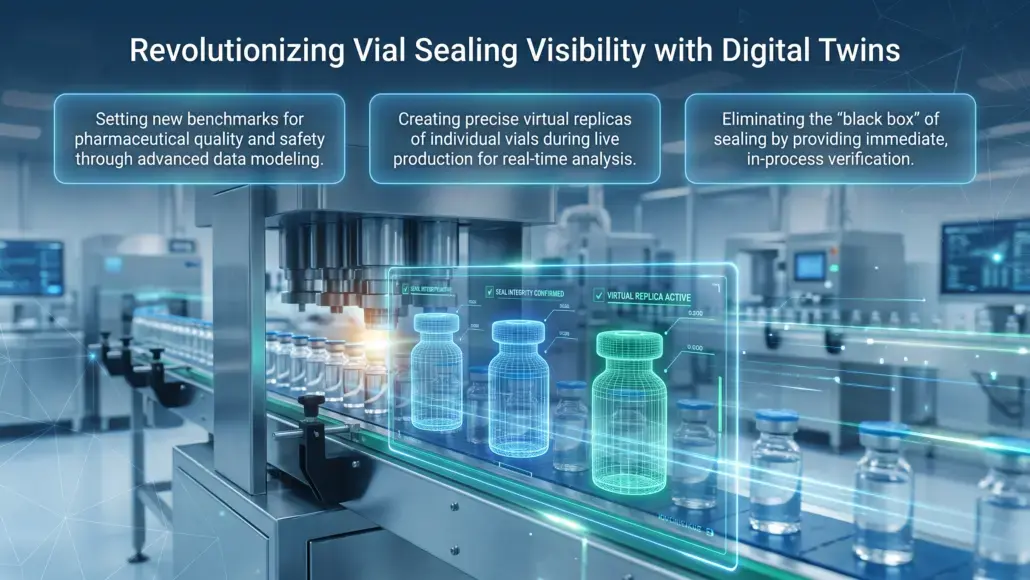
The pharmaceutical industry is undergoing a digital transformation, where advanced data modeling and physical manufacturing set new benchmarks for quality and safety. At the heart of this evolution is digital container twins improving vial sealing visibility, a technology creating precise virtual replicas of individual vials during production. For decades, the sealing and capping process remained a significant “black box” in pharmaceutical packaging, where quality was often verified only after the fact through destructive testing or statistical sampling. However, the emergence of digital twins has shifted the paradigm toward proactive, real-time monitoring. By simulating the physical forces, thermal dynamics, and mechanical tolerances of the sealing process, digital twins provide engineers with a granular view of how each seal is formed, ensuring that Container Closure Integrity (CCI) is maintained at a level of precision that was previously unattainable.
The Critical Nature of Container Closure Integrity in Pharma
Maintaining the sterile boundary of a pharmaceutical product is the most fundamental requirement of vial sealing, and digital container twins improving vial sealing visibility are now the primary tools for ensuring this boundary is never compromised. A failure in the seal can lead to microbial contamination, oxidation of sensitive biological products, or the loss of potency, all of which pose significant risks to patient safety. Traditional methods of checking for these failures often rely on visual inspection or vacuum decay testing, which are effective but do not provide insight into why a failure occurred. Digital twins address this by capturing the physics of the interaction between the glass flange, the rubber stopper, and the aluminum cap. By understanding the “residual seal force” in a virtual environment, manufacturers can detect subtle anomalies that might not be visible to the naked eye but could lead to long-term stability issues, thereby enhancing the overall reliability of the sterile supply chain.
Bridging the Gap Between Physical Capping and Digital Models
The implementation of digital container twins improving vial sealing visibility requires a sophisticated integration of sensor technology and computational power. As a vial enters the capping station, high-speed cameras and pressure sensors collect data on the vertical force applied by the capping head, the torque of the rollers, and the specific geometry of the vial’s neck. This physical data is instantly fed into a digital twin model that has been pre-configured with the material properties of the glass and the elastomeric components. The digital twin then simulates the sealing event in milliseconds, comparing the real-world data against the “golden batch” profile. This bridge allows for the immediate identification of deviations, such as a slightly misaligned stopper or a variation in glass thickness, which allows the system to reject the specific vial before it even leaves the capping zone, significantly reducing the risk of downstream quality failures.
Enhancing Process Visibility Through Predictive Analytics
One of the most transformative aspects of digital container twins improving vial sealing visibility is the move from reactive monitoring to predictive analytics. By analyzing the trends across thousands of virtual sealing events, the system can identify when a capping head is beginning to drift out of alignment or when a specific lot of stoppers is showing slightly different compression characteristics. This foresight allows maintenance teams to intervene before a single defective vial is produced. Instead of waiting for a batch to fail a leak test, manufacturers can use the digital twin to simulate “what-if” scenarios, determining the exact parameters needed to optimize the seal for a new product formulation or a different vial size. This level of visibility transforms the sealing process into a data-driven science, where every mechanical action is understood, modeled, and optimized for maximum safety.
Regulatory Compliance and the Impact of Annex 1
The pharmaceutical regulatory landscape, particularly with the recent updates to EudraLex Annex 1, is placing a much higher emphasis on the continuous monitoring of sterile processes, and digital container twins improving vial sealing visibility are becoming essential for compliance. Regulators now expect manufacturers to have a comprehensive understanding of their processes and to implement proactive measures to ensure sterility. Digital twins provide a complete digital audit trail for every single vial, documenting the exact conditions under which it was sealed. This data is invaluable during regulatory inspections, as it demonstrates a level of process control that traditional documentation cannot match. By providing a “life history” of the container closure, digital twins help manufacturers meet the rigorous requirements for Quality Risk Management (QRM) and Contamination Control Strategy (CCS), ensuring that every product reaches the patient in a perfectly sealed state.
Reducing Rejection Rates and Operational Waste
Beyond the safety and regulatory benefits, digital container twins improving vial sealing visibility offer significant economic advantages by reducing operational waste and rejection rates. In high-value biological manufacturing, the cost of a single rejected vial can be thousands of dollars. Traditional capping processes often have a baseline rejection rate due to mechanical variability that is difficult to diagnose. Digital twins allow engineers to “see” into the machine, identifying the root cause of rejects—whether it be a specific roller wearing down or a mismatch in component tolerances. By fine-tuning the process based on digital twin simulations, manufacturers can achieve a much tighter distribution of seal quality, leading to a substantial decrease in waste. This efficiency not only improves the bottom line but also ensures that critical, life-saving medicines are produced with the highest possible yield and resource efficiency.
The Role of IoT and Sensor Fusion in Digital Twin Accuracy
The accuracy of digital container twins improving vial sealing visibility is directly proportional to the quality of the data captured at the point of manufacture. This has led to the rise of “sensor fusion,” where multiple types of data—acoustic, visual, and mechanical—are combined to create a high-fidelity model. For example, acoustic sensors can detect the subtle “click” of a cap seating correctly, while force sensors measure the exact Newton-meters of pressure applied. When these disparate data points are fused together in a digital twin, they provide a multi-dimensional view of the sealing event. This holistic perspective is crucial for identifying complex failure modes that a single sensor might miss, such as a micro-crack in the glass flange that only manifests under specific compression forces. As IoT technology continues to advance, the resolution of these digital twins will only increase, providing even deeper visibility into the molecular-level interactions of the seal.
Scaling Digital Twins Across Global Manufacturing Networks
As pharmaceutical companies look to standardize their operations, the ability to scale digital container twins improving vial sealing visibility across global manufacturing sites is becoming a major competitive advantage. Once a digital twin model has been perfected at a lead site, it can be deployed as a “digital template” to other facilities around the world. This ensures that a vial sealed in a facility in Asia meets the exact same quality specifications as one sealed in Europe or North America. Centralized quality teams can monitor the performance of capping lines across multiple continents in real-time, identifying global trends and sharing optimization strategies instantly. This global visibility is essential for maintaining brand integrity and ensuring that patients receive the same high-quality medicine regardless of where it was manufactured, truly globalizing the standards of pharmaceutical excellence.
Despite the clear advantages, the implementation of digital container twins improving vial sealing visibility is not without its challenges. It requires a significant upfront investment in both hardware and data infrastructure. Furthermore, there is a cultural shift required within the manufacturing organization, as operators and quality teams must learn to trust and act upon digital models rather than just physical inspections. Data silos between the engineering, IT, and quality departments can also hinder the seamless flow of information needed for a successful digital twin. Overcoming these hurdles requires a clear roadmap, starting with pilot projects on high-risk lines and gradually expanding as the organization builds the necessary technical and analytical capabilities to manage a fully digitized manufacturing ecosystem.
Future Outlook: Smart Packaging and End-to-End Visibility
The future of digital container twins improving vial sealing visibility extends beyond the factory walls and into the entire lifecycle of the product. We are moving toward a reality where the digital twin of the vial remains active even after it leaves the facility, potentially incorporating data from “smart” labels that monitor temperature and handling during transit. This end-to-end visibility will allow manufacturers to verify that the container closure integrity has remained intact throughout the cold chain and all the way to the point of care. As AI and machine learning continue to evolve, these digital twins will become even more autonomous, self-correcting manufacturing parameters in real-time and providing healthcare providers with absolute certainty about the quality and safety of the vial in their hands.
The adoption of digital container twins improving vial sealing visibility is not just a technological upgrade; it is a fundamental reimagining of how pharmaceutical quality is ensured. By bringing the “hidden” physics of the sealing process into the digital light, manufacturers are able to achieve a level of control and transparency that was once thought impossible. This technology is the cornerstone of the Pharma 4.0 revolution, where data is used to protect patients, optimize resources, and meet the most stringent regulatory demands. As the industry continues to embrace these digital models, the gap between the virtual and physical worlds will continue to close, leading to a future where every pharmaceutical vial is a masterpiece of precision engineering, guaranteed by the invisible but powerful presence of its digital twin.