










The biotech industry has never lacked brilliant scientists or bold ideas. What is often missing is leadership recognizing the behaviors required to build a great early-stage company are not the same as those required to take it to market — and willingness to adapt accordingly.
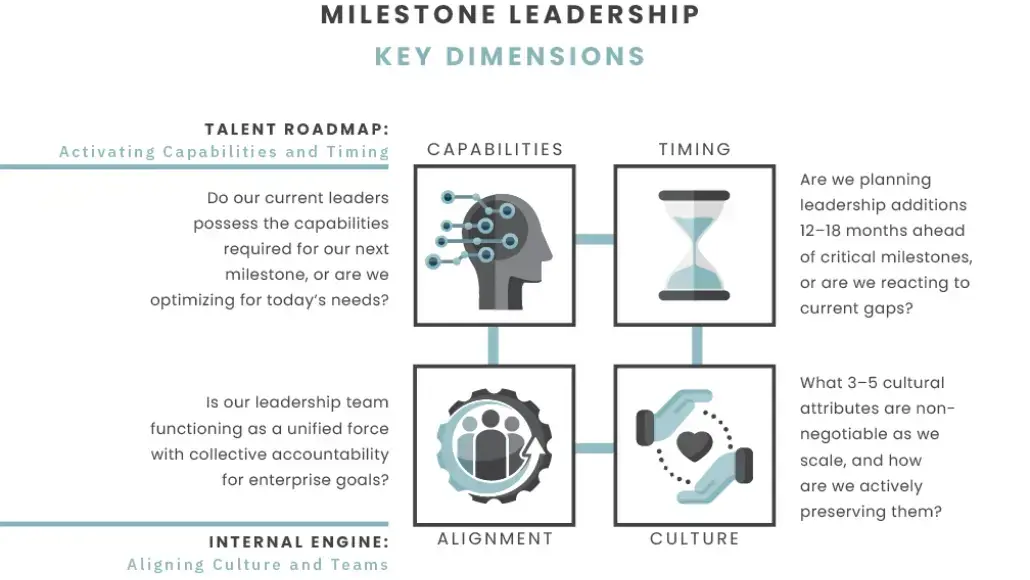
In our recent report, From Science to Scale: Building Biotech Companies via Milestone Leadership, we introduced a framework for understanding how leadership capabilities, timing, culture, and alignment must evolve as biotech companies progress from scientific discovery to commercialization.
Leadership readiness is not only a question of who is in the room. It is also a question of how leaders show up: how they communicate under pressure, make decisions across functions, navigate transitions, and reinforce the culture the organization needs at its current stage.
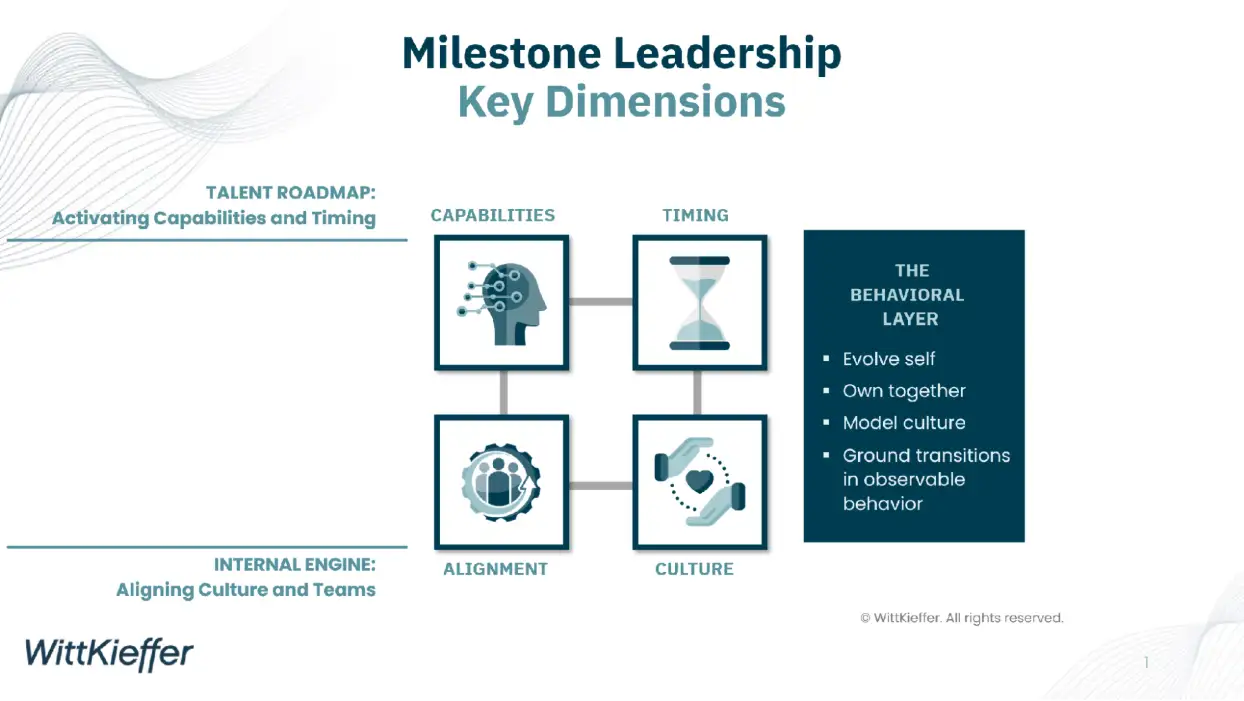
This article examines how leadership evolution is reflected in everyday behaviors, team dynamics, and cultural practices, and how these factors ultimately determine whether individual excellence translates into sustained organizational performance.
The Behavioral Pivot No One Plans For
The most consequential transition in biotech is not the one that happens between stages. It is the one that happens inside a leader: the shift from depth to breadth, from doing to directing, from championing a scientific vision to stewarding an enterprise.
This is a difficult transition: the behaviors that create early credibility can actively impede later success. In early scientific development, CEOs often earn credibility by acknowledging uncertainty and holding multiple hypotheses open. As companies move toward Phase II, however, leaders must increasingly translate uncertainty into decision criteria, explicit choices, and organizational direction. The CSO who goes deep into every experiment is indispensable when the team is ten people; that same leader can become a bottleneck when the team is fifty.
The behavioral shift that matters at each transition depends not only on what leaders add to their repertoire but also on what they stop doing. A pre-clinical leader who does not stop doing bench-level scientific work in Phase I risks blocking translational progress. A Phase I CEO who remains primarily a scientific champion in Phase II risks failing to build the commercial and organizational infrastructure the company urgently needs. A Phase II CCO who has not shifted from market intelligence to revenue accountability by commercial launch risks building strategy instead of sales.
At each stage, the highest-leverage behavioral question is not, What new skills do I need? It is, What am I still doing that I should stop? This is a harder question, because abandoning successful behaviors often means letting go of a professional identity. The behaviors that earn recognition early become habits that are hard to break precisely because they used to work well.
As companies scale, success increasingly comes from developing leaders and creating systems that enable others to perform at a high level without the leader’s constant involvement. The most effective leaders continually examine where they may be slowing the organization down, seek candid feedback from boards and colleagues, and have (or build) the self-awareness and courage to relinquish responsibilities that no longer serve the company in its new stage of growth. Ultimately, the leaders who navigate transitions most successfully are those who are willing to let go of the very behaviors and identities that made them successful in the first place.
What Happens When Teams Stop Owning the Outcome Together
One of the most common behavioral risks we observe in maturing biotech leadership teams is the gradual emergence of functional silos. It is so predictable that it might as well be written into the development calendar. As functions professionalize and headcount grows, most C-suite leaders begin optimizing for their own domains. The CFO manages the balance sheet. The CMO manages the clinical program. The CCO builds the commercial strategy. Somewhere in that professionalization, the habit of collectively owning the enterprise outcome gradually dissipates.
The contrast is clearest in an early-stage company, where information flows broadly and accountability is naturally shared across a small leadership team. But the behavioral norms that produce this, such as radical transparency, unsolicited input across domains, and shared accountability, are often not explicitly preserved as the company grows. Instead, they get crowded out by the specialization that scale demands.
The antidote requires explicit, recurring behavior. High-performing biotech leadership teams do three things that siloed teams do not. First, they have deliberate conversations, separate from functional updates, about what the team collectively owns above and beyond each executive’s individual mandate. Who is responsible for ensuring the clinical story serves the commercial strategy? Who bridges the gap between scientific data and payer language? These cross-functional accountabilities do not appear on organizational charts. They must be named and claimed. Second, these teams create regular cadences in which they grapple with enterprise-level tensions rather than reporting on functional progress. Third, they evaluate executives on their contributions to team effectiveness, not just their functional metrics. The evaluation system is the clearest signal an organization sends about what it actually values. If team contributions are not reflected in performance criteria, enterprise optimization becomes extremely difficult.
Leadership transitions are among the most powerful and most squandered opportunities to refresh team alignment. When a new leader joins, the instinct is to get them up to speed on their functional domain as quickly as possible. But the team’s behavioral norms are rarely made explicit. The new leader absorbs whatever dynamic already exists, which often means the dynamic absorbs them rather than evolving with them. The teams that manage this best treat each significant transition as a moment to revisit collective norms, not just functional onboarding.
Culture Is Defined by Behavior, Not by a Statement
The cultural paradox in biotech is well documented but rarely managed effectively. The urgency, scientific passion, and entrepreneurial scrappiness that attract early talent and drive early breakthroughs are exactly the qualities most at risk of dilution as the organization grows, professionalizes, and begins adding people who bring norms shaped by other organizations’ needs. Every significant hiring wave imports a variety of assumptions about organizational culture. Without active management, the company’s culture can drift toward the average, unexamined blend of the cultures that walked in through the door.
The organizations that preserve their cultural DNA through scaling are not the ones with the best values statements. They are the ones whose leaders consistently and publicly model the culture, even at personal cost.
Culture is transmitted through three leadership behaviors above all others: what they celebrate, what they tolerate, and what they model. When a CEO publicly recognizes a team member who raised a safety concern that slowed a trial, even if they are privately wincing at the delay, it teaches the organization that scientific integrity is real, not aspirational. When a leadership team routinely makes decisions in hallways rather than through the forums they ostensibly use for governance, the organization learns to bypass official processes. Each of these is a cultural signal, and they accumulate to shape culture far more powerfully than any declared set of values.
The most durable cultural mechanism is explicit identification of what are non-negotiables, the three to five behaviors the organization commits to preserving regardless of scale. For most biotech companies, these include some version of scientific integrity, patient focus, and a bias for action. What changes across stages are not these non-negotiables but the behaviors through which they are expressed. Urgency in a twenty-person pre-clinical team may rely on rapid, informal coordination. Urgency in a two-hundred-person commercial organization requires fast decisions executed through clear governance. Naming these non-negotiables and then actively evolving how they are expressed at scale is the work of culture stewardship. Dysfunction emerges when organizations cling to the early-stage interpretation of a value rather than adapting its expression to evolving needs and realities.
One more behavioral discipline matters here: honesty about what is being lost. Leaders who manage culture evolution by insisting that everything will be preserved generate cynicism. The team knows what has changed. The transition from a twenty-person team to a two-hundred-person organization genuinely involves losses, including the speed of informal decision-making, the visibility of individual contribution, and the sense that everyone knows the whole picture. Acknowledging those losses openly, honoring them, and being clear about why the evolution is necessary is not weakness. It is the trust-building behavior that makes people willing to change.
The Founder Crossroads
No behavioral challenge in biotech is more emotionally charged than the moment when a founding leader must evolve, be complemented by additional leadership, transition into a different role, or support their own succession planning. This is worth naming separately because the behaviors that signal whether a founder is making the required shift or resisting it are usually visible long before boards or investors are willing to act on them.
Founders who navigate the transition successfully tend to exhibit several recognizable behaviors. They solicit perspectives that challenge their own. They make decisions explicitly rather than by instinct. They talk about the organization’s needs rather than only about their vision. They build leaders around them rather than remaining the most essential person in the room. Founders who are not making the shift display the opposite pattern. They remain the primary scientific voice, even when clinical and commercial voices are equally needed; they treat new governance processes as bureaucratic impediments rather than organizational assets, and they tend to reduce complex enterprise tradeoffs to a single scientific question.
Navigating the transition from visionary builder to enterprise leader requires founders to evaluate honestly whether their behaviors are evolving as quickly as the company itself. Founders should intentionally seek out perspectives that challenge their assumptions, create decision-making processes that rely on data and cross-functional input rather than instinct alone, and spend as much time developing leadership talent as advancing the science. A useful self-assessment is to ask: Am I still the central voice in every critical discussion, or am I enabling others to lead?
Equally important, boards and investors should ground succession and development conversations in observable behaviors rather than loyalty, history, or personal affinity. Indicators such as a founder’s willingness to embrace governance, delegate authority, incorporate commercial and operational perspectives, and prioritize the organization’s needs over personal ownership provide far more reliable signals of future effectiveness than reputation or past accomplishments. Ultimately, the most successful founders are those who recognize that leadership at the next stage may require a fundamentally different version of themselves and who approach that evolution with humility, self-awareness, and a commitment to what the company needs most.
The Behavioral Edge
The biotech companies that successfully advance from the lab to the market tend to share a common trait that is easy to overlook in an industry understandably obsessed with scientific differentiation: their leaders know what stage they are in, behave accordingly, and build teams that do the same. They manage culture as a strategic asset rather than a background condition. They build alignment through practice, not through organizational charts. And they treat leadership transitions as opportunities to evolve, not just personnel decisions.
The science matters enormously. But in an industry where execution challenges are as formidable as scientific ones, the behavioral edge is what separates the companies that reach patients from the ones that do not. As companies approach each milestone, the most important leadership question may be deceptively simple: What must we stop doing, start doing, and preserve to succeed at the next stage?