













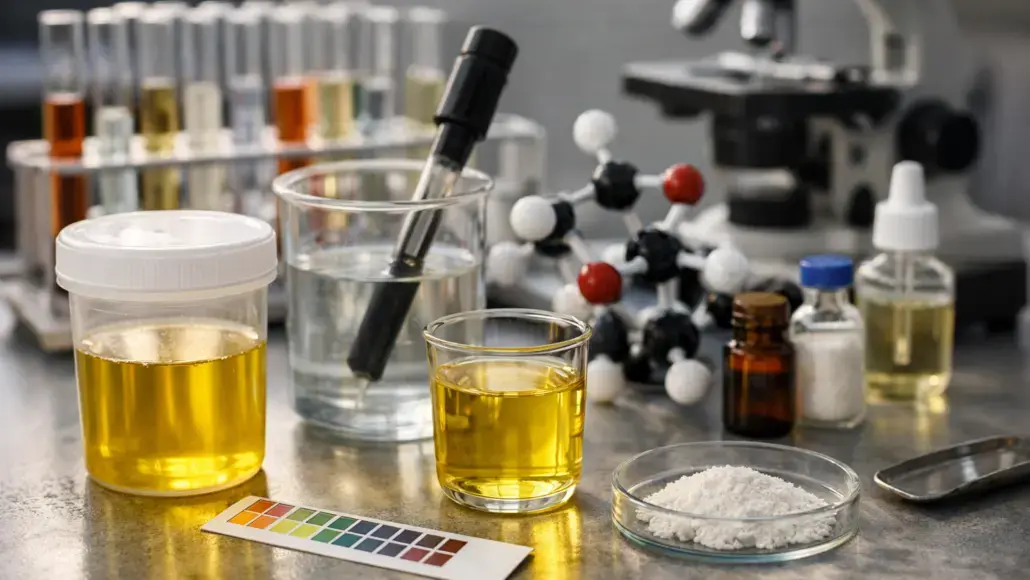
Synthetic urine sounds simple until you look closely at what natural urine actually contains. At first glance, it may appear to be little more than water with a few dissolved substances, but urine is a chemically complex biological fluid whose composition reflects hydration, metabolism, diet, kidney function, and other physiological factors. Researchers who formulate artificial urine therefore have to consider far more than color and appearance. They must reproduce measurable chemical and physical characteristics that make the fluid behave similarly to authentic urine in laboratory settings.
The subject is particularly interesting because synthetic urine has legitimate scientific and industrial applications. Researchers use artificial formulations to test analytical instruments, study chemical interactions, evaluate medical technologies, and create standardized laboratory samples. Scientific work on artificial urine shows that realistic formulations commonly focus on compounds such as urea, creatinine, electrolytes, uric acid, and citrate, while also attempting to reproduce properties such as pH, specific gravity, and osmolality.
Water Is the Foundation of the Mixture
The largest component of human urine is water, accounting for roughly 95 percent of its composition. That makes water the foundation of any artificial formulation, but the goal is not simply to fill a container with purified water and add a handful of chemicals. The dissolved substances influence the solution’s density, acidity, conductivity, and other measurable characteristics, meaning the proportions matter.
One of the most important compounds is urea. Produced during the body’s processing of proteins, urea is a major nitrogen-containing waste product excreted through the kidneys. Research on artificial urine identifies urea as one of the dominant chemical contributors to the fluid and one of the most important substances to reproduce when creating a laboratory model.
The concentration of urea also demonstrates why artificial urine cannot be treated as a single universal recipe. Human urine varies naturally depending on hydration, diet, metabolism, and other factors. Consequently, scientific formulations may use target ranges rather than attempting to duplicate one person’s urine exactly.
Creatinine and Other Metabolic Compounds
Creatinine is another important component because it is a normal waste product associated with muscle metabolism. It is routinely measured in urine analysis and therefore has considerable importance when researchers are trying to create a chemically realistic urine substitute. Published artificial-urine research includes creatinine among the principal compounds selected for formulations intended to approximate human urine.
Uric acid is another naturally occurring waste product, although it is generally present at lower concentrations than urea. Other compounds can include citrate and various dissolved ions. Sodium, potassium, chloride, calcium, magnesium, ammonium, phosphate, and sulfate all contribute to the broader chemical profile of urine. A research formulation published in Scientific Reports, for example, incorporated several of these components to improve the similarity between artificial and human urine.
This mixture illustrates an important principle of biological chemistry: relatively small quantities of minor components can still matter when a laboratory is evaluating a complex sample. A liquid can look convincing while having a very different chemical profile.
Why pH and Specific Gravity Matter
Chemical composition is only one part of the equation. Synthetic urine also has to reproduce physical properties that laboratories can measure. Two particularly important characteristics are pH and specific gravity.
pH describes how acidic or alkaline a solution is. Human urine can naturally fall across a fairly broad range, with published research reporting values around 4.5 to 8.0 under physiological conditions. Diet, hydration, metabolism, and other factors can contribute to variation. Artificial urine therefore needs appropriate buffering and dissolved compounds to establish a realistic pH rather than simply adding an arbitrary acid or base.
Specific gravity, meanwhile, measures the density of urine relative to water. Because dissolved substances increase the density of a solution, specific gravity provides useful information about how concentrated a urine sample is. Research on human urine reports a broad physiological range, and studies of commercial synthetic urine have likewise measured specific gravity as one of the key characteristics used to evaluate the samples.
The Role of Electrolytes and Salts
Electrolytes give synthetic urine another layer of chemical realism. Sodium and potassium are among the principal ions found in urine, while chloride, calcium, magnesium, phosphate, sulfate, and other ions can also be present. These substances affect ionic strength, conductivity, osmolality, and overall chemical behavior.
Researchers do not necessarily need to reproduce every molecule found in natural urine for every application. Human urine contains thousands of detectable chemical components, but attempting to include all of them would make a practical laboratory formulation unnecessarily complicated. Instead, artificial urine protocols generally select abundant compounds, consistently present, or especially relevant to the particular experiment.
That approach makes synthetic urine useful as a controlled research material. Scientists can deliberately specify concentrations, prepare repeatable batches, and investigate how a system responds to a standardized fluid. In medical-device research, for example, consistency can be more useful than attempting to reproduce every fluctuation found in real biological samples.
Why There Is No Single Perfect Synthetic Urine Formula
It is tempting to think of synthetic urine as having one definitive chemical recipe, but scientific research shows that formulations differ according to their intended purpose. A formulation designed for laboratory analysis may contain a different selection or concentration of compounds from one designed for medical research, analytical instrument testing, or educational experiments.
Research comparing artificial formulations with human urine has found that achieving a perfect spectral match is difficult because natural urine itself varies considerably between individuals. Factors including diet, sex, metabolism, hydration, and time of collection can alter the chemical profile.
Commercial products can also vary significantly. A recent Journal of Analytical Toxicology study examined multiple synthetic urine products and found differences in creatinine, urea, pH, specific gravity, and other measurable characteristics. The researchers also identified cases in which synthetic samples could be distinguished through more advanced analytical methods.
How Modern Laboratories Analyze the Difference
The increasing sophistication of analytical chemistry has made it possible to look beyond the basic measurements. Traditional specimen-validity measurements may examine characteristics such as pH, creatinine concentration, and specific gravity. More advanced techniques can investigate molecular signatures and search for compounds that would normally be present in authentic human urine.
Liquid chromatography coupled with tandem mass spectrometry, commonly known as LC-MS/MS, is one example of a highly sensitive analytical approach. Research has demonstrated that synthetic urine may lack certain endogenous biomolecules normally found in authentic samples, while some commercial formulations can contain identifiable compounds associated with their manufacture.
This distinction is important scientifically because it demonstrates the difference between reproducing a handful of measurable properties and reproducing a biological fluid in its entirety. Matching pH and density does not automatically mean a sample has the same molecular complexity as naturally produced urine.
Synthetic Urine Has Legitimate Scientific Uses
Despite the attention synthetic urine sometimes receives in connection with drug-testing discussions, its scientific applications are broader. Artificial urine can provide researchers with a consistent medium for laboratory experiments where obtaining large quantities of authentic human urine would be inconvenient, variable, or ethically inappropriate.
A standardized artificial sample can help laboratories test analytical methods under controlled conditions. Researchers can also adjust individual components to study how specific chemicals behave in a urine-like environment. This makes artificial formulations useful for areas ranging from medical research to materials testing and analytical chemistry.
The broader scientific value comes from reproducibility. When researchers know exactly which compounds are present and approximately how much of each compound has been added, they can repeat experiments more reliably. That is one reason artificial biological fluids are valuable across laboratory science.
What the Chemistry Reveals About Biological Fluids
Synthetic urine is ultimately a useful demonstration of how difficult it can be to replicate something produced naturally by the human body. A simplified formulation may contain water, urea, creatinine, salts, citrate, and other compounds, but authentic urine reflects a continuously changing biological system.
The challenge is therefore not simply making a liquid that resembles urine. It is understanding which chemical characteristics matter for a particular purpose and controlling those characteristics with enough precision to make the resulting material useful. Research into artificial urine continues to refine formulations by comparing their chemical and physical properties with authentic biological samples.
For anyone researching commercially available products, it is also worth approaching broad claims carefully. Terms such as “realistic” or “lab-grade” can mean different things depending on the intended application. Independent scientific characterization provides a more meaningful basis for understanding what a formulation actually contains than appearance alone. For readers comparing consumer-oriented information, resources such as reviews quick fix plus may appear in discussions of synthetic urine products, but those discussions should be considered separately from peer-reviewed laboratory evidence.
Conclusion
Synthetic urine is a fascinating example of applied chemistry because it sits at the intersection of biology, analytical science, and materials formulation. Its basic ingredients may sound familiar – water, urea, creatinine, salts, and other dissolved compounds – yet reproducing the measurable characteristics of natural urine requires careful attention to concentration, pH, specific gravity, and molecular composition.
The most important takeaway is that there is no single ingredient responsible for making artificial urine chemically realistic. Instead, its properties emerge from the interaction of many components. Scientific studies continue to show that while selected physical and chemical characteristics can be reproduced effectively, authentic urine contains a much broader and naturally variable molecular profile. Understanding that distinction provides a clearer picture of what synthetic urine really is: not simply colored water, but a carefully engineered chemical model of a complex biological fluid.