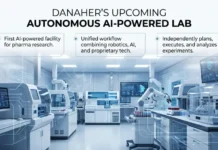









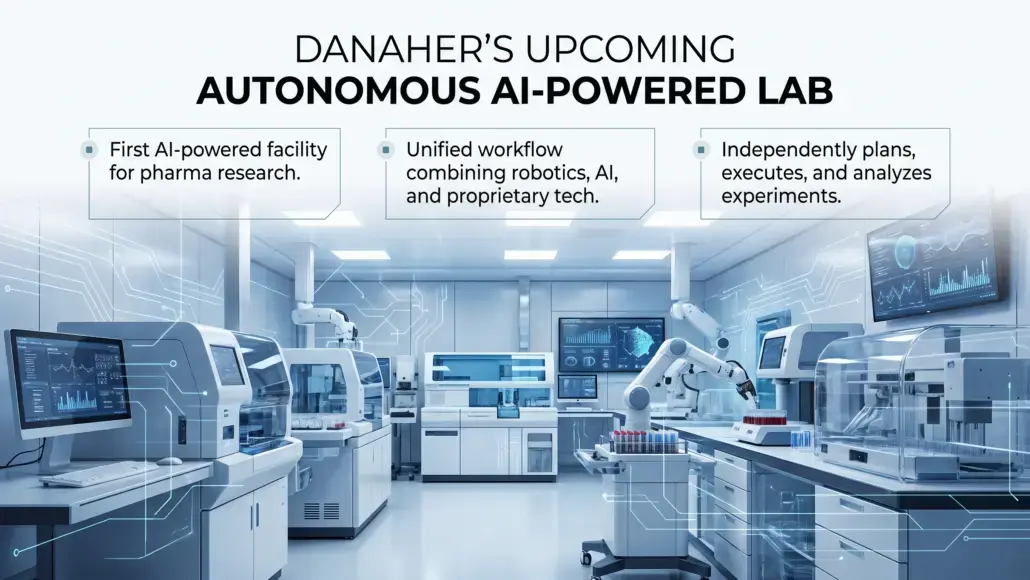
In a significant step for pharmaceutical research, Danaher has announced plans to launch its first AI-powered autonomous research facility. Expected to become fully operational in early 2027 at the Abcam headquarters in Cambridge, UK, the upcoming AI autonomous lab will combine robotics, artificial intelligence, and proprietary technologies into a single, unified workflow. This closed-loop system is designed to independently plan, execute, and analyze experiments with minimal human intervention, helping researchers rapidly develop custom molecular tools and affinity reagents.
Combining Capabilities for Continuous Learning
The facility will integrate technologies from five prominent Danaher companies: Beckman Coulter Life Sciences, Cytiva, Genedata, Integrated DNA Technologies, and Molecular Devices. By uniting these capabilities, the laboratory establishes a continuous design-make-test-learn cycle. Artificial intelligence models will design antibody candidates and other affinity reagents, which are then automatically built and tested. Experimental results continuously feed back into the system to inform and refine subsequent designs. To achieve this seamless device orchestration and laboratory automation, the company is collaborating with Automata, a firm that previously secured a US$45m Series C investment from Danaher.
Julie Sawyer Montgomery, CEO of Danaher, emphasized the impact of this integration: “researchers move from an idea to tested and validated affinity reagents up to 8x faster while maintaining scientific rigour. “This is the full power of Danaher in action, bringing together our science, technology and culture of continuous improvement to accelerate the journey from discovery to impact.”
Luciano Lucas, Vice President and Enterprise Head of Autonomous and Intelligent Labs at Danaher, highlighted the strategic vision behind the project. He noted, “We are…building a broader foundation for the future of science: a new generation of intelligent scientific devices designed to generate AI-ready data, integrate seamlessly into customer-defined workflows, be easily controlled programmatically…incorporate expert-level agentic capabilities, simplify operation, improve data quality and help researchers gain deeper insights. “These capabilities can benefit scientists whether they work in manual, semi-automated, or fully autonomous environments.”
Industry Trends and Strategic Partnerships
This new AI autonomous lab reflects a broader shift across the pharmaceutical and biotech sectors toward merging computational intelligence with physical experimentation. Other major players are also advancing drug discovery through similar methods. Roche is pursuing AI-driven laboratories to connect research operations, targeting up to 20 new molecular entities by 2030. Likewise, AI-native organizations such as Recursion Pharmaceuticals, Isomorphic Labs, and Insilico Medicine are leveraging automated physical experimentation combined with machine learning to accelerate drug discovery pipelines.
Beyond laboratory automation, Danaher continues to expand its strategic alliances. The company previously established a 2025 partnership with AstraZeneca to develop novel diagnostic tools designed to identify patients suitable for precision medicines. Additionally, a collaboration with Innovaccer focuses on AI-powered healthcare technology to connect data and workflows, reflecting a comprehensive strategy to merge external digital innovation with the life sciences sector.