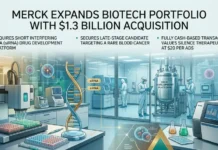













In late 2025, with the ink barely dry on the deal, Merck confirmed it would acquire Cidara Therapeutics for approximately 9.2 billion USD, a move that crystallised in 2026 as the centrepiece of Merck’s strategic pivot. Merck’s strategic pivot: Cidara acquisition and $70B revenue ambition signals more than a bet on one long‑acting antiviral; it is a deliberate recalibration of the company’s innovation and growth roadmap toward respiratory health, vaccines, and antiviral therapies, as the blockbuster era of Keytruda‑centric dominance begins to fade into a more diversified successor phase.
For institutional investors, the significance lies not just in the headline price tag, but in the logic behind it. The Cidara deal is emblematic of a broader industry shift: large pharma increasingly using targeted, science‑driven acquisitions to offset patent cliffs and build balanced, defensible portfolios rather than relying on internal R&D alone. Merck’s $70 billion revenue ambition by mid‑decade, articulated at events such as the J.P. Morgan Healthcare Conference in January 2026, frames the Cidara acquisition as a core lever in that growth plan, not a one‑off novelty.
This pivot is particularly visible in 2026, as Merck integrates Cidara’s lead compound, CD388 (now being developed as MK‑1406), into its respiratory and vaccines strategy. The long‑acting, strain‑agnostic flu antiviral concept is positioned as a potential successor‑generation asset in a franchise that has already been reshaped by earlier moves, including the 2021 Keytruda–Januvia‑era repositioning and Merck’s renewed emphasis on vaccines and infectious disease.
What Merck bought with Cidara
At the core of Merck’s strategic pivot: Cidara acquisition and $70B revenue ambition is the molecule CD388, now designated MK‑1406. Cidara had developed CD388 as a “strain‑agnostic” long‑acting influenza antiviral with a twice‑yearly administration paradigm, a profile that, if realised in large‑scale trials, would sit between traditional flu vaccines and single‑season therapeutics.
The concept is compelling: a long‑acting agent that provides durable protection across multiple flu seasons, reducing the need for annual vaccination while maintaining a high barrier to resistance. For Merck, that fits neatly into a broader respiratory and vaccines strategy that has already invested in respiratory syncytial virus (RSV) and other respiratory pathogens, and that seeks to build a more integrated, multi‑year protective franchise rather than a patchwork of single‑year or seasonal programmes.
Beyond the lead molecule, the Cidara acquisition also brought platform‑level know‑how in antiviral discovery and clinical development, particularly in the design of long‑acting agents and the management of influenza‑season dynamics. For Merck, which had previously relied more heavily on oncology and chronic‑disease franchises, this represents an expansion of scientific capability into a domain where population‑level prevention and seasonal‑cycle economics are central.
Aligning Cidara with the $70B revenue ambition
In public statements leading into 2026, Merck’s leadership framed the Cidara acquisition as a cornerstone of its ambition to reach about 70 billion USD in revenue by the middle of the decade. The message to investors is clear: the company no longer intends to anchor its growth story primarily on the continued dominance of Keytruda or other legacy oncology assets, many of which are facing or approaching patent expiry.
Instead, Merck is deliberately building a more diversified engine, with multiple franchises oncology, vaccines, diabetes, and now long‑acting antivirals and respiratory prevention contributing to the top‑line expansion. The 70B revenue ambition is less a generic aspirational target and more a specific roadmap for portfolio transformation, with the Cidara acquisition serving as one of the more visible, capital‑intensive bets along that path.
From a strategy‑development standpoint, the deal also signals a shift in how Merck thinks about risk and return. Long‑term, large‑value, science‑driven transactions such as Cidara are being prioritised over smaller, incremental bolt‑on buys that might have been the norm in earlier cycles. This is consistent with a broader industry trend toward “portfolio‑rebalancing” acquisitions, where the goal is not just to add an asset, but to re‑position the entire company’s growth narrative.
Building a respiratory and vaccines franchise
The respiratory and vaccines angle is critical to understanding Merck’s strategic pivot: Cidara acquisition and $70B revenue ambition. Merck has already established itself as a major player in RSV with its vaccine offering, and the company has signalled that respiratory and infectious‑disease prevention will be one of the key growth pillars over the next several years.
With Cidara’s MK‑1406, Merck gains a potential long‑term, high‑value influenza asset that could complement its existing RSV and routine‑vaccine franchises. The envisioned twice‑yearly dosing regimen creates a unique commercial and epidemiological profile: it sits between classic annual flu vaccines and more frequent therapeutic interventions, offering a recurring revenue stream that aligns with seasonal and pandemic‑preparedness dynamics.
For governments, payers and public‑health agencies, the value proposition is clear: a product that could reduce seasonal influenza burdens, lower hospitalisation rates, and ease the strain on healthcare systems during respiratory‑season peaks. If clinical trials demonstrate robust efficacy and safety, such an asset could become a core component of national immunisation and prophylaxis programmes, opening a high‑volume, long‑duration commercial opportunity.
From a manufacturing and supply‑chain perspective, the respiratory and antiviral focus also aligns with Merck’s evolving industrial‑policy stance. The company is investing in capacity and resilience in vaccine and antiviral production, partly in response to calls for greater domestic or regionally anchored supply in the United States and Europe. The Cidara deal fits within that broader narrative of building a franchise whose value is not only clinical and commercial, but also geopolitical and supply‑chain‑relevant.
Merck’s broader M&A and R&D posture in 2026
The Cidara acquisition is best understood not in isolation, but as part of Merck’s broader M&A and R&D posture in 2026. The company has been selectively active in the med‑tech and biotech spaces, exploring deals and partnerships that bolster its respiratory, vaccine and chronic‑disease portfolios while maintaining a relatively tight discipline on overall deal value.
In oncology, Merck continues to fortify Keytruda with combination trials and adjunct therapies, but there is a growing emphasis on building complementary assets in areas such as cell‑therapy and immuno‑modulation that can sustain the franchise beyond the immediate patent cliff. At the same time, the company is pruning less‑strategic programmes and divesting non‑core assets, a sign that the 70B ambition is linked to a more disciplined, value‑driven reallocation of capital.
For investors, the Cidara‑driven pivot raises a natural question: how much of Merck’s 70B narrative is dependent on assets that are still early in their development cycle? The company is now required to balance the optimism around MK‑1406 and other late‑stage bets with the reality that regulatory and clinical risk remain material. The board’s response has been to layer the Cidara acquisition with a set of earlier‑stage bets and partnerships that diversify the innovation pipeline, reducing the risk of over‑reliance on any single molecule or indication.
Strategic implications for the broader pharma sector
More broadly, Merck’s strategic pivot: Cidara acquisition and $70B revenue ambition offers a template that other large pharma companies are watching closely. In an environment where pricing pressure is structural and patent cliffs are inevitable, the playbook increasingly involves:
- Targeted acquisitions of high‑potential, science‑driven assets in growing therapeutic areas (respiratory, infectious disease, immuno‑oncology, etc.).
- Explicit linkage of such deals to mid‑term revenue and margin targets, with clear communication to investors about the expected contribution of each transaction.
- Integration of acquired molecules into broader, multi‑franchise growth narratives, so that no single asset becomes the sole hinge of the company’s future.
Merck’s 70B ambition, underpinned by the Cidara acquisition, illustrates how value creation is shifting from purely operational excellence and pricing power to a more integrated combination of R&D, M&A, and portfolio‑design excellence. The respiratory and antiviral focus also reflects a deeper recognition that population‑level prevention and infrastructure‑relevant assets can command resilient pricing and policy support, even as the therapeutic environment grows more constrained.
For global pharma in 2026, Merck’s Cidara‑driven pivot is a signal that the era of relying on one or two mega‑blockbusters is giving way to a more diversified, more resilient, and more strategically deliberate growth model. The 70B revenue ambition, realised through a mix of internal innovation and carefully chosen external bets, may well become a benchmark for how other large players navigate the transition from blockbuster dependency to portfolio‑centric growth.