











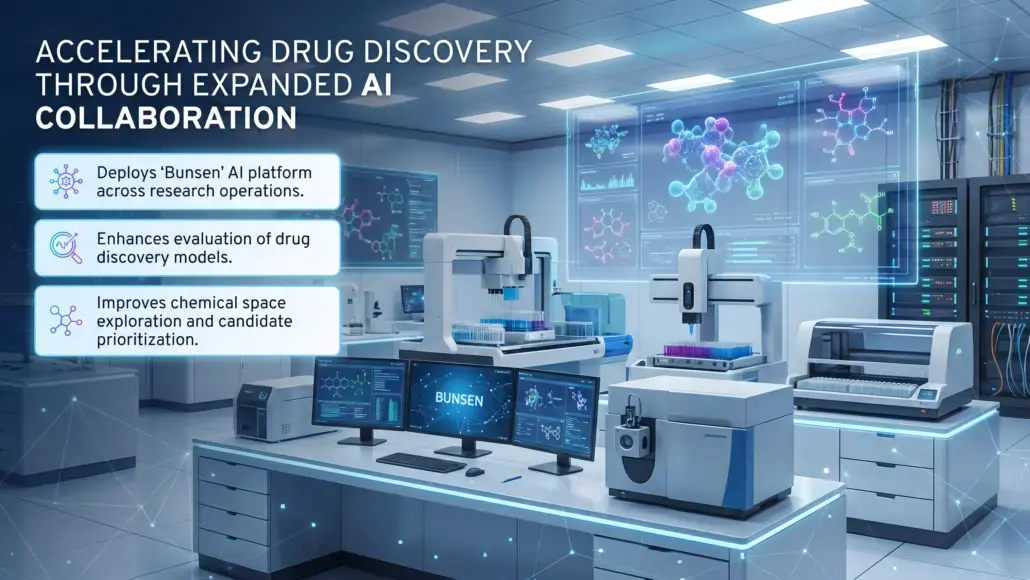
Bristol Myers Squibb has expanded its ongoing strategic partnership with Schrödinger through a new agreement to deploy the agentic AI co-scientist platform, Bunsen, across its research operations. Building upon an established collaboration in which Bristol Myers Squibb already utilizes Schrödinger computational tools, this enterprise-wide integration is designed to help scientific teams evaluate drug discovery AI models, explore chemical space more extensively, prioritize molecular candidates with greater confidence, and support early-stage decision-making.
Expanding Advanced Drug Discovery AI Solutions Across Scientific Teams
Under the terms of the expanded arrangement, Schrödinger will broaden the implementation of its suite of computational solutions throughout Bristol Myers Squibb scientific teams. The rollout includes both Bunsen and RetroSynth, an AI-driven synthesis planning platform engineered to perform high-throughput evaluation of complex chemical synthesis pathways. Designed as an agentic co-scientist, Bunsen executes computational methods, handles complex planning and interpretation tasks, and integrates directly with existing research technologies to automate complex molecular discovery workflows.
Reflecting on the expanded deployment, Schrödinger platform chief scientific officer Robert Abel stated: “BMS is a long-standing customer and collaborator, and they have been an industry leader in integrating computation into drug discovery.”
Abel further added: “We are thrilled they are deploying Bunsen at a large scale. Adopting Bunsen and our computational platform at scale will empower a broader group of scientists to embrace a predict-first computational approach.”
Integrating AI and Physics-Based Simulation for Enhanced Workflows
The software platform developed by Schrödinger combines physics-based simulation with artificial intelligence to assist researchers with hypothesis evaluation and synthetic feasibility analysis. By embedding these capabilities directly into daily scientific workflows, the technology supports early decision-making across global research efforts. The computational solutions provided by Schrödinger are currently licensed by leading organizations across the pharmaceutical, biotechnology, industrial, and academic sectors.
Highlighting the role of computational tools, Bristol Myers Squibb computational sciences vice-president Stephen Johnson stated: “Over the past several years, AI has become a key enabler for our scientists, allowing them to scale their creativity and scientific expertise across our research organisation.”
Johnson elaborated on the platform’s role in advancing research: “Bunsen is another capability we are adding to that toolkit, one that allows our scientists to think differently about how physics-based tools can be used to navigate molecular design space and accelerate the discovery of innovative medicines for patients.”
Deepening Enterprise High-Performance Computing Infrastructure
This strategic initiative follows recent steps by Bristol Myers Squibb to strengthen its technological framework. Last month, the company deepened its collaborations with Nvidia to deploy an AI-enabled supercomputer, which it claims is the “most powerful single-owned Nvidia infrastructure in life sciences”. Together with tools like RetroSynth and Bunsen, these infrastructure enhancements underscore how drug discovery AI technology and computational platforms are being scaled across modern pharmaceutical research organizations to support complex molecular discovery projects.