









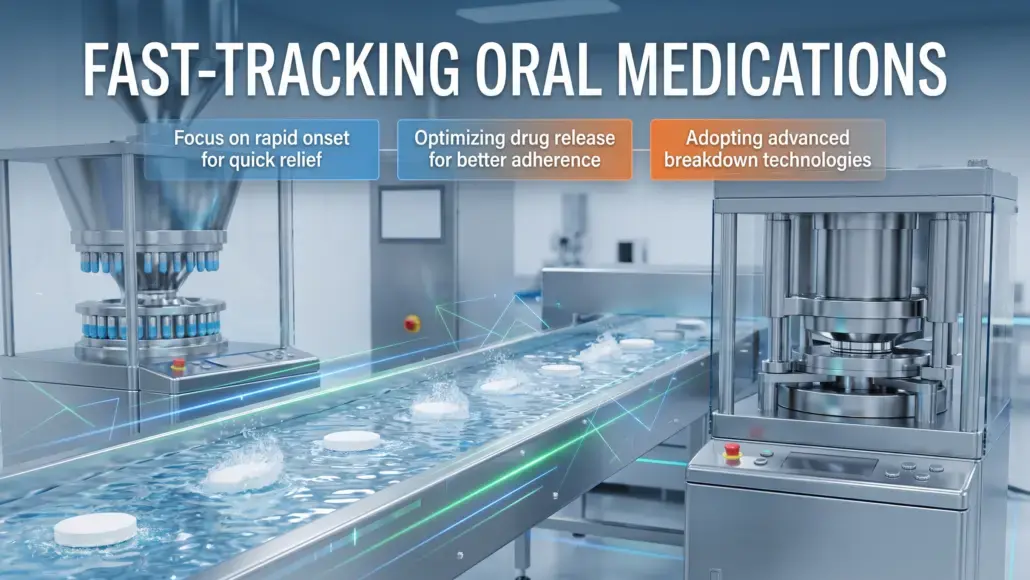
The pharmaceutical industry is experiencing a significant shift in the development of fast acting oral medications, driven by the need for rapid onset of action and improved patient adherence. The optimization of drug release profiles is fundamental to therapeutic success, particularly for conditions requiring quick symptomatic relief. To meet these demands, developers are increasingly adopting advanced immediate release technologies that facilitate the rapid breakdown of solid dosage forms within the gastrointestinal tract. These technological advancements focus on overcoming the physical and chemical barriers that often delay drug absorption, such as poor solubility and slow disintegration. By fine tuning the interaction between the active pharmaceutical ingredient and the surrounding excipient matrix, manufacturers can ensure that the medication is delivered to the systemic circulation in the shortest possible timeframe.
Optimization of Superdisintegrants in Tablet Formulations
The speed at which a tablet disintegrates is a primary determinant of its overall performance in an immediate release application. Superdisintegrants are specialized excipients designed to expand rapidly when exposed to gastric fluids, creating internal pressure that forces the tablet to burst apart. The selection and concentration of these agents are critical, as they must function effectively at low inclusion levels to maintain the mechanical integrity of the dosage form. Researchers are now investigating the synergistic effects of combining different classes of superdisintegrants, such as cross linked celluloses and starches, to achieve faster and more reliable results. These combinations are particularly useful for formulations containing high levels of hydrophobic drugs, which can naturally resist water penetration and delay the onset of action.
The mechanism of action for these agents involves capillary action and swelling, which must be carefully balanced to prevent the formation of a viscous gel layer that could impede drug diffusion. Scientific analysis of these processes allows formulators to predict the behavior of the tablet under varying physiological conditions. By utilizing particle engineering techniques, the surface area and porosity of the disintegrant particles can be optimized to maximize water uptake speed. This technical precision ensures that advanced delivery platforms provide a consistent and predictable performance across diverse patient populations. Additionally, the use of these advanced excipients allows for the development of smaller tablets that are easier for patients to swallow, further improving the likelihood of successful treatment outcomes. This reduction in size is particularly valuable in multi drug regimens where the total pill burden can be a significant deterrent to adherence. The ability to achieve rapid disintegration at lower excipient concentrations also provides more space for the active ingredient, facilitating the creation of higher strength dosage forms within manageable physical dimensions. Formulators must also consider the impact of these agents on the long term stability of the product, as some superdisintegrants are hygroscopic and can attract moisture that might degrade sensitive drug molecules. Maintaining a controlled environment during manufacturing and utilizing high barrier packaging are essential strategies for mitigating these risks. The continued innovation in excipient science is providing developers with a wider range of tools to address these complex formulation challenges.
Enhancing Solubility for Rapid Systemic Absorption
A significant challenge in the development of fast acting medications is the prevalence of poorly water soluble drug candidates in the industry pipeline. Even if a tablet disintegrates rapidly, the drug cannot be absorbed until it is fully dissolved in the aqueous environment of the stomach or small intestine. To address this, immediate release technologies often incorporate solubility enhancement methods such as micronization, solid dispersions, or the use of cyclodextrins. Micronization involves reducing the particle size of the drug substance to the micrometer scale, which dramatically increases the surface area available for dissolution. This physical modification allows the drug to reach its maximum concentration in the gastric fluid much faster than conventional formulations.
Solid dispersions, on the other hand, involve dispersing the drug molecule within a hydrophilic polymer matrix, often through techniques like hot melt extrusion or spray drying. This approach creates an amorphous state that is inherently more soluble than the crystalline form of the drug. The integration of these techniques within an immediate release framework requires a deep understanding of the thermal and mechanical properties of the drug polymer blend. By ensuring that the drug remains in its amorphous state throughout its shelf life, manufacturers can guarantee the stability and efficacy of the final product. The ability to combine rapid disintegration with enhanced solubility is a key factor in the successful commercialization of modern oral therapies.
Role of High Speed Compression in Performance Consistency
The manufacturing process itself plays a vital role in determining the final performance characteristics of an oral dosage form. High speed tablet presses apply significant mechanical forces to the powder blend, which can influence the porosity and hardness of the resulting tablets. If a tablet is compressed too tightly, the entry of water can be restricted, leading to delayed disintegration regardless of the excipients used. Conversely, a tablet that is too soft may crumble during packaging or transport. Advanced immediate release technologies involve the precise control of compression parameters to achieve a balance between mechanical strength and rapid breakdown. Real time monitoring systems now allow for the continuous adjustment of press settings based on the physical properties of the incoming material.
The use of sophisticated sensors and feedback loops ensures that each tablet produced meets the exact specifications for weight, thickness, and hardness. This level of process control is essential for maintaining the quality and consistency of the drug product over long manufacturing runs. In addition to hardware improvements, the development of specialized lubricants has reduced the negative impact of compression on dissolution rates. These lubricants are designed to provide the necessary flow and ejection properties without creating a waterproof barrier around the drug particles. By optimizing both the formulation and the manufacturing process, pharmaceutical companies can produce highly consistent immediate release products that meet the stringent requirements of regulatory agencies and healthcare providers alike.
Impact of Taste Masking on Patient Adherence
For medications intended to be taken as orally disintegrating tablets or chewable dosage forms, the sensory experience is a major factor in patient compliance. Many active pharmaceutical ingredients have an inherently bitter or unpleasant taste, which can lead to treatment avoidance, particularly in pediatric and geriatric populations. Immediate release technologies address this issue through the use of sophisticated taste masking techniques that prevent the drug from interacting with taste buds without delaying its absorption. This can be achieved through the application of thin, pH sensitive polymer coatings or the formation of complex ions that only release the drug in the acidic environment of the stomach.
The engineering of these taste masking systems requires a high degree of precision to ensure that the coating is thick enough to block the taste but thin enough to allow for rapid dissolution once swallowed. Modern developments in microencapsulation allow for the creation of very small particles that can be incorporated into various dosage formats without altering the texture or mouthfeel. This focus on the patient experience is becoming increasingly important as the industry moves toward more patient centric drug design. By making medications easier and more pleasant to take, pharmaceutical companies can improve the effectiveness of chronic disease management and acute symptom relief. The integration of taste masking with rapid release profiles represents a significant advancement in the development of modern oral drug products.
Future Perspectives in Fast Acting Oral Delivery
The continued evolution of oral drug delivery is likely to see further integration of digital tools and novel material sciences. The emergence of three dimensional printing offers the potential for highly customized dosage forms with complex internal structures that can precisely control the rate of drug release. This technology could allow for the creation of tablets with varying densities or multi layered designs that optimize the delivery of multiple active ingredients. As research in this area progresses, we can expect to see immediate release technologies that are tailored to the specific physiological needs of individual patients, leading to truly personalized medicine.
Additionally, the development of new polymers and bio adhesive materials will open up new possibilities for enhancing the residence time of medications in specific parts of the gastrointestinal tract. This could be particularly beneficial for drugs that have a narrow absorption window. The ongoing collaboration between formulation scientists, chemical engineers, and clinicians is driving the innovation needed to overcome the remaining challenges in fast acting oral delivery. By focusing on the fundamental science of drug release and absorption, the pharmaceutical industry is well positioned to continue improving the performance and reliability of oral medications for years to come. The goal remains the same: to provide patients with the most effective and convenient treatments possible, supported by the highest standards of technical excellence.
The integration of advanced analytical tools with traditional formulation expertise will be the cornerstone of future breakthroughs in this field. As regulatory expectations continue to rise, the ability to demonstrate a deep understanding of the factors influencing drug performance will be a critical differentiator for pharmaceutical companies. The focus on speed and reliability will continue to drive the adoption of new technologies that can deliver life saving medications to patients more efficiently than ever before. This ongoing commitment to innovation ensures that the industry can meet the evolving needs of healthcare systems worldwide while maintaining the highest levels of quality and safety. The transition to more automated and data driven manufacturing processes will further enhance the consistency and accessibility of these vital therapies. Additionally, the exploration of bio inspired materials may lead to the next generation of immediate release systems that offer even greater precision in drug delivery.