












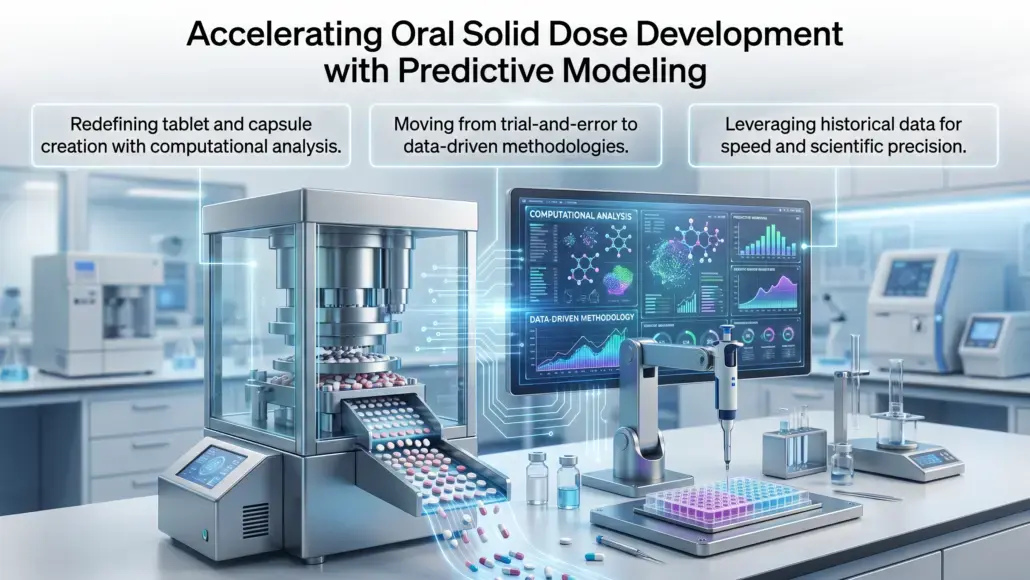
The integration of computational modeling and algorithmic analysis is currently redefining the methodology behind tablet and capsule creation in the pharmaceutical sector. Pharmaceutical organizations are increasingly transitioning away from empirical trial and error approaches in favor of data driven methodologies that prioritize speed and scientific precision. This shift is particularly evident in the adoption of the discipline of predictive modeling, which leverages historical data and molecular simulations to anticipate how active pharmaceutical ingredients will interact with various excipients. By utilizing these advanced tools, developers can identify the most stable and effective delivery systems long before physical prototyping begins. The primary objective is to shorten the development timeline while simultaneously enhancing the probability of clinical success for complex oral solid dose products. This transition is necessitated by the increasing complexity of new chemical entities, many of which exhibit poor solubility and permeability characteristics that traditional methods struggle to address within compressed commercial timelines.
Molecular Modeling and Computational Excipient Screening
The initial stages of drug product development often involve significant uncertainty regarding the physical compatibility of a new chemical entity with common pharmaceutical additives. Traditional methods require extensive laboratory testing to observe physical and chemical changes over time, which consumes both material and human resources. In contrast, predictive formulation design allows researchers to simulate molecular interactions at an atomic level to forecast stability and degradation pathways. Computational tools can assess the solubility parameters and hydrogen bonding potential between the drug molecule and various polymers or fillers. This proactive screening identifies potential issues such as crystallization or poor flow properties that might otherwise only emerge during late stage stability studies. By narrowing down the list of viable excipients through digital simulation, formulation scientists can focus their laboratory efforts on a refined subset of combinations that demonstrate the highest potential for long term performance.
The application of molecular dynamics simulations provides insights into the behavior of the drug substance within a solid matrix. These simulations account for factors such as temperature, humidity, and mechanical stress, providing a comprehensive view of how a formulation might behave during manufacturing and storage. The ability to visualize these interactions in a virtual environment reduces the reliance on large quantities of expensive active ingredients during the early phases of discovery. Additionally, this scientific approach aligns with Quality by Design principles by establishing a deep understanding of the relationship between formulation variables and critical quality attributes. This deep technical insight ensures that the final product is not only effective but also inherently stable throughout its shelf life. The digital characterization of excipient landscapes allows for the identification of synergistic combinations that can stabilize high drug loads, a frequent requirement for potent active ingredients.
Machine Learning Algorithms in Tablet Optimization
Beyond molecular interactions, the mechanical properties of oral solid doses are critical for successful large scale production. Machine learning models are now being trained on vast datasets encompassing thousands of previous formulations to predict the compressibility and compactibility of new blends. These algorithms analyze the particle size distribution, moisture content, and surface area of individual components to determine the optimal ratios for a specific dosage form. When advanced computational models are applied to tablet compression, they enable the optimization of tensile strength and disintegration times without the need for exhaustive design of experiments in the physical plant. This quantitative approach allows for the rapid identification of the design space, ensuring that the formulation is resilient enough to withstand the rigors of high speed industrial presses.
The use of neural networks and random forest algorithms helps in deciphering non linear relationships between formulation inputs and output metrics. For instance, the effect of a specific lubricant concentration on the dissolution profile of a hydrophobic drug can be accurately forecasted. These models can also suggest alternative excipients if a primary choice presents manufacturing challenges, such as sticking or capping during the tableting process. By integrating these digital tools into the workflow, pharmaceutical companies can significantly reduce the number of pilot batches required to reach a final configuration. This efficiency is vital in an industry where speed to market is a major competitive advantage and every delay carries significant financial implications. The transition to these digital workflows marks a significant departure from the artisanal aspects of traditional formulation, replacing intuition with verifiable data. The ability to iterate hundreds of formulations in a matter of seconds allows for a level of optimization that was previously inconceivable.
Enhancing Bioavailability through Solubility Forecasting
A significant proportion of new chemical entities entering the development pipeline are classified as poorly soluble, presenting substantial challenges for oral delivery. Predictive formulation design plays a vital role in addressing these challenges by forecasting the solubility enhancement potential of various technology platforms, such as amorphous solid dispersions or lipid based systems. Digital tools can predict the glass transition temperature of a drug polymer blend, which is a key indicator of the physical stability of an amorphous system. By understanding these thermal properties in advance, scientists can design formulations that prevent the drug from reverting to its less soluble crystalline form. This predictive capability is essential for ensuring that the medication remains efficacious from the moment it is manufactured until it is consumed by the patient.
In addition to physical stability, computational models can simulate the release kinetics of a drug within the gastrointestinal tract. By incorporating physiological parameters such as pH variations and transit times, these simulations provide a realistic estimation of how a formulation will perform in vivo. This allows for the fine tuning of disintegrants and surfactants to achieve the desired absorption profile. The ability to predict pharmacokinetic outcomes early in development helps in selecting the most promising candidates for clinical trials, thereby reducing the risk of failure due to poor bioavailability. This strategic use of data not only improves patient outcomes but also optimizes the allocation of research and development budgets by filtering out suboptimal formulations before they reach expensive human testing phases. The precision offered by these models is particularly advantageous when dealing with narrow therapeutic index drugs where consistent absorption is paramount for safety.
Advanced Computational Fluid Dynamics in Coating Processes
The application of protective or functional coatings is a critical step in the manufacturing of many oral solid dose products. Predictive formulation design is now being extended to the coating phase, where computational fluid dynamics (CFD) are used to model the movement of air and droplets within a coating pan. These models allow engineers to predict the uniformity of the coating layer based on process parameters such as spray rate, atomization pressure, and pan speed. Ensuring a uniform coating is essential for controlled release products where the thickness of the polymer layer directly dictates the rate of drug delivery. By simulating the coating process in a virtual environment, manufacturers can identify the ideal operating conditions to minimize defects such as twinning or orange peel effects.
The integration of CFD with mechanical models provides a comprehensive view of how tablets interact with the coating equipment. This technical analysis helps in preventing physical damage to fragile cores and ensures that the final product meets stringent appearance and performance standards. Additionally, these simulations can be used to scale up the process from laboratory equipment to industrial scale production with high confidence. The reduction in physical trial runs during scale up leads to significant savings in time and materials, further accelerating the path to commercialization. The ability to troubleshoot potential issues in a digital twin of the coating pan provides a level of control that enhances the overall reliability of the manufacturing process. This proactive approach to process optimization is a key driver of operational excellence in modern pharmaceutical facilities.
Data Integration and the Future of Pharmaceutical Innovation
The success of predictive formulation design is heavily dependent on the quality and accessibility of historical development data. Pharmaceutical companies are investing in centralized data lakes that aggregate information from diverse sources, including laboratory notebooks, manufacturing logs, and analytical reports. By breaking down data silos, organizations can create a rich repository of information that fuels more accurate and reliable models. This holistic view of the development lifecycle enables a more integrated approach to formulation, where insights from one project can directly inform the strategy for the next. The continuous refinement of these models through the incorporation of new data ensures that the predictive power of the system increases over time, leading to even greater efficiencies in the future.
As the industry moves toward more personalized and complex therapies, the demand for sophisticated formulation tools will continue to grow. The development of multi drug combinations and pediatric dosage forms requires a level of precision that traditional methods struggle to provide. Predictive formulation design offers the flexibility and accuracy needed to handle these complexities, allowing for the rapid creation of tailored solutions for specific patient populations. The ongoing evolution of hardware and software will further enhance the speed and resolution of these simulations, making them an indispensable part of the pharmaceutical toolkit. The ultimate goal is a fully digitalized development process where the final formulation is optimized and validated in a virtual environment before a single tablet is ever pressed. This vision of the future represents a fundamental shift in how medicines are designed, promising a new era of efficiency and innovation in drug delivery. The reduction in physical waste and the acceleration of clinical timelines will ultimately lead to a more sustainable and responsive pharmaceutical industry.