











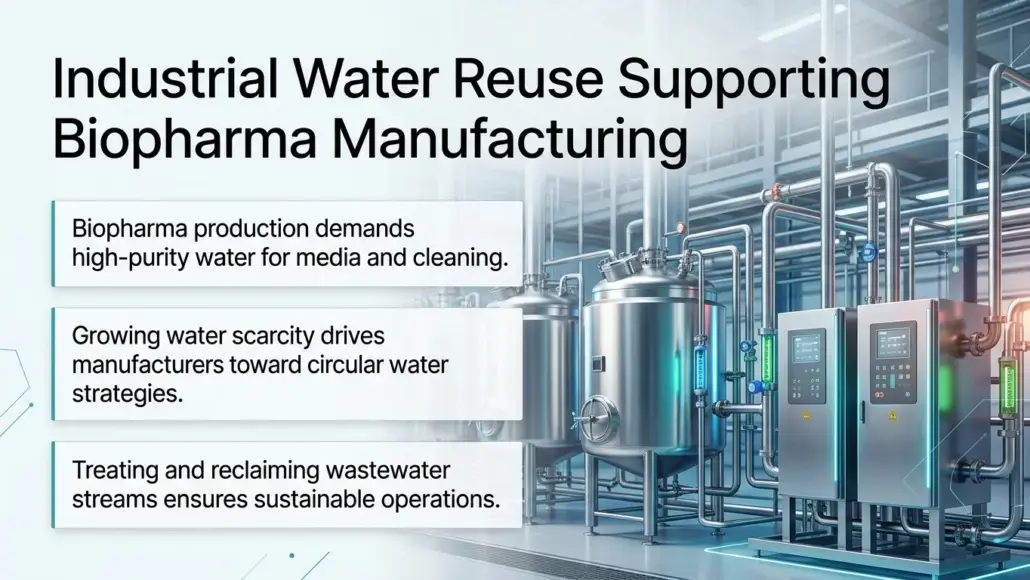
The biopharmaceutical industry is one of the most water-intensive sectors of the global economy, requiring quantities of high-purity water for media preparation, equipment cleaning, and final product formulation. As global water scarcity increases and regulatory pressure on environmental sustainability intensifies, manufacturers are increasingly turning to circular water strategies. Fluid-handling and treatment equipment supporting biopharma manufacturing involves the reclamation and treatment of wastewater streams for non-product contact applications, such as cooling tower make-up, boiler feed, or facility irrigation. By implementing these systems, biopharma companies can reduce their consumption of fresh water, lower their operational costs, and demonstrate a commitment to corporate social responsibility without compromising the quality of their primary manufacturing processes.
Successful implementation of water reuse requires a detailed understanding of the various water streams within a facility. In a typical biopharma plant, water is used in a cascading fashion, with the highest quality water being used in production and the resulting discharge being sent to a wastewater treatment plant. Many of these discharge streams, such as the reject water from reverse osmosis systems or the condensate from steam generators, are relatively clean and can be reclaimed with minimal treatment. By capturing and redirecting these streams, manufacturers can create a more resilient water supply that is less dependent on municipal sources and better able to withstand periods of drought or infrastructure failure.
The transition to a circular water economy also provides an opportunity for biopharma companies to improve their overall process efficiency. By treating and reusing water on-site, facilities can reduce the volume of wastewater that must be sent to municipal treatment plants, potentially lowering sewage fees and reducing the environmental impact of the facility’s operations. Additionally, the heat energy contained in many wastewater streams can be recovered and reused, leading to significant energy savings. This reuse strategy is therefore a environmental strategy and a key driver of operational excellence.
Categorizing and Assessing Reclaimable Water Streams
The first step in industrial water reuse supporting biopharma manufacturing is the characterization of the available wastewater sources. These streams are typically categorized based on their chemical and biological composition, which determines the level of treatment required for their intended reuse. For example, cooling tower blowdown is often high in dissolved solids and minerals, requiring membrane filtration or ion exchange before it can be used for other purposes. On the other hand, the reject water from a purified water system is often of higher quality than the incoming city water and can be reused for many utility applications.
Conducting a water balance study is essential for identifying the most promising opportunities for reuse. This involves measuring the flow rate and quality of every water inlet and outlet in the facility and identifying where demand and supply can be matched. For instance, a facility might discover that the water used for rinsing equipment can be collected and treated for use in the facility cooling system. This systematic approach ensures that the most cost-effective and impactful reuse projects are prioritized, providing a clear path toward greater water efficiency.
The water balance study should also consider the seasonal variations in water demand and the potential impact of future production expansion. By developing a dynamic model of the facility’s water cycle, engineers can design reuse systems that are flexible and scalable. This forward-looking approach ensures that the water reuse strategy remains effective over the long term and can adapt to the changing needs of the biopharma manufacturing process. The integration of flow meters and data loggers throughout the facility is essential for collecting the accurate data needed for this level of analysis.
Treatment Technologies for High Quality Reclaimed Water
Once the reclaimable streams have been identified, the appropriate treatment technologies must be selected to ensure that the water meets the requirements for its intended application. Industrial water reuse supporting biopharma manufacturing often utilizes a multi-barrier approach, combining biological treatment, membrane filtration, and advanced oxidation. Membrane bioreactors (MBRs) are popular in biopharma applications, as they combine the efficiency of activated sludge treatment with the high-quality filtration of a membrane, producing an effluent that is free of suspended solids and pathogens.
For applications requiring even higher purity, such as boiler feed or high-pressure cooling systems, reverse osmosis and electrodeionization can be used to remove dissolved salts and organic matter. Additionally, UV irradiation and ozone treatment are often employed to ensure that the reclaimed water is biologically stable and does not contribute to the formation of biofilms in the facility’s utility loops. The design of these treatment systems must be integrated with the overall facility control system to ensure that the quality of the reclaimed water is continuously monitored and that any deviations are addressed. This level of oversight is necessary to protect expensive utility equipment and to maintain a safe working environment for facility staff. Integrated fluid-handling solutions can further support reliable process performance across biopharmaceutical manufacturing environments.
The selection of treatment technology also depends on the specific contaminants present in the wastewater. For example, biopharma wastewater may contain trace amounts of pharmaceutical ingredients or specialized cleaning chemicals that require advanced treatment methods such as activated carbon adsorption or advanced oxidation processes (AOPs). By selecting the right combination of technologies, manufacturers can ensure that the reclaimed water is safe for its intended use and does not pose a risk to the environment or to human health. This technical precision is a key element of a successful industrial water reuse strategy.
Regulatory Considerations and Compliance Frameworks
While the reuse of water for non-product contact applications is supported by regulatory agencies, it still requires management and documentation. Manufacturers must ensure that there is no risk of cross-contamination between the reclaimed water and the high-purity water used in production. This involves the use of physical breaks, such as air gaps, and the clear labeling of all reclaimed water piping. Industrial water reuse supporting biopharma manufacturing must be conducted in accordance with local environmental regulations and industry best practices, such as those provided by the International Society for Pharmaceutical Engineering (ISPE).
The impact of water reuse on the facility’s environmental permit must be evaluated. In some jurisdictions, the discharge of treated wastewater to a municipal sewer system is subject to limits on volume and concentration. By reusing water on-site, a facility can reduce its total discharge volume, which may lead to lower permit fees and a more positive relationship with local environmental authorities. However, the concentration of contaminants in the remaining discharge may increase, necessitating sophisticated wastewater treatment. A holistic approach to water management considers these trade-offs and seeks to optimize the overall environmental performance of the facility.
Compliance also involves the regular testing and monitoring of the reclaimed water quality to ensure that it continues to meet the required standards. This data must be thoroughly documented and made available for review during environmental audits and regulatory inspections. By maintaining a high standard of documentation and oversight, biopharma companies can demonstrate that their water reuse activities are being conducted in a safe and responsible manner. This transparency is essential for building trust with regulators, investors, and the local community and for ensuring the long-term success of the sustainability program.
Economics and Sustainability in Biopharma Water Management
The economic case for industrial water reuse supporting biopharma manufacturing is becoming compelling as the costs of water and wastewater disposal continue to rise. While the initial capital investment for a reuse system can be significant, the long-term savings in utility costs often lead to a return on investment. Additionally, many governments offer incentives and grants for projects that improve water efficiency and reduce environmental impact. Beyond the direct financial benefits, water reuse also provides intangible value by enhancing the company’s brand reputation and attracting environmentally conscious investors and employees.
Sustainability is no longer a peripheral concern for the biopharma industry but is a element of business strategy. Companies that can demonstrate a level of resource efficiency and a low environmental footprint are better positioned to compete in an increasingly regulated global market. By integrating water reuse into their operations, biopharma manufacturers can ensure a reliable supply of this critical resource for years to come, supporting the production of life-saving medications while protecting the health of the planet. This commitment to circularity and resource stewardship is a defining characteristic of a modern, forward-thinking biopharmaceutical organization.
The social and environmental benefits of water reuse are also significant. By reducing the demand for fresh water, biopharma companies can help to alleviate the pressure on local water resources and contribute to the overall water security of the region. This is particularly important in areas where water resources are already stressed due to population growth or climate change. Additionally, by reducing the volume of wastewater discharged to the environment, facilities can help to protect local ecosystems and improve the quality of local water bodies. These broader impacts are a key component of the industry’s commitment to corporate social responsibility and sustainable development.
Integrating Water Reuse into Facility Design and Operation
To maximize the benefits of water reuse, it should be integrated into the initial design of new biopharma facilities. This allows for the inclusion of separate piping systems for reclaimed water and the optimization of the facility layout to minimize the costs of collection and distribution. For existing facilities, a phased approach to implementation may be more practical, starting with the most easily reclaimable streams and gradually expanding the system as new opportunities are identified. Regardless of the approach, the involvement of all relevant stakeholders, from production and engineering to quality and environmental health and safety (EHS), is essential for success.
The ongoing operation of a water reuse system requires a commitment to regular maintenance and operator training. Staff must be educated on the operation of the fluid-handling and treatment equipment and the importance of maintaining the quality of the reclaimed water. Regular inspections and cleaning of the treatment units are necessary to ensure their continued efficiency and to prevent the buildup of contaminants. By treating the water reuse system as a critical utility and providing it with the necessary resources and oversight, biopharma companies can ensure its long-term reliability and effectiveness.
Finally, the use of advanced control and monitoring systems can further enhance the performance of the water reuse system. By integrating the treatment equipment with the facility SCADA system, engineers can monitor the water quality and flow rates in real time and automatically adjust the treatment parameters as needed. This automation ensures that the reclaimed water always meets the required standards and provides the documented evidence needed for regulatory compliance. The integration of data analytics can also help to identify trends and optimize the performance of the reuse system over time, further improving the sustainability and efficiency of the biopharma manufacturing facility.