





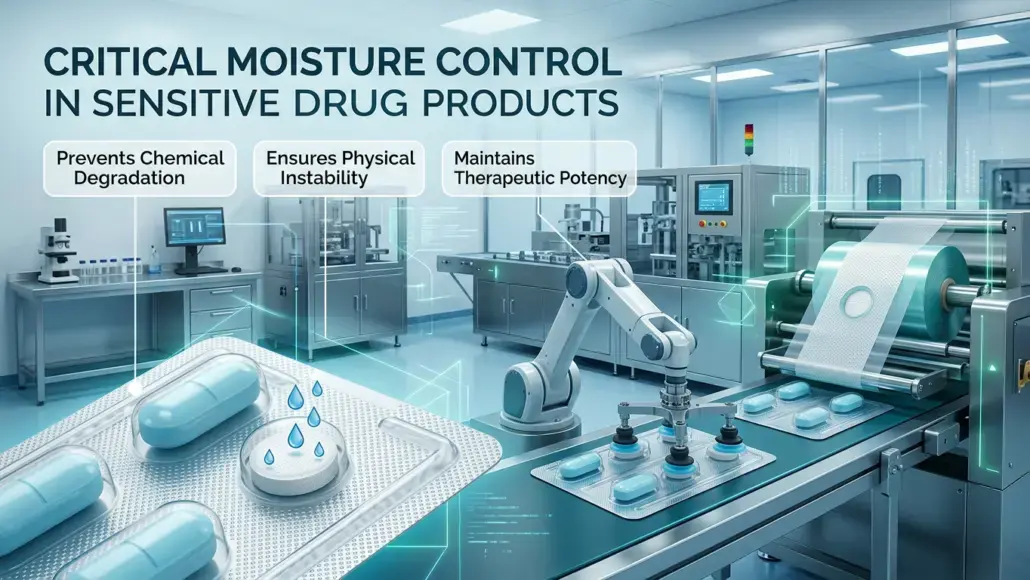
The pharmaceutical industry faces significant challenges in protecting sensitive drug formulations from environmental factors, with moisture ingress being one of the most critical threats to product stability. Many modern pharmaceuticals, particularly solid oral dosage forms and diagnostic reagents, are highly hygroscopic, meaning they readily absorb water from the surrounding atmosphere. This moisture can lead to chemical degradation, physical instability, and a reduction in therapeutic potency. Traditional methods of moisture control often involve the use of loose desiccant canisters or sachets placed within the primary container. However, these methods can introduce risks such as accidental ingestion by patients or interference with high-speed automated filling lines. As a result, the development of specialized active systems has emerged as a superior alternative, offering a more efficient and reliable solution for long term humidity management.
By embedding moisture-adsorbing agents directly into the polymer matrix of the container walls or closures, manufacturers can create a controlled micro-environment that actively protects the drug product throughout its shelf life. This integrated approach not only eliminates the need for loose components but also provides a more uniform distribution of moisture control within the package. The technology relies on advanced material science, where desiccants such as molecular sieves or silica gel are compounded into resins to form functional layers. This ensures that the primary packaging serves as more than just a passive barrier; it becomes an active participant in maintaining the chemical and physical integrity of the medicine.
Mechanisms of Moisture Adsorption in Polymer Matrices
The efficacy of these advanced containers is rooted in the thermodynamic properties of the adsorbent materials and their interaction with the polymer carrier. Molecular sieves are commonly chosen for pharmaceutical applications due to their high affinity for water molecules even at low relative humidity levels. These materials possess a crystalline structure with uniform pores that selectively trap water while excluding larger molecules. When these particles are dispersed within a plastic matrix, they create a tortuous path for moisture ingress, effectively slowing down the rate at which humidity can reach the drug product. The adsorption process is typically exothermic, and the capacity of the system is determined by the concentration of the desiccant within the polymer and the thickness of the active layer.
In many designs, a multi-layer structure is utilized to optimize performance. An outer layer provides a high moisture barrier to prevent external humidity from entering, while the internal desiccant-integrated layer adsorbs any residual moisture trapped during the filling process or moisture that permeates through the outer wall. This dual-action mechanism ensures that the internal relative humidity remains within the specified range required for the stability of the active pharmaceutical ingredient. Engineers must carefully balance the mechanical properties of the polymer with the loading level of the desiccant to ensure that the container maintains its structural integrity and closure seal performance.
Design Considerations for Solid Dosage Forms
When designing packaging for solid oral dosage forms such as tablets and capsules, the spatial constraints and the sensitivity of the formulation are primary considerations. These integrated solutions offer the advantage of maximizing the internal volume of the container, as there is no need to reserve space for a separate sachet. This can lead to more compact packaging designs, which reduce storage and transportation costs. In addition, for products delivered in blister packs, the use of desiccant-integrated films or foils provides targeted protection for individual doses. This is particularly beneficial for drugs that are sensitive to the micro-environment created within the small cavity of a blister.
The selection of the specific desiccant type and concentration depends on the moisture sensitivity profile of the drug. Some formulations may require a rapid drawdown of humidity, while others benefit from a steady, long term equilibrium. Before selecting an active barrier solution, manufacturers must conduct thorough chemical compatibility testing to ensure that the moisture-absorbing additives do not migrate into the drug formulation. The design process also involves evaluating the ease of use for the end user, ensuring that the packaging remains intuitive and accessible, especially for elderly patients who may have difficulty with complex closure systems.
Optimizing Shelf Life Through Active Barrier Systems
The primary goal of implementing desiccant-integrated packaging is to extend the shelf life of moisture-sensitive products, particularly in regions with high ambient humidity. Standard packaging might fail to maintain the necessary dry conditions over a two-year or three-year period, leading to the formation of degradation products or changes in the dissolution rate of the tablet. By using active barrier systems, pharmaceutical companies can ensure that their products remain within specification for a longer duration, reducing waste and improving supply chain efficiency. This is especially critical for global markets where products are shipped across diverse climatic zones, ranging from arid deserts to tropical rainforests. The shift toward these technologies reflects a broader commitment to ensuring product integrity in increasingly volatile global supply chains. The ability to customize the adsorption capacity allows for a more tailored approach to packaging, where the protection level is matched exactly to the needs of the formulation. This precision helps in optimizing material usage and reducing the overall footprint of the packaging system. Additionally, the integration of moisture scavengers into the primary container reduces the number of components that must be managed by the pharmacy or the patient, thereby simplifying the administration process and reducing the risk of errors. Manufacturers are also exploring the use of sustainable polymers to house these active agents, seeking to balance high performance with environmental responsibility. The adoption of bio-based resins or recycled materials in the outer layers of a multi-layer container can significantly reduce the carbon intensity of the packaging without compromising the moisture-absorbing capabilities of the internal layers. This dual focus on performance and sustainability is becoming a key driver in the selection of materials for new drug launches. In addition, the integration of smart sensors into these active systems could allow for real-time monitoring of the internal humidity levels during transport, providing an additional layer of quality assurance for high-value therapies. This data-driven approach to packaging allows for more proactive intervention if a breach in the cold chain or a failure in the barrier occurs.
- Reduction in the risk of chemical hydrolysis of the active ingredient.
- Prevention of physical changes such as tablet softening or capsule brittleness.
- Improvement in the stability of diagnostic test strips and reagents.
- Enhancement of patient safety by removing loose desiccant components.
The implementation of these systems requires a rigorous validation process, including real-time and accelerated stability testing. These studies provide the data necessary to demonstrate that the internal environment remains stable and that the desiccant capacity is sufficient for the intended duration of use. As regulatory requirements for product stability become more stringent, the adoption of desiccant-integrated packaging is expected to increase across a wider range of therapeutic categories.
Performance Validation Under Accelerated Aging Conditions
Validating the performance of these active components involves exposing the container to high temperature and high humidity conditions to simulate the stresses it will encounter during distribution and storage. The rate of moisture adsorption is monitored over time, and the results are compared against mathematical models of moisture permeation. These models account for the surface area of the package, the thickness of the walls, and the specific moisture vapor transmission rate (MVTR) of the polymer. By correlating these factors, scientists can predict the exact point at which the desiccant will become saturated and the internal humidity will begin to rise.
This predictive capability is essential for setting appropriate expiration dates and for choosing the right packaging specifications for different markets. The validation process also includes testing the integrity of the seal, as even the most advanced desiccant system cannot compensate for a faulty closure. Induction sealing or high-performance screw caps are often paired with active packaging to ensure a complete hermetic seal. The combination of a durable physical barrier and an active internal scavenger provides the highest level of protection available for sensitive pharmaceutical products.
Strategic Implementation and Regulatory Compliance
The transition to active packaging solutions involves a strategic assessment of the total cost of quality. While active packaging may have a higher unit cost compared to standard bottles, the benefits in terms of reduced product loss, improved patient compliance, and simplified manufacturing processes often outweigh the initial investment. From a regulatory perspective, the materials used in these systems must comply with food and drug contact regulations. Manufacturers must provide detailed information on the composition of the active layers and demonstrate that they do not negatively impact the safety or efficacy of the drug.
In the final analysis, the move toward desiccant-integrated packaging represents a significant advancement in pharmaceutical material science. The ability to integrate functional properties directly into the structure of the container marks a departure from traditional passive packaging methods. This innovation allows for greater control over the stability of sensitive products, ensuring that they reach the patient in the intended state. As the pharmaceutical industry continues to develop increasingly complex and sensitive molecules, the role of active packaging will only grow in importance. The investment in these technologies is an investment in the long term safety and efficacy of modern medicine. The collaboration between material scientists, packaging engineers, and pharmaceutical developers is essential for realizing the full potential of these systems. By working together, these experts can create packaging that not only protects the drug but also enhances its value and accessibility. The future of pharmaceutical packaging lies in the effective integration of protective functions, and the industry is well on its way to achieving this goal. The continued research into new adsorbent materials and more efficient manufacturing processes will drive further improvements in performance and cost-effectiveness. Ultimately, the goal is to provide patients with the best possible care, and high-quality packaging is a vital part of that commitment. By moving beyond simple containment to active protection, the industry can better address the challenges of stabilizing modern drug formulations. The ability to control the internal environment with precision ensures that patients receive medications that are both safe and effective, regardless of the environmental conditions. As new therapies continue to push the boundaries of chemical complexity, the importance of innovative packaging solutions will only continue to grow.