












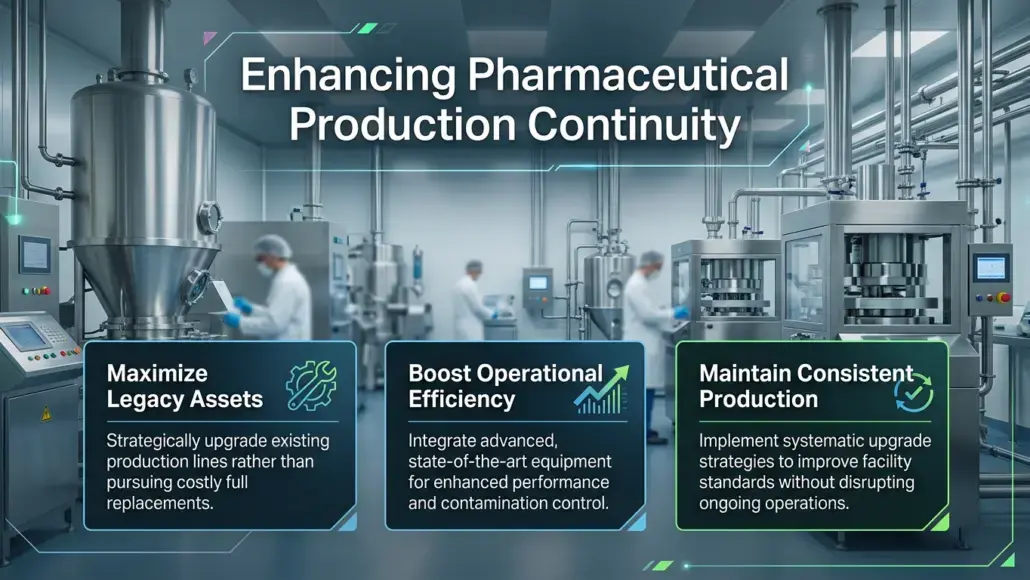
The rapid advancement of manufacturing technology presents both an opportunity and a challenge for pharmaceutical companies operating legacy facilities. While new, state-of-the-art equipment offers superior contamination control and operational efficiency, the total replacement of existing lines is often economically and logistically prohibitive. The systematic application of these upgrade strategies provides a strategic pathway for enhancing facility performance while maintaining production continuity. By identifying and upgrading critical components of aging machinery, manufacturers can achieve modern standards of quality and compliance without the extended downtime associated with a full facility overhaul. This approach ensures that the production of essential medicines remains stable and reliable in an increasingly demanding global market sector. The ability to update aging systems without compromising the sterile environment is a critical advantage for established manufacturers. By focusing on targeted improvements, companies can maintain a high level of performance while managing the total cost of ownership for their production assets. This balanced approach is essential for long-term sustainability.
Coordinating Life Cycle Management for Equipment Retrofit Planning
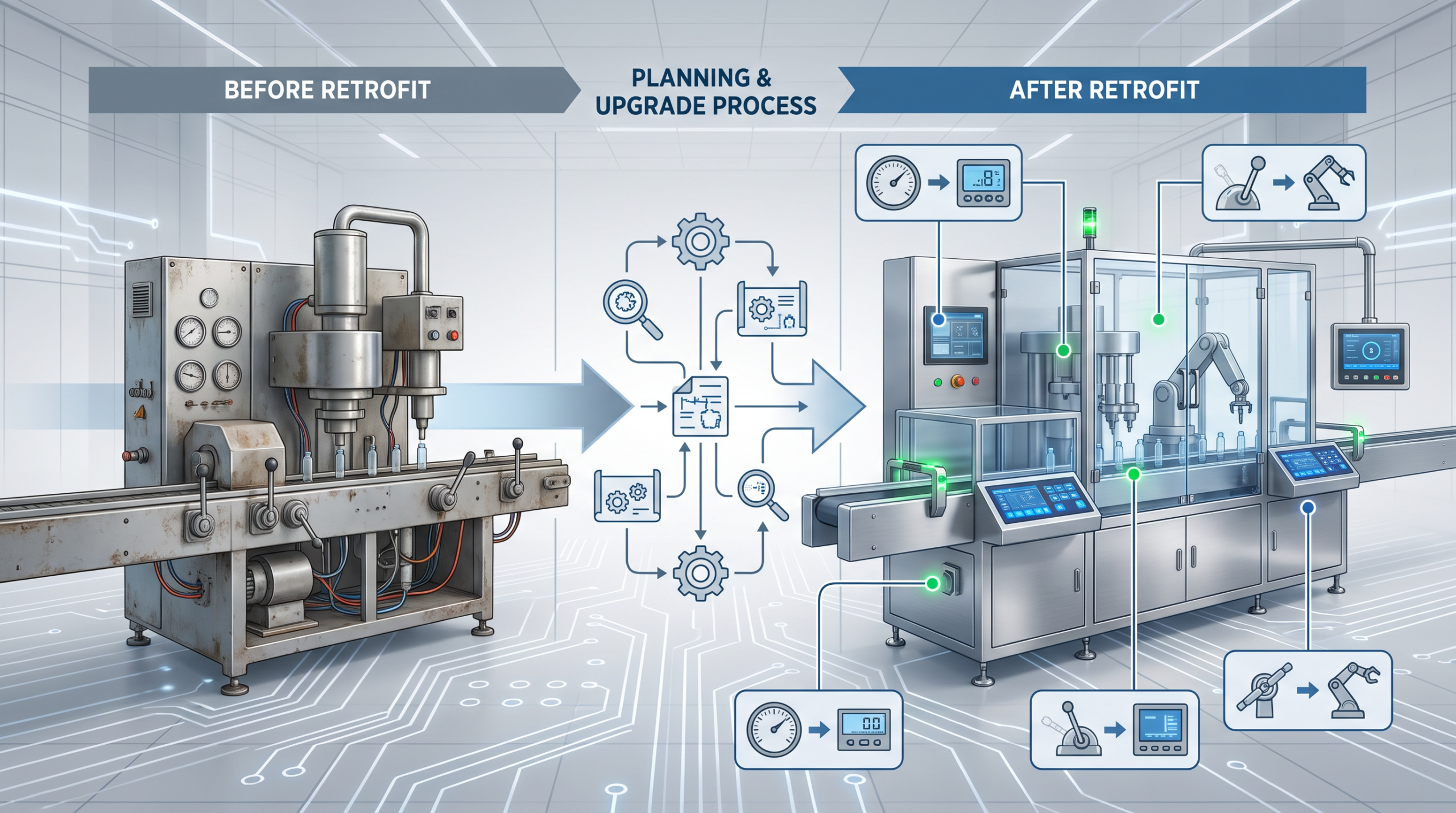
The lifecycle of pharmaceutical equipment is determined by its ability to meet evolving regulatory requirements and production demands. Over time, components such as control systems, sensors, and mechanical seals may become obsolete or prone to failure, creating a risk to production continuity. The systematic process of facility improvement starts with a detailed audit of the existing machinery to identify these points of vulnerability. This audit should consider the availability of spare parts, the frequency of unplanned maintenance, and the impact of the equipment on the overall contamination control strategy. By prioritizing the most critical upgrades, manufacturers can allocate their resources more effectively and minimize the risk of catastrophic failure.
Coordinating these retrofits requires a multi-disciplinary approach that involves engineering, quality assurance, and production teams. Each upgrade must be evaluated for its impact on the validated state of the equipment and the surrounding environment. The planning phase must also include a detailed assessment of the necessary change control procedures, ensuring that all modifications are documented and validated according to GMP standards. This level of coordination is essential for maintaining the integrity of the manufacturing process and ensuring that the retrofitted equipment remains compliant with the latest regulatory expectations. The goal is to extend the useful life of the asset while simultaneously improving its performance and reliability.
Additionally, the integration of modern digital technologies is a key component of the retrofit process. This includes the installation of advanced sensors for real-time monitoring of pressure, temperature, and airflow, as well as the upgrade of programmable logic controllers (PLCs) to support data integrity and audit trail requirements. These digital enhancements provide a wealth of information for process optimization and troubleshooting, allowing for continuous improvement in production yields and product quality. The structural evolution of the equipment is a permanent commitment to the highest levels of operational excellence.
Minimizing Downtime during Pharmaceutical Hardware Upgrades
One of the primary benefits of these upgrade strategies is the ability to schedule upgrades during planned maintenance shutdowns, thereby minimizing the impact on production schedules. This requires a high degree of technical precision and logistical coordination to ensure that all necessary parts and personnel are available when the shutdown begins. The use of pre-assembled and pre-tested modules can significantly accelerate the installation process, reducing the time required for on-site integration and validation. By minimizing the window of opportunity, manufacturers can maintain a steady supply of products to the market and avoid the financial losses associated with extended outages.
Minimizing downtime also involves a proactive approach to validation and testing. This includes the development of detailed validation plans that specify the required tests for each upgraded component. By performing as much testing as possible off-line or in a simulated environment, companies can reduce the time required for on-site qualification. The goal is to achieve a “plug-and-play” capability, where new components are integrated into the existing system with minimal disruption. This efficiency is particularly important for high-volume facilities where even a single day of lost production can have significant financial implications. The transition to updated hardware must be as seamless as possible to ensure long-term stability.
To achieve this level of optimization, manufacturers should consider the following factors:
- The use of modular components that can be easily swapped out during a short maintenance window.
- The implementation of comprehensive training programs for maintenance staff to ensure they are proficient in the new technology.
- The inclusion of detailed contingency plans for potential delays or technical issues during the retrofit process.
- The provision of adequate technical support from the equipment manufacturer during the installation and validation phases.
- The strategic scheduling of retrofits to align with seasonal demand patterns and inventory levels.
- The development of detailed standard operating procedures (SOPs) for the new equipment to ensure a smooth transition for the production staff.
- The use of remote monitoring and diagnostic tools to identify potential issues before they cause a shutdown.
These considerations ensure that the retrofit process is as efficient and secure as possible, supporting the overall production continuity objectives.
Risk Assessment Frameworks for Aging Sterile Infrastructure
A resilient risk assessment framework is the foundation of effective facility improvement. It provides a structured methodology for evaluating the potential impact of aging infrastructure on product quality and patient safety. By utilizing tools such as Quality Risk Management (QRM), manufacturers can identify the areas of highest risk and prioritize their retrofit efforts accordingly. This assessment must consider the potential for mechanical failure, the risk of contamination, and the impact of the equipment on the overall facility compliance. The goal is to move from a reactive mode of operation to a proactive one, where potential issues are addressed before they become critical.
The effectiveness of the risk assessment relies on the collection and analysis of historical maintenance data and performance metrics. This data provides a clear baseline for the current state of the equipment and allows for the detection of any potential trends or drifts in performance. By analyzing the root causes of previous failures, manufacturers can identify the specific components that are most in need of an upgrade. This targeted approach ensures that the retrofit planning is data-driven and grounded in a thorough understanding of the process. The synergy between historical data and proactive risk assessment is a hallmark of a mature manufacturing organization.
Additionally, the risk assessment must account for the changing regulatory sector. A resilient framework for risk management is the foundation of effective facility management. By identifying potential failure points before they occur, manufacturers can ensure that their operations remain stable and predictable. This proactive stance is essential for maintaining the confidence of both regulators and patients. As global agencies introduce new guidelines, such as the Annex 1 implementation, the expectations for sterile manufacturing continue to rise. Equipment that was once considered compliant may no longer meet the modern standards for contamination control. Therefore, the retrofit planning must be aligned with these new requirements, ensuring that the facility remains at the forefront of excellence. By staying ahead of the regulatory curve, pharmaceutical companies can avoid costly citations and improve their standing in the global market.
Future Proofing Manufacturing Lines through Iterative Updates
The ultimate goal of equipment retrofit planning is to future-proof the manufacturing facility, ensuring that it remains competitive and compliant for years to come. This is achieved through a program of iterative updates that continuously improve the performance and reliability of the machinery. By adopting a mindset of continuous improvement, manufacturers can avoid the need for massive, disruptive capital projects and instead implement a series of smaller, more manageable upgrades. This approach allows for greater flexibility in responding to changing market demands and technological advancements.
Future-proofing also involves the adoption of industry standards for connectivity and interoperability, such as the principles of Industry 4.0. By integrating legacy equipment into a digital manufacturing network, companies can utilize the power of advanced analytics and artificial intelligence to optimize their processes. This connectivity allows for real-time monitoring of equipment health and performance, enabling predictive maintenance and reducing the risk of unplanned downtime. The integration of digital technologies into the retrofit process is not just a technical upgrade but a strategic investment in the future of the organization.
As the pharmaceutical industry continues to move toward more personalized medicine and highly specialized biologics, the need for flexible and secure manufacturing solutions will only increase. The role of equipment retrofit planning in meeting these challenges is essential, providing a reliable and scalable platform for the next generation of therapeutic products. By focusing on the synergy between lifecycle management, risk assessment, and technological innovation, companies can ensure that their manufacturing facilities remain at the forefront of quality and safety. The journey toward operational excellence is an ongoing process, but with the right strategic foundation, the industry is well-positioned to meet the demands of the modern healthcare environment. The continuous improvement of manufacturing infrastructure is a fundamental pillar of pharmaceutical quality assurance. By embracing a proactive approach to hardware updates, manufacturers can ensure that their products are consistently delivered with the highest level of safety and efficacy. This commitment to excellence is what defines the leaders in the sterile manufacturing industry.
The anchor text for the interlinking opportunity is Annex 1 implementation, and the complete sentence is: As global agencies introduce new guidelines, such as the Annex 1 implementation, the expectations for sterile manufacturing continue to rise.