













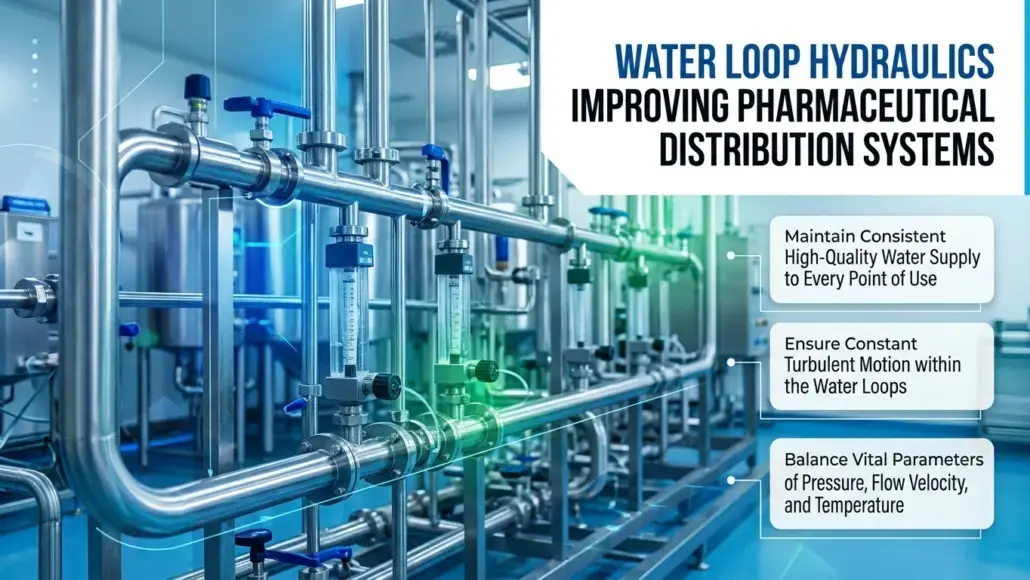
The design and operation of distribution loops for purified water and water for injection are critical to the success of pharmaceutical manufacturing. Maintaining a consistent supply of high-quality water to every point of use requires a balance of pressure, flow velocity, and temperature. Recent engineering developments have focused on water loop hydraulics improving pharmaceutical distribution systems by ensuring that the water remains in a state of constant, turbulent motion. This turbulence is essential for preventing the settling of particles and the development of microbial colonies on the internal surfaces of the piping. By applying hydraulic principles, manufacturers can create distribution networks that are reliable and efficient, supporting the requirements of modern drug production.
Effective hydraulic management begins with the selection of the correct pipe diameters and pump capacities. If the pipes are too large, the flow velocity may drop below the threshold required for turbulence, leading to stagnant areas where bacteria can thrive. Conversely, if the pipes are too small, the resulting high pressure and friction can lead to excessive energy consumption and the potential for pipe erosion. Engineers use modeling software to calculate the Reynolds number at every point in the loop, ensuring that the flow remains within the turbulent regime under all operating conditions. This level of detail is necessary to satisfy regulatory inspectors and to guarantee the integrity of the water supply.
The distribution loop must also be designed to maintain a consistent pressure at every point of use, regardless of how many outlets are open at any given time. This is achieved through the use of pressure control valves and variable speed drives on the distribution pumps. By monitoring the pressure at various points in the loop, the control system can adjust the pump speed to maintain a stable hydraulic profile. This ensures that every process receives the required volume of water at the correct pressure, minimizing the risk of process variability and ensuring the consistent quality of the pharmaceutical product.
Principles of Turbulent Flow and Microbial Control
The primary goal of water loop hydraulics improving pharmaceutical distribution systems is the maintenance of a high Reynolds number, typically above 3,000 to 4,000, depending on the specific system design. In a turbulent flow regime, the water moves in a chaotic manner with lateral mixing, which creates a shearing force against the pipe walls. This shear stress is a deterrent to the attachment of microorganisms and the formation of biofilms. Without sufficient turbulence, even the most highly purified water can become a breeding ground for bacteria, as the laminar flow at the pipe surface allows for the accumulation of nutrients and the protection of microbial cells.
To achieve this necessary turbulence, the distribution pumps must be sized to provide the required flow rate while overcoming the frictional losses inherent in the piping network. Variable speed drives are often employed to maintain a constant pressure in the loop as the demand at various points of use fluctuates. This ensures that even during periods of high demand, the flow velocity at the furthest point of the loop does not drop below the minimum required for microbial control. The integration of flow meters and pressure sensors throughout the system allows for real-time monitoring of hydraulic performance, enabling the control system to make adjustments to pump speed or valve positions.
The relationship between flow velocity and microbial growth is well-documented, with industry standards typically recommending a minimum velocity of 1.5 meters per second in the main distribution loop. However, the specific velocity required can vary depending on the pipe diameter, the surface finish of the piping, and the operating temperature of the water. Engineers must conduct thorough hydraulic calculations to ensure that the required velocity is maintained at all times, even during the most demanding production cycles. By maintaining a high level of turbulence, manufacturers can significantly reduce the risk of biological contamination and ensure the long-term reliability of their water distribution network.
Managing Dead Legs and System Connectivity
A significant challenge in the design of pharmaceutical water systems is the elimination of dead legs, which are stagnant areas of piping where water does not circulate. Standard industry practice, often referred to as the 3D or 6D rule, mandates that the length of any branch or fitting should not exceed a specific multiple of the pipe diameter. However, engineering trends are pushing for even stricter limits, with the goal of achieving zero dead leg configurations wherever possible. Proper water loop hydraulics improving pharmaceutical distribution systems involves the use of specialized valves and fittings that minimize stagnation and ensure that every part of the system is subjected to the same level of flow and sanitization.
The connectivity between the main distribution loop and the individual points of use must also be considered. When a valve is opened to draw water for a production process, it should not cause a drop in pressure or flow in the rest of the system. This requires the use of hydraulic balancing techniques, such as the installation of orificing or the use of balanced loop configurations. By ensuring that the hydraulic profile of the loop remains stable during all phases of operation, manufacturers can prevent the backflow of contaminants and maintain the validated state of the system. This level of hydraulic precision is a factor in the overall reliability of the pharmaceutical utility infrastructure.
In addition to the main distribution loop, the design of the individual point-of-use connections is critical for maintaining water quality. These connections should be as short as possible and should be designed to drain completely after use to prevent the accumulation of stagnant water. The use of specialized point-of-use valves, such as diaphragm valves, provides a sanitary and reliable connection that is easy to clean and sanitize. By paying close attention to these small details, engineers can ensure that the water quality remains high from the moment it leaves the purification system until it reaches the final production process.
Energy Efficiency and Thermal Management in Loop Design
While the focus of water loop hydraulics improving pharmaceutical distribution systems is quality and compliance, energy efficiency is an important consideration. The continuous circulation of water at high velocities requires a amount of electrical energy, and the friction generated by this flow can lead to a rise in water temperature. For cold purified water systems, this heat must be removed by refrigeration units to prevent the water from entering the temperature range where microbial growth is most rapid. For hot water for injection systems, maintaining a temperature above 80 degrees Celsius is essential for self-sanitization, but this requires a constant input of thermal energy.
Optimizing the hydraulic design can lead to energy savings by reducing frictional losses and allowing for the use of more efficient pumps and heat exchangers. Engineers may choose to use smoother pipe materials or to optimize the layout of the loop to minimize the number of elbows and fittings. Additionally, the use of control algorithms can allow the system to operate at lower flow velocities during periods of non-production, provided that the required level of turbulence is maintained. This balance between hydraulic performance and energy consumption is a aspect of sustainable pharmaceutical manufacturing, as facilities look to reduce their environmental footprint without compromising on product safety.
The integration of heat recovery systems can further improve the energy efficiency of the water distribution loop. For example, the heat generated by the distribution pumps can be captured and used to pre-heat the feed water for the steam generators or to provide heating for other facility processes. Similarly, the cooling units used for cold water systems can be integrated into the facility’s overall HVAC system to provide more efficient cooling. By taking a holistic approach to energy management, pharmaceutical manufacturers can significantly reduce their operating costs and improve their environmental performance while still meeting the most demanding quality standards.
Validation and Long Term Hydraulic Performance Monitoring
A pharmaceutical water system must be validated to prove that it can consistently deliver water of the required quality under all hydraulic conditions. This validation process includes testing of the flow rates and pressures at every point of use, as well as the verification of the sanitization procedures. During the performance qualification phase, the system is monitored under varying load conditions to ensure that the hydraulic balance is maintained and that no stagnant areas develop. This documentation provides the evidence required for GMP compliance and serves as a baseline for future performance evaluations.
Long-term monitoring of the hydraulic performance is essential for detecting the onset of system degradation. Changes in pressure or flow rates can indicate the buildup of scale, the fouling of filters, or the gradual wear of pump impellers. By analyzing these trends over time, maintenance teams can identify potential problems before they lead to a system failure or a quality excursion. The use of digital twin technology, where a virtual model of the system is synchronized with real-time sensor data, provides a tool for hydraulic optimization. This allows engineers to simulate the impact of changes to the system or to test the efficacy of new sanitization protocols in a virtual environment before implementing them in the physical facility.
The validation of hydraulic performance also involves verifying the efficacy of the sanitization procedures under various flow conditions. For example, during thermal sanitization, it must be demonstrated that the required temperature is reached and maintained at every point in the loop, even at the furthest point of use. Similarly, for chemical sanitization, the concentration of the sanitizing agent must be verified throughout the system. By integrating these hydraulic considerations into the overall validation strategy, manufacturers can provide a higher level of assurance that their water distribution network will consistently perform as intended and will remain free of biological contamination over its entire operational life.
Hydraulic Balancing for Complex Multi Loop Systems
In large pharmaceutical facilities, the water distribution system often consists of multiple interconnected loops, each serving a different production area or utility. Managing the hydraulics of these complex systems requires a sophisticated approach to balancing and control. If one loop draws a large volume of water, it can cause a pressure drop in the other loops, potentially compromising the water quality or disrupting production processes. Water loop hydraulics improving pharmaceutical distribution systems in these environments involves the use of hydraulic decouplers and pressure-maintaining valves to isolate the various loops and ensure that each operates independently.
Hydraulic balancing is achieved through the use of flow control devices that regulate the distribution of water between the various loops. These devices must be carefully adjusted to ensure that the required flow rate and pressure are maintained in every part of the system, even during periods of peak demand. The use of advanced control systems can allow for real-time balancing of the entire network, with the pumps and valves automatically adjusting to changes in demand across the facility. This level of automated control is essential for maintaining the stability and reliability of large-scale pharmaceutical water systems.
Additionally, the design of multi-loop systems must account for the potential for cross-contamination between the various loops. Each loop should be provided with its own sanitization and monitoring equipment, and the connections between the loops should be designed to prevent backflow. By maintaining a high level of hydraulic isolation and control, manufacturers can ensure that a problem in one part of the system does not affect the water quality in the rest of the facility. This modular approach to system design is a key element of a resilient and reliable pharmaceutical utility infrastructure, supporting the continuous production of high-quality medications.