





Next-Generation Laboratory Equipment Redefining Drug Discovery Workflows
The landscape of pharmaceutical research is undergoing a seismic shift, driven by a convergence of computational power and engineering precision. As the industry faces mounting pressure to reduce the timeline and cost of bringing new therapeutics to market, the role of AI-driven high-throughput screening platforms and other advanced instrumentation has moved from experimental novelty to operational necessity. The modern drug discovery laboratory is no longer just a collection of benchtops and pipettes; it is a sophisticated ecosystem of interconnected technologies designed to maximize data throughput and predictive validity. This transformation is not merely about speed; it is about the fundamental quality of the decisions made at the earliest stages of research.
The Evolution of Screening Technologies in Early-Stage R&D
Historically, high-throughput screening (HTS) was a numbers game—a brute-force approach to testing vast libraries of compounds against biological targets. Laboratories would process hundreds of thousands of wells, hoping for a “hit” based on simple fluorescent or luminescent readouts. Today, the paradigm has shifted towards smart screening. The integration of artificial intelligence into screening hardware has given rise to AI-driven high-throughput screening platforms that are capable of adaptive experimentation. These systems do not simply process plates; they interpret data streams in real-time to adjust concentrations, re-test ambiguous results, and flag anomalies without human intervention.
This leap in capability addresses one of the most persistent challenges in drug discovery: the trade-off between speed and data quality. Traditional HTS campaigns often yielded high false-positive rates, necessitating extensive downstream validation. Next-generation systems, utilizing advanced imaging and label-free detection technologies, provide multiparametric readouts that characterize compound behavior with granular detail. This depth of insight allows research teams to triage compounds based on functional profiles rather than simple binding affinity alone, significantly enriching the quality of leads entering the pipeline. The ability to perform complex phenotypic screening at scale means that researchers can now interrogate biology in a more physiologically relevant context earlier in the process.
Automation Beyond Liquid Handling
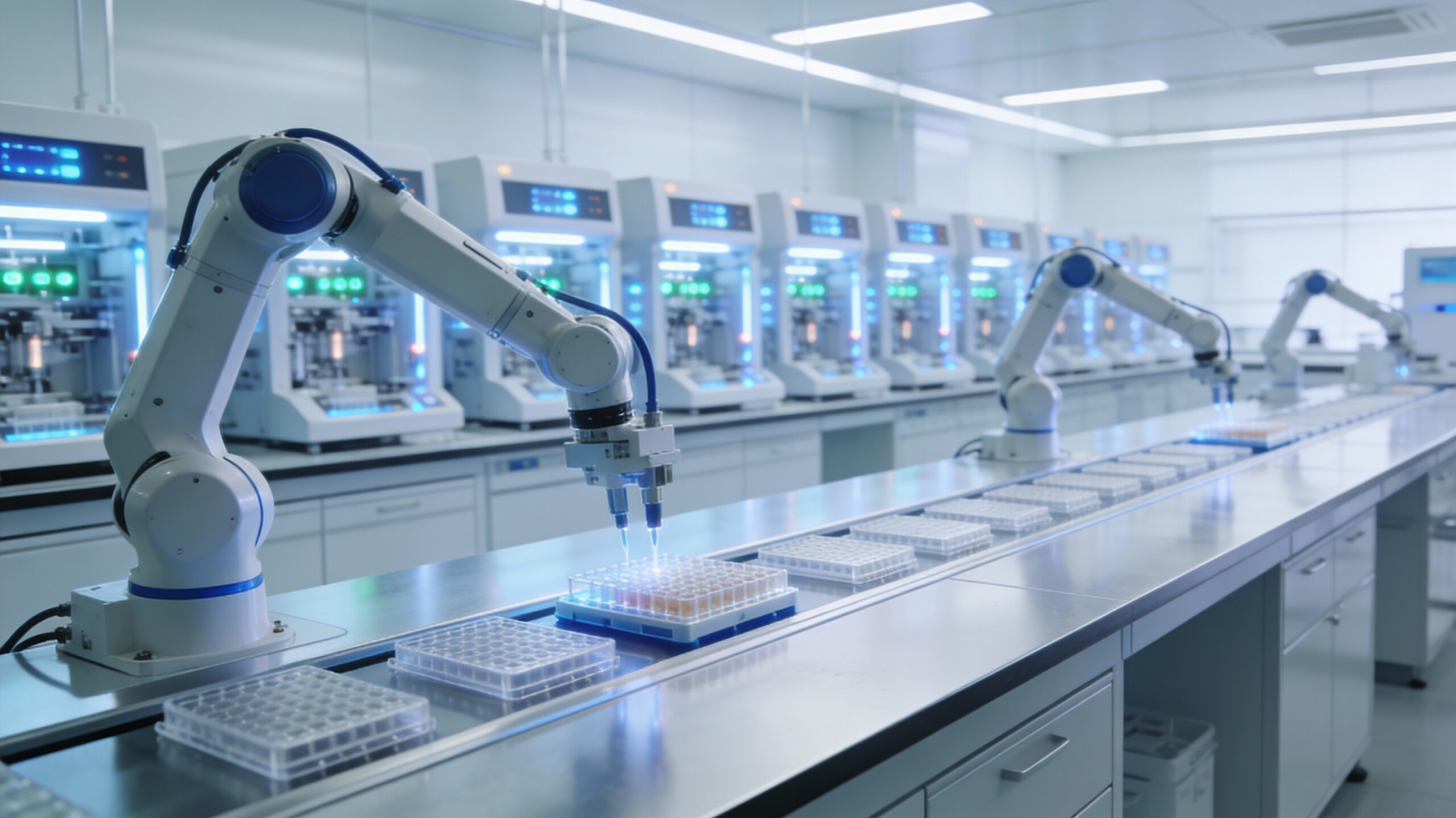
While automated liquid handlers have been staples of the lab for decades, the scope of automation has expanded to encompass entire assay workflows. Modern automated assay systems are designed as modular workcells that integrate incubators, plate readers, washers, and centrifuges into a seamless robotic line. This holistic approach to automation is critical for complex biological assays, such as cell-based screens or 3D spheroid models, which require precise environmental control and timing.
The impact of these systems extends beyond simple throughput. By standardizing every physical manipulation a sample undergoes, automated platforms eliminate the inter-operator variability that plagues manual experimentation. In the context of AI-driven high-throughput screening platforms, this reproducibility is vital. Machine learning models require clean, consistent data to train effectively. The automation of the physical assay ensures that the datasets fed into predictive algorithms are of the highest fidelity, creating a virtuous cycle where better hardware leads to better data, and better data leads to smarter algorithms. Furthermore, the modular nature of these systems allows laboratories to reconfigure their workflows rapidly as research needs change, providing a level of agility that fixed automation islands could never offer.
Artificial Intelligence as a Force Multiplier for Instrumentation
The phrase “AI-integrated” is often used as a buzzword, but in the context of laboratory equipment, it refers to specific, tangible capabilities. Advanced flow cytometers and high-content imaging systems now come equipped with onboard processors capable of classifying cell populations or identifying morphological changes milliseconds after image acquisition. This edge computing capability reduces the data burden on central servers and allows for immediate “go/no-go” decisions during screening runs.
For instance, in hit identification campaigns, an intelligent system can automatically trigger a secondary confirmatory screen for any well showing activity above a certain threshold. This dynamic resource allocation ensures that expensive reagents and instrument time are focused on the most valuable samples. Furthermore, these intelligent systems are increasingly capable of predictive maintenance, monitoring their own performance metrics to alert operators to potential failures—such as a clogging tip or a failing light source—before they compromise an experimental run. This self-awareness in instrumentation minimizes downtime and ensures that critical project timelines are not derailed by preventable technical issues.
Enhancing Data Integrity and Decision Making
The digitalization of laboratory equipment is reshaping how decisions are made in drug discovery. The seamless export of data from AI-driven high-throughput screening platforms into centralized laboratory information management systems (LIMS) and electronic lab notebooks (ELN) ensures a complete digital thread for every candidate molecule. This traceability is essential not only for internal decision-making but also for regulatory filings.
When data is siloed in standalone instruments, the holistic view of a drug candidate’s profile is often lost. Next-generation equipment breaks down these silos. By standardizing data formats and utilizing open APIs, modern lab instruments allow for the aggregation of disparate datasets—combining biophysical data, cellular activity, and ADME (absorption, distribution, metabolism, excretion) profiles into a comprehensive dashboard. This integrated view empowers project leaders to make data-driven decisions with a level of confidence that was previously unattainable in early discovery. It facilitates a “fail fast, fail cheap” strategy where unpromising candidates are eliminated before they consume significant development resources.
The Future of the Discovery Lab
Looking ahead, the trajectory of laboratory equipment innovation is clear: smaller, faster, and smarter. We are seeing the emergence of microfluidic devices that perform massive screens on chips the size of a credit card, drastically reducing reagent costs and sample requirements. These “lab-on-a-chip” technologies, when coupled with AI-driven high-throughput screening platforms, promise to democratize access to advanced discovery capabilities, allowing smaller biotech firms to compete with large pharma in terms of screening power.
Moreover, the rise of remote-controlled “cloud labs” is challenging the very definition of a research facility. In these fully automated facilities, scientists design experiments via code and execute them on equipment located miles away. This model relies entirely on the robustness and intelligence of the underlying equipment. As these technologies mature, they will continue to redefine the economics of drug discovery, shifting the focus from manual labor to intellectual design and data interpretation. The laboratory of the future will be less about manual dexterity and more about the orchestration of intelligent systems.
Conclusion
In conclusion, the adoption of next-generation laboratory equipment is not merely an upgrade of tools; it is a transformation of the drug discovery workflow itself. By leveraging the power of automation and artificial intelligence, pharmaceutical companies can navigate the immense complexity of biology with greater speed and precision. AI-driven high-throughput screening platforms serve as the engine of this new era, turning data into actionable knowledge at a pace previously unimaginable. As these technologies continue to evolve, they will undoubtedly become the standard, empowering scientists to unravel disease mechanisms and deliver life-saving therapies to patients with unprecedented efficiency. The future of medicine is being built today, one automated assay at a time.