














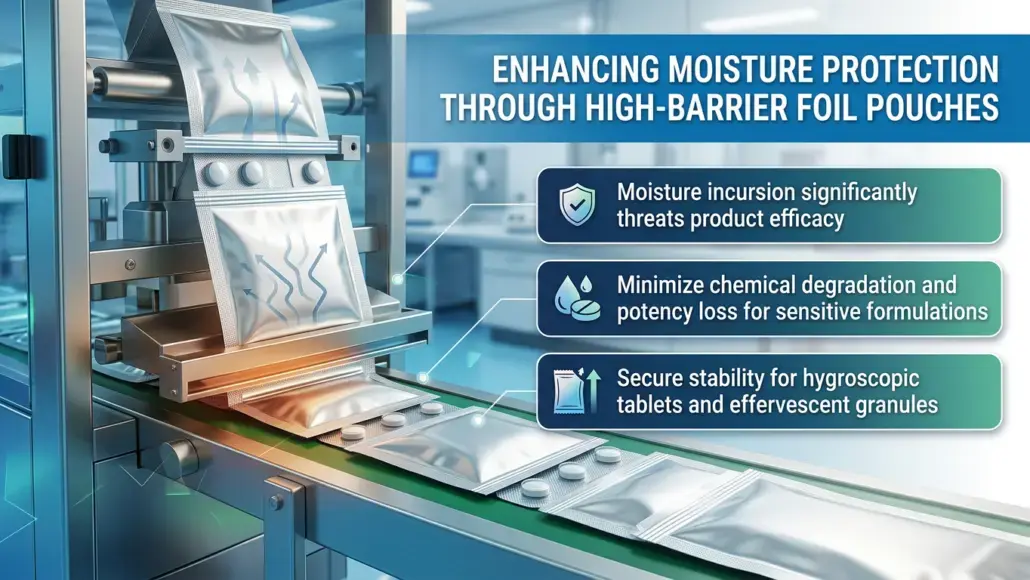
The stability of pharmaceutical formulations is highly dependent on the control of environmental factors, with water vapor ingress being one of the most significant threats to product efficacy. For many solid oral dosage forms, such as hygroscopic tablets and effervescent granules, even minute amounts of humidity can trigger chemical degradation, physical changes, or the loss of potency. Consequently, the implementation of moisture protection strategies is a primary focus during the drug development and packaging selection phases. High-barrier foil pouches have emerged as the gold standard for these sensitive applications, offering a near-absolute barrier that surpasses the performance of traditional polymer-based alternatives.
The Physics of Water Vapor Transmission in Barrier Materials
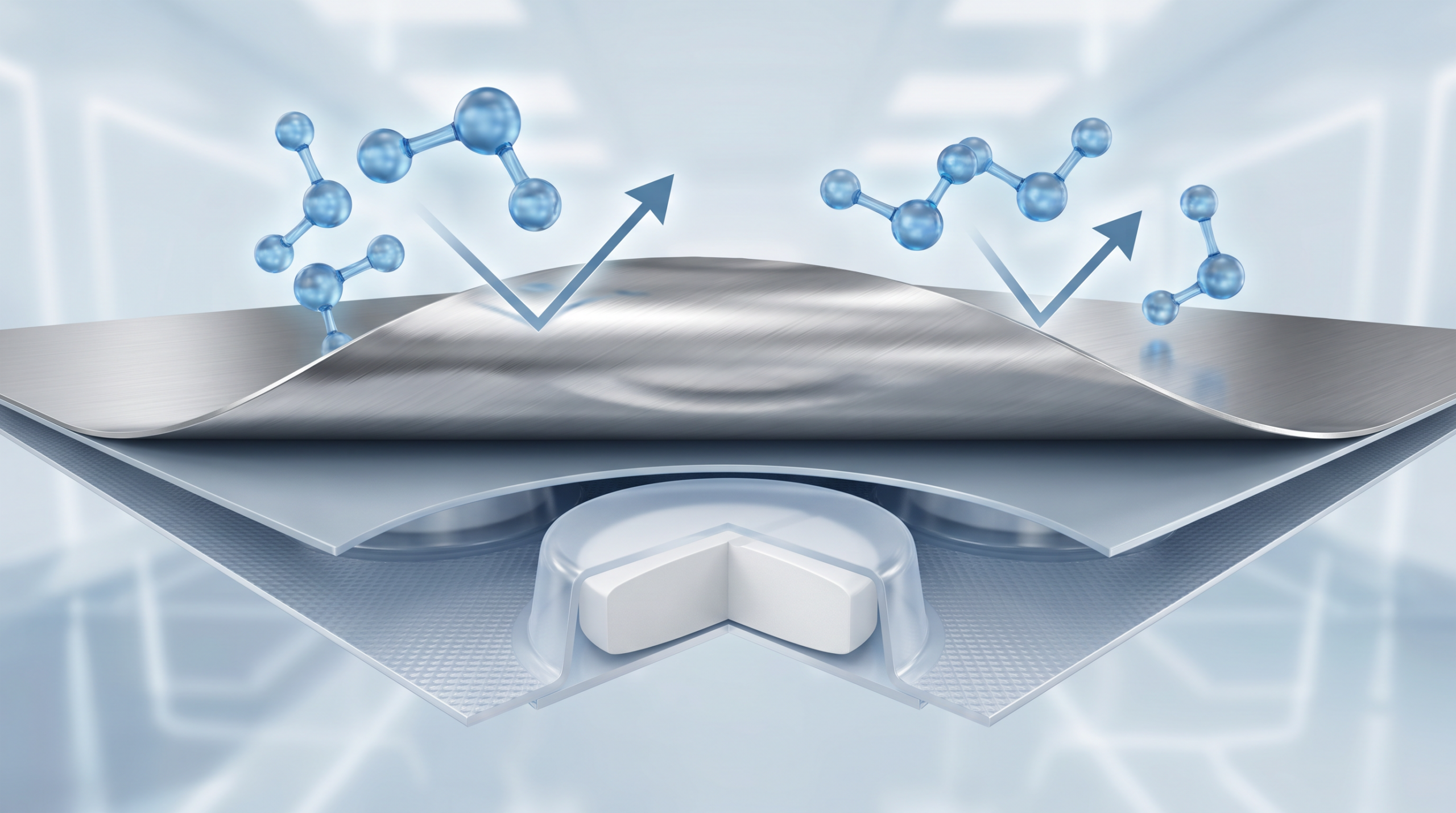
Understanding the mechanism of moisture protection requires an analysis of the Water Vapor Transmission Rate (WVTR), which measures the amount of water vapor that passes through a specific area of a material over a given period. While high-performance polymers like polychlorotrifluoroethylene (PCTFE) or cyclic olefin copolymers (COC) offer impressive barrier properties, they still rely on the slow diffusion of water molecules through the polymer matrix. In contrast, aluminum foil acts as a total physical barrier. Because aluminum is a crystalline metal, there are no gaps between the molecules for water vapor to penetrate, provided the foil is of sufficient thickness to avoid pinholes.
In a typical pharmaceutical laminate, the aluminum foil is usually between 7 and 25 microns thick. At thicknesses above 20 microns, the foil is generally considered to be pinhole-free, providing a WVTR that is essentially zero. This level of moisture protection is critical for medications that must be distributed in tropical climates (Zone IVb), where high ambient temperatures and humidity levels place extreme stress on the packaging. By utilizing a metallic barrier, pharmaceutical manufacturers can ensure that the internal microenvironment of the pouch remains dry throughout the entire shelf life of the medication, regardless of the external conditions.
The integration of foil into a multi-layer structure also provides secondary benefits, such as protection against oxygen and light. This multi-functional approach is essential for complex drug molecules that are susceptible to multiple degradation pathways. However, the reliance on a metallic layer introduces specific engineering challenges, particularly regarding the flexibility and flex-crack resistance of the laminate. If the foil layer is fractured during handling or through the rigors of the supply chain, the moisture protection is immediately compromised. Therefore, the choice of outer and inner polymer layers is vital to provide the necessary mechanical support and protection for the brittle foil core.
Comparative Advantages of Metallic over Non-Metallic Barriers
While advancements in polymer science have led to the creation of ultra-high-barrier films, the inherent properties of aluminum foil continue to offer unique advantages for pharmaceutical applications. One of the most significant benefits is the consistency of the barrier regardless of the temperature. Many polymer barriers exhibit a significant increase in permeability as the temperature rises, which can be problematic during shipping through hot regions. The moisture protection provided by aluminum foil remains constant across a wide range of temperatures, providing a more predictable and stable environment for the drug product.
Another advantage is the dead-fold characteristic of foil, which allows the package to maintain its shape after being bent or folded. This property is particularly useful in pouch applications where the material must be tightly formed around the product. However, it is essential to ensure that the sealant layer design is optimized to work with the foil. A well-engineered sealant ensures that the perimeter of the pouch is as secure as the barrier itself, preventing “wicking” of moisture through the seal area. Without a high-performance seal, the benefits of the foil barrier would be lost at the edges of the package.
Furthermore, foil-based laminates offer excellent chemical resistance, which is important when packaging aggressive formulations or those containing volatile active ingredients. The metallic surface does not absorb or react with most pharmaceutical compounds, ensuring that the moisture protection does not come at the cost of product-package interaction. This inertness is a critical factor in regulatory submissions, as it simplifies the extractables and leachables profile of the packaging system. For manufacturers, the reliability and regulatory acceptance of foil make it a low-risk choice for high-value medications.
Addressing Integrity and Durability in Foil Laminates
The primary vulnerability of a foil-based pouch is its susceptibility to physical damage, such as punctures or flex-cracks. When a laminate is repeatedly bent, the thin aluminum layer can develop microscopic fractures that are invisible to the naked eye but allow for the passage of water vapor. To mitigate this risk, engineers use specialized lamination techniques to bond the foil to tough outer layers like oriented polyester (PET) or biaxially oriented nylon (BON). These layers absorb the mechanical energy and prevent the foil from stretching beyond its limit, thereby preserving the moisture protection.
- Outer Layer Selection: PET provides excellent puncture resistance and a high-quality surface for printing, while Nylon offers superior flex-crack resistance for larger pouches.
- Adhesive Technology: The use of solvent-free or high-performance solvent-based adhesives is necessary to prevent delamination, which can create voids for moisture accumulation.
- Internal Cushioning: In some cases, an additional layer of LDPE is used between the foil and the sealant to provide a “cushioning” effect during the sealing process.
- Quality Control Monitoring: Techniques such as laser surface inspection and infrared thermography are used during production to detect any defects in the foil layer before the material is converted into pouches.
In addition to the material structure, the design of the pouch itself plays a role in maintaining moisture protection. For example, gusseted pouches or those with bottom seals must be carefully engineered to avoid high-stress points at the corners where the foil is most likely to crack. The radius of folds and the geometry of the seal area are optimized using finite element analysis (FEA) to ensure that the stress is distributed evenly across the package. This proactive approach to design reduces the likelihood of failure during the distribution cycle, ensuring that the medication reaches the patient in perfect condition.
Testing protocols for these pouches are also more rigorous than those for standard packaging. In addition to WVTR testing of the flat material, manufacturers perform “whole-package” testing, which involves placing the finished pouch in a high-humidity chamber and measuring the weight gain over time. This captures the combined performance of the barrier, the seals, and any potential defects introduced during the manufacturing process. By verifying the moisture protection at the package level, pharmaceutical companies can be confident in the real-world performance of their packaging solutions.
Process Considerations for High-Speed Pouching Operations
The conversion of high-barrier foil laminates into finished pouches requires specialized equipment and careful process management. Because foil conducts heat very efficiently, the sealing parameters must be tightly controlled to prevent overheating of the internal sealant layer. Excessive heat can lead to “burn-through” or the degradation of the adhesives used in the laminate, both of which would compromise the moisture protection. Precise temperature sensors and water-cooled seal bars are often used to maintain the ideal thermal profile during the high-speed sealing cycle.
Production speeds for foil-based pouches are typically slower than for pure polymer films due to the higher thermal mass of the metallic layer. However, advancements in sealing technology, such as ultrasonic sealing or impulse sealing, are allowing for faster throughput without sacrificing quality. These methods provide more localized heat, which is ideal for protecting the integrity of the foil barrier while achieving a secure bond. Maintaining a high level of moisture protection in a high-volume environment is a constant balancing act between speed, cost, and quality.
Validation of the sealing process is a regulatory requirement and is particularly critical for moisture-sensitive products. The validation study must demonstrate that the chosen parameters consistently produce seals that meet the required specifications for strength and integrity. This often involves the use of specialized tools for packaging validation to ensure that every machine on the production line is operating within the same tight tolerances. By standardizing the process, manufacturers can minimize the variability that leads to intermittent barrier failures and ensure a consistent level of protection across all batches.
Strategic Implementation and Future Trends in Barrier Science
The strategic selection of high-barrier foil pouches is often driven by the need to simplify global supply chain logistics. By using the highest possible level of moisture protection, companies can use a single packaging format for multiple markets, reducing the need for region-specific stability studies and localized inventory. While foil is more expensive than many plastic films, the reduction in product waste due to degradation and the simplification of the supply chain often lead to a lower total cost of ownership. This economic argument is becoming increasingly persuasive as the pharmaceutical industry looks for ways to optimize its operations.
Looking forward, the industry is exploring ways to improve the sustainability of foil-based packaging. Aluminum is highly recyclable, but the challenge lies in separating it from the plastic layers in a laminate. New “recycling-ready” structures are being developed that use thinner foil layers combined with more compatible polymers to facilitate easier sorting and processing at end-of-life. Additionally, there is ongoing research into atomic layer deposition (ALD) and other nano-coating technologies that could provide foil-like moisture protection with a fraction of the material.
While these new technologies are promising, the proven reliability and performance of high-barrier foil pouches ensure that they will remain a staple of pharmaceutical packaging for years to come. The ability to provide a total physical barrier against environmental threats is an unmatched advantage for the most sensitive and critical medications. As long as moisture protection remains a primary concern for drug stability, the engineering of foil-based laminates will continue to be a vital field of expertise within the pharmaceutical industry. Through continued innovation in material science and process control, the industry will further refine these solutions to meet the evolving needs of patients and healthcare systems worldwide.