














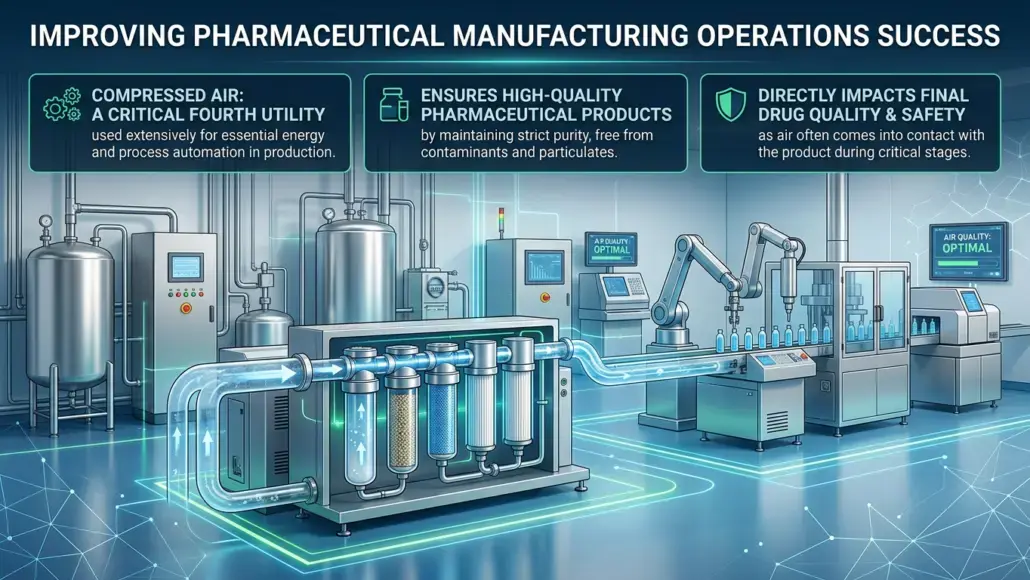
The reliability of utility systems often dictates the overall efficiency of complex production environments. In the context of pharmaceutical manufacturing operations, compressed air is frequently referred to as the fourth utility, serving as a critical energy source for everything from pneumatic conveying to sterile filling and packaging. Because this air often comes into direct or indirect contact with the final drug product, its quality is not merely a matter of mechanical performance but a fundamental requirement for regulatory compliance. Ensuring a consistent supply of high-purity air is essential for preventing contamination and maintaining the sterile conditions necessitated by Good Manufacturing Practice (GMP) standards.
The architectural design of a pharmaceutical facility must account for the distribution of these utilities with the same level of detail as the production lines themselves. Piping networks must be constructed from materials that do not shed particles or react with the compressed air, such as high-grade stainless steel. Proper sizing and layout are critical for minimizing pressure drops and preventing the accumulation of stagnant air, which could harbor microbial growth. The integration of centralized compressor rooms with localized filtration and drying stations ensures that the air quality at the point of use meets the specific requirements of each application. This systemic approach is vital for the smooth execution of industrial production processes, where any disruption can lead to significant financial losses.
Standards for Air Quality in Sterile Environments
The pharmaceutical industry adheres to the most stringent international standards for compressed air quality, primarily ISO 8573-1. For pharmaceutical manufacturing operations, the requirement is almost universally Class 0 air, which specifies that the air must be completely free of oil in all forms, including aerosols, vapors, and liquids. Even a minute amount of oil contamination can have catastrophic consequences, including the degradation of active ingredients, the promotion of microbial growth, and the failure of sensitive analytical equipment. By utilizing oil-free compressor technologies, such as oil-free screw or centrifugal systems, manufacturers eliminate the risk of lubricant entering the air stream, thereby protecting the integrity of the manufacturing process.
Oil-free screw compressors utilize a specialized coating on the rotors to prevent contact without the need for lubrication in the compression chamber. This design ensures that the air remains pure throughout the entire compression cycle. Centrifugal compressors, on the other hand, use high-speed impellers to compress the air, naturally avoiding the use of oil in the process. Both technologies are widely used in the sector, with the choice often depending on the required air volume and the specific operational profile of the facility. The ability to produce Class 0 air without the need for expensive and maintenance-heavy filtration stages is a significant advantage for modern pharmaceutical manufacturing operations, reducing both risk and operational complexity.
Beyond oil content, the control of moisture and particulate matter is equally vital. Excess moisture in compressed air lines can lead to corrosion in the distribution piping, which introduces metallic particles into the system and provides a medium for bacterial proliferation. To mitigate this, advanced industrial production processes employ sophisticated desiccant or refrigerated dryers combined with high-efficiency filtration systems. These components ensure that the pressure dew point is maintained at a level that inhibits microbial activity, typically -40 degrees Celsius or lower for sterile applications. Heat-of-compression (HOC) dryers are particularly efficient in this regard, as they use the thermal energy generated during the compression process to regenerate the desiccant, significantly reducing the energy required for drying.
Role of Pneumatic Systems in Material Handling
Pneumatic conveying is a primary application for compressed air within industrial production processes, particularly in the handling of dry powders and granulates. This method of transport offers significant advantages over mechanical systems, including the reduction of dust generation and the prevention of cross-contamination between different batches. By using a closed-loop pneumatic system, manufacturers can move materials between various stages of production, such as from the mixer to the tablet press, without exposing the product to the external environment. This level of containment is critical when handling potent compounds or hazardous substances where operator safety and environmental protection are paramount.

The selection of the conveying phase (dilute or dense) depends on the physical properties of the material being transported. Dense phase conveying uses a lower velocity and higher pressure, which is gentler on fragile granules and reduces the risk of particle attrition. Dilute phase conveying is better suited for non-abrasive materials and offers higher throughput at a lower cost. Advanced analytical instruments improving pharmaceutical quality control are often connected to these pneumatic systems to provide feedback loops that adjust manufacturing parameters in real time. This synergy ensures that the mechanical operations of the plant are perfectly synchronized with the chemical and physical requirements of the product, resulting in a more predictable manufacturing cycle.
Vacuum conveying is another important technique, especially for transferring materials from drums or bulk bags into the production line. This method uses a vacuum pump to create a pressure differential that draws the material through the piping. Because the system operates under negative pressure, any leaks will draw air into the system rather than blowing product out, which is a key safety feature when handling highly active or toxic materials. The integration of these pneumatic solutions into the broader framework of pharmaceutical manufacturing operations allows for a more flexible and efficient production process, capable of handling a wide variety of product formats.
Energy Efficiency and Operational Resilience
The energy consumption of compressed air systems can represent a significant portion of the total operational costs for a facility. For large-scale industrial production processes, improving the efficiency of these systems is a key component of broader sustainability initiatives. Modern compressors are equipped with variable speed drive (VSD) technology, which allows the motor to adjust its output to match the fluctuating demand for air. This prevents the wasteful practice of running a compressor at full capacity when only a fraction of the air is needed, potentially reducing energy consumption by as much as thirty to fifty percent.
- Implementation of VSD technology to match air supply with real-time demand.
- Regular leak detection audits to identify and repair inefficiencies in the distribution network.
- Use of heat recovery systems to repurpose the thermal energy generated during compression for facility heating or water pre-heating.
- Advanced control systems that synchronize multiple compressors to operate at their collective peak efficiency.
- Installation of high-efficiency motors (IE3 or IE4) to minimize internal energy losses.
- Optimization of pressure settings to the lowest possible level that still meets the requirements of the equipment.
The resilience of the compressed air supply is also a major consideration. Any unplanned downtime can result in the loss of expensive batches and significant delays in the supply chain. To ensure continuous operation, facilities typically employ a redundant configuration, where multiple compressors are installed in parallel. This allows for routine maintenance to be performed on one unit without interrupting the air supply to the production lines. Additionally, the integration of predictive maintenance tools, which use vibration analysis and thermal imaging to detect early signs of component wear, allows for proactive repairs that prevent failures. These systems are often connected to the central building management system (BMS), providing a comprehensive view of the facility’s utility health.
Maintaining Sterile Air for Aisle and Packaging
In the final stages of production, compressed air is used for cleaning containers, purging vials, and providing a sterile blanket of air during the filling process. In these applications, the air must not only be oil-free and dry but also sterile. This is achieved through the use of point-of-use sterile filters that are designed to remove bacteria and viruses from the air stream. For industrial production processes, the validation of these filters is a critical regulatory requirement, often involving integrity testing before and after each production run to ensure that they have not been compromised. This process is essential for maintaining the sterility of the final product and ensuring patient safety.
The packaging process itself relies heavily on compressed air for the operation of blister packaging machines, cartoners, and labeling equipment. The speed and precision of these machines are directly related to the stability and pressure of the compressed air supply. Inconsistent air pressure can lead to jams, mislabeled products, and excessive waste. By maintaining a stable, high-quality air supply, manufacturers can achieve the high throughput required to meet market demand while minimizing the risk of packaging defects. The evolution of compressor technology continues to support the growing complexity of these automated systems, providing the reliable power needed for the next generation of pharmaceutical manufacturing operations.
Sterilization-in-place (SIP) systems are also used to maintain the cleanliness of the compressed air distribution network. These systems use steam to sterilize the piping and filters without the need for disassembly, saving time and reducing the risk of contamination during the cleaning process. The integration of SIP with the compressed air system is a key feature of modern sterile manufacturing facilities, ensuring that the entire production environment remains compliant with the highest standards of hygiene. As the industry moves toward more complex biopharmaceutical products, the need for these advanced sterilization techniques will only increase.
Future Outlook for Utility Management
As the industry moves toward Industry 4.0 and the “Smart Factory” model, the management of utility systems like compressed air is becoming increasingly data-driven. The integration of Internet of Things (IoT) sensors allows for the remote monitoring of compressor performance and air quality from anywhere in the world. This level of visibility enables industrial production processes to optimize their maintenance schedules, track energy consumption in real time, and respond instantly to any deviations from established quality standards. The transition from reactive utility management to a proactive, data-centric approach is fundamental to achieving the levels of efficiency and reliability required in the modern pharmaceutical environment.
Looking forward, the development of even more efficient compression technologies and the potential for on-site nitrogen generation from compressed air will further enhance the autonomy of manufacturing facilities. Nitrogen is used extensively for inerting tanks and protecting oxygen-sensitive ingredients, and producing it locally can significantly reduce the costs and logistical challenges associated with bulk gas deliveries. By continuously investing in advanced utility infrastructure, pharmaceutical companies can build a foundation for long-term operational success. The commitment to maintaining a world-class utility environment is the most effective strategy for ensuring that industrial production processes remain competitive and continue to deliver high-quality medicines to patients globally.