




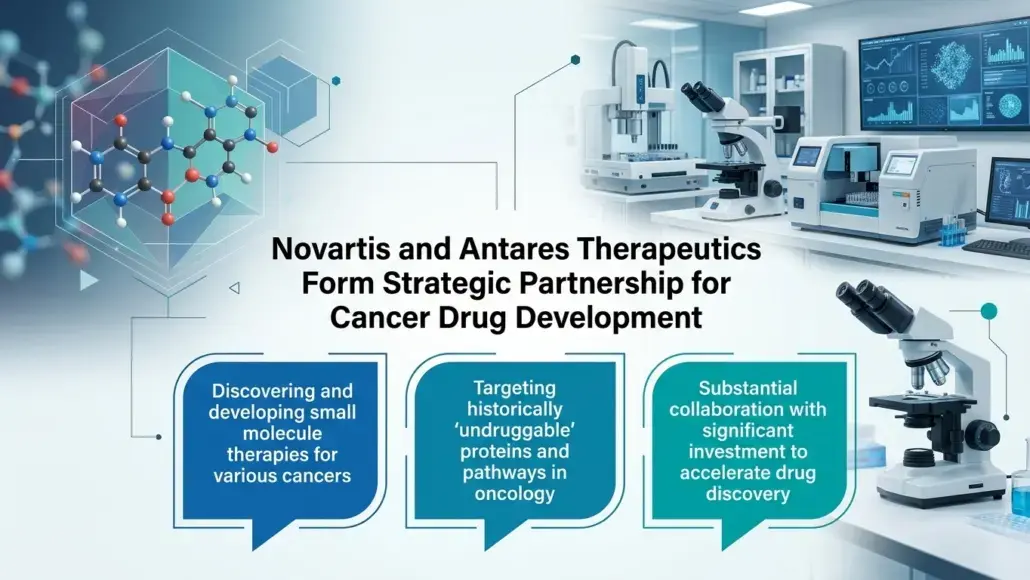
Novartis has finalized a significant collaboration agreement with Antares Therapeutics to advance the discovery and development of small molecule therapies for various cancers. The deal, which could reach a total value of $1.9 billion, focuses on addressing oncology targets that have historically been categorized as undruggable. Under the terms of the agreement, Novartis will provide an initial payment of $105 million to Antares. The partnership also includes provisions for up to $1.8 billion in additional payments tied to the achievement of specific development, regulatory, and commercial milestones, as well as royalties on future product sales. This oncology deal aims to combine the research capabilities of a specialized biotech with the global scale of a major pharmaceutical leader.
Advancing Precision Oncology Through Innovative Discovery Engines
Antares Therapeutics, which launched as an independent entity from Scorpion Therapeutics in June 2025, will lead the initial research efforts. The company utilizes a sophisticated drug discovery engine that integrates proprietary compound libraries with a next-generation mass spectrometry platform and advanced pocket-finding techniques to identify new therapeutic opportunities. Antares will apply these technologies to a limited number of undisclosed targets until Novartis elects to license the resulting assets. Adam Friedman, CEO of Antares, stated: “From the outset, our goal has been to build a discovery engine that systematically unlocks high-value, challenging targets and delivers first-in-class precision oncology medicines. This collaboration lets us scale that engine alongside Novartis’ world-class development capabilities and global reach, so we can translate our science into transformative therapies for patients faster than either of us could alone. It builds on the work of a team that has consistently produced highly selective medicines against some of the hardest targets in drug discovery.”
Strategic Growth in the Novartis Oncology Portfolio
The agreement follows a period of strong financial performance for the oncology deal. In 2025, oncology sales at Novartis rose by 18% to reach $16.8 billion, solidifying its position as the largest therapeutic segment for the company. A primary driver of this growth was the breast cancer medication Kisqali, which recorded $4.8 billion in global revenue during the same year. Fiona Marshall, president of biomedical research at Novartis, noted: “Many of the most compelling targets today in oncology have historically been considered undruggable. We believe this collaboration has the potential to unlock a new wave of targeted therapies and bring meaningful advances to patients.” By securing access to the Antares drug discovery platform and its proprietary compound libraries, Novartis continues to bolster its pipeline of targeted treatments within its primary therapeutic segment.
Broader Trends in Pharmaceutical Sector Dealmaking
This collaboration is part of a wider trend of active dealmaking within the life sciences industry. During the first quarter of 2026, the total value of pharmaceutical deals in the United States exceeded $65 billion, representing a high point for the sector. Other notable transactions in 2026 include the acquisition of a portfolio of PI3Kα inhibitors by Novartis from Synnovation Therapeutics for $3 billion, and the $2 billion acquisition of Excellergy. In the broader market, Sun Pharma completed an $11.75 billion takeover of Organon, while GSK acquired Nuvalent for $10.6 billion. Antares Therapeutics, which began with $177 million in Series A funding, anticipates that its lead precision oncology program will commence clinical trials in 2026. The company currently maintains several additional programs in preclinical stages as it prepares for upcoming clinical trials and further cancer research milestones.