














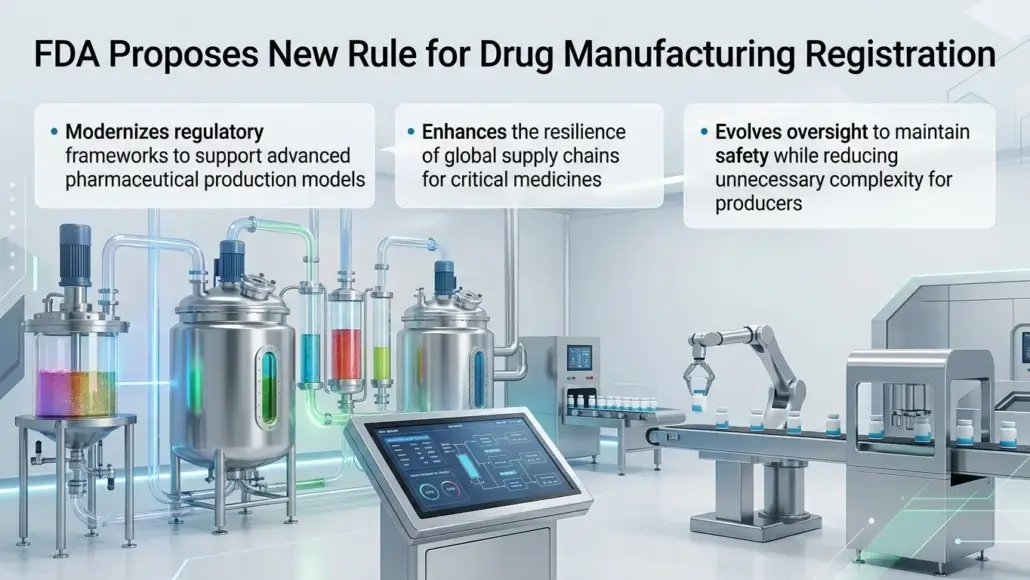
The modernization of regulatory frameworks is becoming essential to support the pharmaceutical industry’s transition toward advanced production models and to ensure the resilience of global supply chains. As innovative manufacturing technologies emerge, traditional oversight mechanisms must evolve to maintain safety standards while reducing unnecessary complexity for producers. In a significant move to align regulations with modern industry practices, the U.S. Food and Drug Administration (FDA) issued a proposed rule on July 10, 2026, aimed at updating drug manufacturing registration procedures. This action is designed to streamline the administrative process for distributed manufacturing establishments and clarify requirements for foreign entities that contribute to the U.S. drug supply. By strengthening domestic pharmaceutical manufacturing and ensuring regulatory frameworks keep pace with innovation, the agency aims to secure reliable access to safe, quality medicines for the public.
Streamlining Distributed Manufacturing via Hub-and-Spoke Models
One of the primary focuses of the proposed rule is the facilitation of distributed manufacturing, which utilizes a “hub-and-spoke” configuration. This model consists of a central quality oversight hub and multiple equivalent manufacturing units at various locations. Under current regulations, each individual unit within such a network must register separately, a requirement that often creates significant administrative burdens. The new proposal would allow these networks to register as a single establishment. Under this streamlined drug manufacturing registration pathway, units could be added, relocated, or removed through a simplified update process. However, to maintain real-time oversight, companies would be required to notify the FDA in advance of any unit relocation. Michael Davis, M.D., Ph.D., Acting Director of FDA’s Center for Drug Evaluation and Research, stated, “The FDA is proposing changes to our establishment registration regulations that would reflect how distributed manufacturing actually works — as one single establishment.” He further noted, “The proposed changes would make it easier for innovative manufacturers to operate efficiently, and give the FDA a clearer, more accurate picture of how and where drugs are being made.”
Enhancing Global Supply Chain Transparency
In addition to domestic improvements, the proposed rule addresses critical gaps in the visibility of foreign drug manufacturing. Currently, certain foreign establishments that produce components—including active pharmaceutical ingredients (APIs)—exclusively for other foreign entities may not be registered with the FDA. This lack of registration limits the agency’s ability to monitor upstream supply chains that eventually enter the United States. The proposed regulation clarifies that these establishments must register and report on the drugs they produce, aligning regulatory standards with statutory requirements. This change is expected to improve the agency’s capacity to detect and respond to potential safety concerns before products reach the patient level.
Dr. Davis emphasized the importance of this transparency, asserting, “When an active ingredient in a medicine reaches an American patient, the FDA should be able to trace exactly where it came from.” He added, “Closing this registration gap for foreign establishments is a concrete step toward increasing the supply chain transparency that patients deserve.” If finalized, the rule is anticipated to reduce registration costs for companies employing distributed models while generating long-term efficiencies for both the industry and the agency. The initiative represents a broader effort to revitalize pharmaceutical manufacturing, improve traceability, and reduce vulnerabilities within the drug supply chain.