










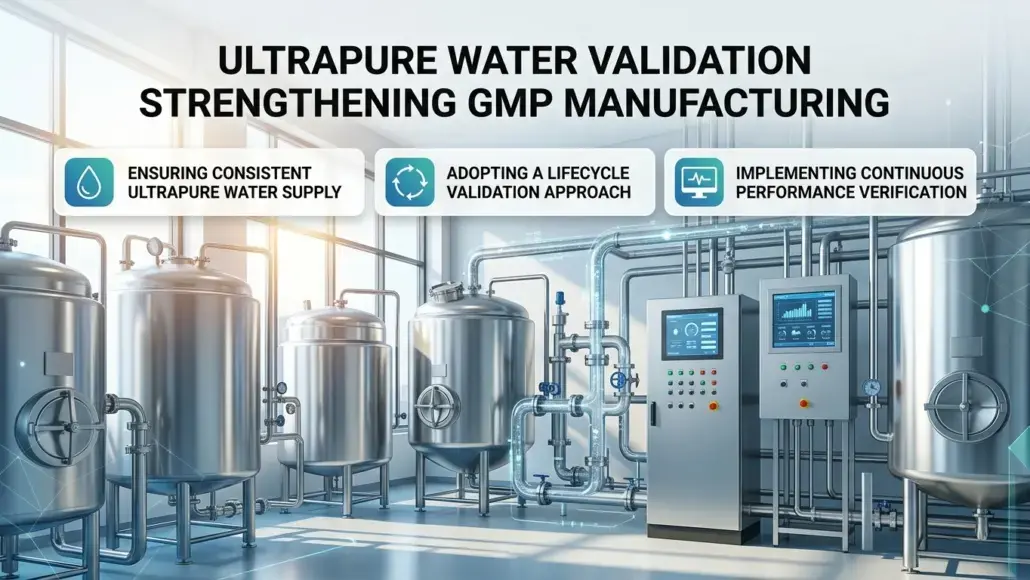
Rigorous adherence to Good Manufacturing Practice (GMP) requires that pharmaceutical water systems provide a consistent supply of ultrapure water meeting exact chemical and microbiological specifications. Recent updates to international regulatory frameworks have placed a renewed emphasis on the lifecycle approach to validation, shifting the focus from point-in-time testing to continuous performance verification. This change in perspective ensures that ultrapure water validation strengthening GMP manufacturing becomes an integrated part of the facility quality management system. The validation process begins long before the first liter of water is produced, starting with a comprehensive User Requirement Specification that defines every critical quality attribute needed for specific therapeutic applications. Engineers and quality assurance professionals must collaborate to design systems that not only meet current pharmacopeial standards but also possess the flexibility to adapt to future regulatory shifts.
The fundamental pillars of system qualification involve Installation Qualification (IQ), Operational Qualification (OQ), and Performance Qualification (PQ). Each stage serves a distinct purpose in confirming that the water purification infrastructure operates as intended under a variety of load conditions. During IQ, every component from the pre-treatment filters to the final polishers is verified against design documents to ensure correct installation and materials of construction. Operational qualification then tests the limits of the system, verifying that pumps, sensors, and valves function correctly across their entire operating range. These phases establish the documented evidence required by regulatory inspectors, ensuring that the system is built and functions as designed.
Strategic Design Principles for Validated High Purity Systems
Designing a system capable of meeting the demands of ultrapure water validation strengthening GMP manufacturing necessitates a deep understanding of fluid dynamics and material science. Modern pharmaceutical facilities prioritize materials like 316L stainless steel or high-purity polymers that resist corrosion and minimize the leaching of organic carbon. The interior surfaces of piping must be polished to specific roughness averages to prevent microbial adhesion and the subsequent development of biological contaminants. System designers focus on maintaining turbulent flow throughout the distribution loop, as high velocities discourage the settling of particulates and the growth of microorganisms.
The configuration of the purification train itself plays a critical role in the success of the validation effort. Most high-purity systems utilize a combination of reverse osmosis, continuous electrodeionization, and ultraviolet irradiation to achieve the required resistivity and total organic carbon levels. Each of these steps must be individually validated to confirm its contribution to the overall quality of the water. For instance, reverse osmosis membranes must be monitored for salt rejection efficiency, while electrodeionization stacks are evaluated for their ability to consistently remove ionic impurities without the use of hazardous chemicals. By integrating these technologies into a coherent, monitored process, manufacturers can ensure that their water supply remains a reliable foundation for pharmaceutical production.
Beyond the core purification steps, the design must account for the physical layout of the facility. Long piping runs and complex distribution networks increase the surface area available for microbial colonization, requiring careful engineering to ensure that sanitization agents reach every corner of the system. The use of dead-leg rules and the elimination of stagnant zones are fundamental to the success of the validation effort. When designing these systems, engineers must also consider the potential for environmental contamination from the surrounding facility. Air breaks, specialized venting, and physical barriers are used to prevent the ingress of dust, microorganisms, and other pollutants.
Implementing Rigorous Sampling and Monitoring Protocols
A validated system is only as reliable as the data used to monitor its performance. Establishing a comprehensive sampling plan is a critical component of ultrapure water validation strengthening GMP manufacturing. This plan must account for seasonal variations in feed water quality, as fluctuations in temperature and mineral content can significantly impact the efficiency of purification components. Sampling points should be strategically located at every major stage of the process, as well as at each point of use within the production facility. This multi-layered approach allows quality teams to identify potential issues before they reach the final product, enabling proactive maintenance and system adjustments.
In addition to manual sampling, the integration of online monitoring tools has become a requirement for modern GMP compliance. Continuous measurements of conductivity, temperature, and total organic carbon provide a real-time window into system health. These sensors must undergo regular calibration and verification to maintain the integrity of the data they produce. When an online sensor detects a deviation from established limits, the system should be programmed to automatically divert the water to drain or trigger an alarm for immediate investigation. This level of automation reduces the risk of human error and ensures that only water of the highest quality enters the manufacturing process.
The frequency and location of sampling are determined through a risk-based assessment that considers the criticality of the water application. For water for injection systems, sampling is typically more frequent and includes tests for endotoxins and a wider range of microbial species. The data generated through these sampling activities is used to establish alert and action levels, which serve as early warning signs of system drift. By closely monitoring these trends, quality professionals can identify the onset of component failure or the gradual accumulation of contaminants, allowing for corrective actions to be taken before the system exceeds regulatory limits.
Regulatory Alignment and Documentation Management
The goal of any validation effort is to provide documented evidence of compliance to regulatory bodies such as the FDA or EMA. This requires a meticulous approach to data management and record-keeping. Every test result, calibration record, and maintenance activity must be recorded in a manner that follows the principles of data integrity, often referred to as ALCOA plus (attributable, legible, contemporaneous, original, and accurate). As pharmaceutical companies transition from paper-based systems to digital platforms, the validation of these software systems themselves becomes a necessary part of the overall GMP strategy.
Effective validation management in a GMP environment also involves a change control process. Any modification to the system, whether it is a simple component replacement or a major capacity upgrade, must be evaluated for its potential impact on water quality. This evaluation determines whether the system requires re-validation or if the change can be managed through existing quality procedures. By maintaining a high standard of documentation and oversight, pharmaceutical manufacturers can confidently demonstrate that their water systems are in a state of control, thereby protecting patient safety and ensuring the efficacy of the medications they produce.
The validation package, which includes the validation master plan, protocols, and summary reports, serves as the definitive record of the system’s compliance status. This documentation must be readily available for review during regulatory inspections and must be updated regularly to reflect changes in system configuration or operational procedures. The transition to electronic document management systems has improved the accessibility and security of these records, but it has also introduced new challenges related to software validation and electronic signatures. Compliance with 21 CFR Part 11 and other digital regulations is essential for ensuring that electronic records are as reliable as their paper counterparts.
Long Term Performance Trends and System Lifecycle
Validation is not a finite project but a continuous cycle that spans the entire life of the water system. Performance Qualification Phase 3 typically involves a year-long monitoring period to demonstrate consistent quality across all seasons. However, the completion of this phase is simply the beginning of the operational life of the system. Ongoing performance monitoring and periodic reviews are essential to detect slow shifts in water quality that might indicate the onset of component failure or the gradual accumulation of contaminants.
Maintaining the validated state of a pharmaceutical water system requires a commitment to preventative maintenance and operator training. Technical staff must understand the intricacies of the system and the importance of following established procedures for sanitization and component replacement. Regular audits, both internal and external, provide an opportunity to identify areas for improvement and ensure that the validation documentation remains current and accurate. Through this holistic approach to system management, ultrapure water validation strengthening GMP manufacturing remains a vital component of the pharmaceutical quality environment, supporting the delivery of safe and effective therapies to patients around the world.
As a system ages, the risk of mechanical failure and microbial contamination increases. A proactive approach to lifecycle management involves the periodic replacement of critical components, such as pumps, valves, and sensors, before they fail. This preventative strategy minimizes the risk of unplanned shutdowns and ensures that the system continues to operate within its validated parameters. Additionally, regular re-evaluation of the validation strategy is necessary to account for updates in regulatory requirements and advancements in purification technology. By staying informed about industry trends and regulatory changes, pharmaceutical manufacturers can ensure that their water systems remain compliant and effective over the long term.
Integrating Quality by Design into Water Validation
The concept of Quality by Design (QbD) has gained significant traction in the pharmaceutical industry, and its application to water systems is no exception. QbD involves defining the desired quality characteristics of the water and then designing the system and the validation process to consistently achieve those characteristics. This approach shifts the focus from testing the final product to controlling the manufacturing process itself. By identifying the critical process parameters and critical quality attributes of the water system, manufacturers can develop a more comprehensive validation strategy that is based on scientific principles and risk assessment.
In a QbD-based validation framework, the design space for the water system is clearly defined, and the impact of process variability on water quality is thoroughly understood. This allow for more flexible and efficient validation activities, as the focus is placed on the most critical aspects of the system. For example, if the relationship between flow velocity and microbial growth is well-understood, the validation effort can focus on ensuring that the minimum velocity is consistently maintained throughout the distribution loop. This scientific approach to validation provides a higher level of assurance that the water system will consistently perform as intended, even in the face of varying operational conditions.
The implementation of QbD also facilitates continuous improvement and innovation. When the process is well-understood, manufacturers can more easily evaluate the impact of new technologies or process modifications on water quality. This encourages the adoption of more efficient and sustainable purification methods, such as the use of ozone for sanitization or the integration of advanced sensors for real-time monitoring. By embracing the principles of QbD, pharmaceutical companies can ensure that their ultrapure water validation strengthening GMP manufacturing efforts are not only compliant but also optimized for efficiency and reliability. This forward-looking approach to validation is essential for meeting the challenges of a rapidly evolving industry and for ensuring the continued safety and efficacy of pharmaceutical products.