











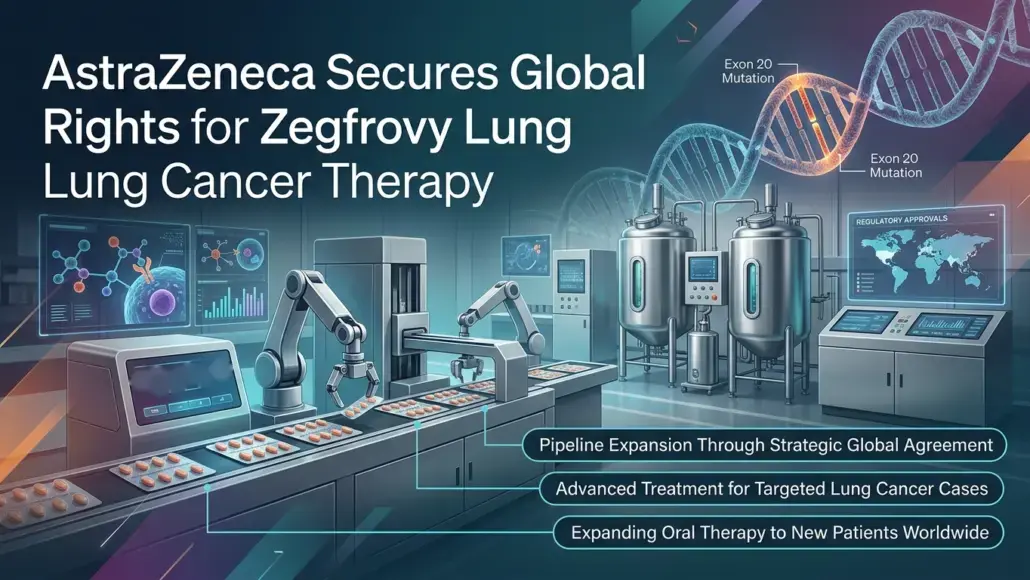
AstraZeneca has expanded its oncology pipeline through a $1.5 billion agreement with Dizal Pharma, securing the Zegfrovy global rights. This oral lung cancer therapy, also known as sunvozertinib, is an irreversible EGFR inhibitor. Currently, sunvozertinib is approved in China and the United States as a second-line treatment for adults with locally advanced or metastatic non-small cell lung cancer (NSCLC). The treatment specifically targets patients with exon 20 insertion mutations who have previously undergone platinum-based chemotherapy. Under the terms of the deal, AstraZeneca will provide an upfront payment of $600 million, with an additional $900 million tied to development, regulatory, and sales milestones.
Clinical Advancements and Frontline Treatment Potential
The strategic move follows significant data from the WU-KONG28 clinical trial. In this clinical trial, the drug achieved a statistically significant improvement in progression-free survival as a monotherapy compared to standard platinum-based chemotherapy. These results suggest that the medication could potentially move into first-line treatment for NSCLC with exon 20 insertion mutations, a category that typically carries a poor prognosis. Currently, the frontline setting for this niche is primarily served by intravenous options. Dizal has already filed for expanded indications in both China and the U.S. to include frontline use.
Strategic Expansion of the Oncology Portfolio
Dave Fredrickson, executive vice president of the oncology business unit at AstraZeneca, commented on the acquisition: “AstraZeneca is a leader in treating EGFR-mutated lung cancer, and we are eager to add Zegfrovy to our world-class portfolio of innovative medicines for patients whose tumours carry exon 20 insertion mutations.” He further noted, “With this agreement, we will bring a differentiated, oral targeted treatment to these patients with limited options across the globe.” By securing the Zegfrovy global rights, the company aims to offer a once-daily oral alternative to existing therapies. While other treatments like furmonertinib are being evaluated in the phase 3 FURVENT trial, this transaction, expected to close in the second half of 2026, strengthens the company’s oncology portfolio.