











The human genome encodes tens of thousands of different proteins, but within the specialized field of drug development, few classes of molecules are as strategically important or as therapeutically promising as those located within the cell membrane. Membrane proteins unlocking drug discovery potential represent a massive and vital segment of the global pharmaceutical landscape, with statistics suggesting that over 50% of all currently approved and marketed drugs target these sophisticated and often elusive molecules. They act as the primary, high-security interface between the complex internal environment of the cell and the external biological world, playing absolutely critical roles in signal transduction, the transport of essential nutrients and ions, and the vital process of cell-cell recognition.
Despite their undisputed therapeutic importance, membrane proteins have historically been notoriously difficult to study in a laboratory setting. Their complex, hydrophobic nature and their absolute requirement for a specific lipid environment to maintain their native, functional structure have presented researchers with a series of formidable technical challenges. However, recent and groundbreaking breakthroughs in the fields of protein engineering, computational modeling, and structural biology are finally allowing scientists to explore these targets with the molecular precision needed to develop the next generation of highly effective and life-saving therapeutics. We are entering an era where the “undruggable” is finally becoming druggable.
The Strategic Importance of Surface Receptors and Channels
The diverse and expansive family of membrane proteins includes a wide variety of receptors, ion channels, and transporters, each of which offers unique and powerful opportunities for therapeutic intervention. Among these many classes, G protein-coupled receptors (GPCRs) are perhaps the most famous and well-studied, as they are intimately involved in an incredibly wide range of physiological processes, from the basic senses of vision and smell to the complex hormonal regulation of mood, heart rate, and metabolism.
Membrane proteins unlocking drug discovery potential through focused GPCR research has already led to the development of many of the world’s most successful and widely used treatments for conditions such as hypertension, type 2 diabetes, and chronic asthma. However, the scientific community estimates that hundreds of “orphan” GPCRs receptors whose natural signaling molecules and biological functions remain unknown are still waiting to be explored, offering a literal treasure trove of potential targets for the drugs of the future. Similarly, the study of voltage-gated and ligand-gated ion channels is providing new avenues for treating complex neurological disorders, chronic pain, and cystic fibrosis. This highlights the broad and deep impact that a better understanding of these proteins can have across almost every therapeutic area in medicine, from psychiatry to oncology. The cell surface is, quite literally, the frontline of medical innovation.
Overcoming Technical Hurdles in Protein Structure Analysis
One of the single greatest and most persistent challenges in targeting membrane proteins is their inherent and extreme instability when they are removed from the protective environment of the cell’s lipid bilayer. Historically, this instability made it nearly impossible to obtain the high-resolution, three-dimensional images of the protein structure that are absolutely necessary for modern, structure-based drug design. For decades, researchers struggled to crystallize these proteins, a prerequisite for X-ray crystallography, often spending years on a single target with no success.
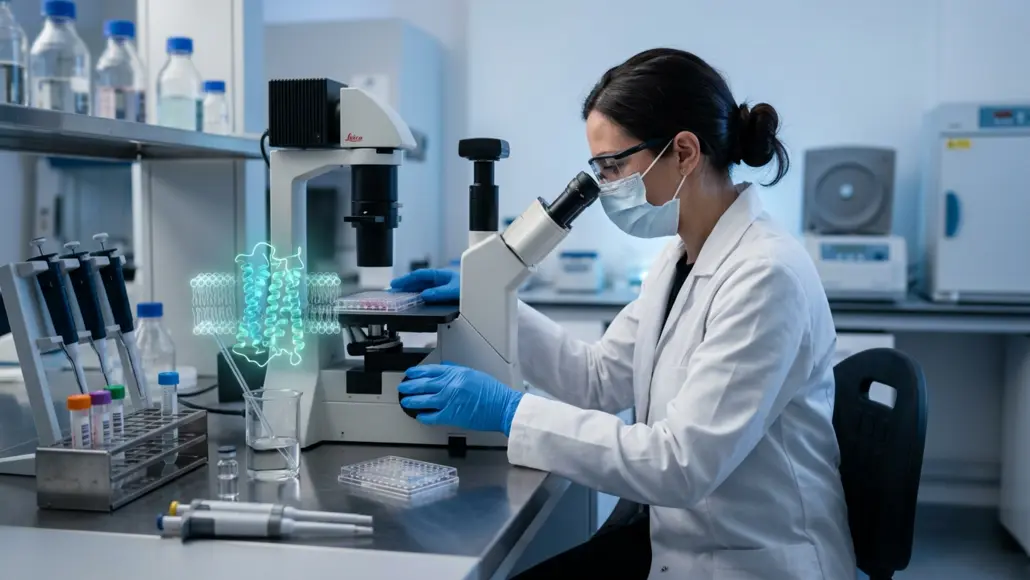
However, the entire field is currently being transformed by the application of revolutionary new techniques in protein structure analysis. Cryo-electron microscopy (cryo-EM) has emerged as a particularly powerful and game-changing tool, allowing scientists to visualize membrane proteins in near-atomic detail in their native-like states without the need for difficult-to-grow crystals. Additionally, the innovative development of highly stable synthetic detergents and advanced lipid environments, such as nanodiscs and polymers, has enabled the isolation and purification of these proteins while preserving their functional activity.
These technical advancements are absolutely critical for membrane proteins unlocking drug discovery potential, as they allow researchers for the first time to see exactly how a potential drug molecule binds to its target receptor at the molecular level. This “visual” data facilitates the rational design of more potent, more specific, and ultimately safer inhibitors or activators, reducing the reliance on the slow and expensive process of trial-and-error screening.
Advancing Target Validation and Biologics Targets
In the modern drug development pipeline, the identification of a new protein sequence is only the very first step in a long and arduous journey; the real, high-value work lies in the process of target validation. This involves proving beyond a doubt that modulating the activity of a specific protein will actually result in a meaningful and safe therapeutic benefit for the patient. This is particularly challenging for membrane proteins, where the signaling pathways are often incredibly complex and interconnected, meaning that hitting the wrong part of the receptor can lead to unintended and potentially dangerous side effects.
Membrane proteins unlocking drug discovery potential therefore requires a sophisticated, multi-faceted approach to validation that combines deep genetic studies with advanced biochemical and cell-based functional assays. Furthermore, the global pharmaceutical industry is increasingly looking toward biologics targets, such as monoclonal antibodies and nanobodies that can bind to the extracellular domains of membrane proteins with extraordinary specificity. These large-molecule drugs offer several significant advantages over traditional small molecules, including much longer half-lives in the body and a reduced risk of off-target toxicity. This makes them an exceptionally attractive option for targeting complex receptors and ion channels that have proven difficult or impossible to modulate with conventional medicinal chemistry.
The Role of Protein Engineering in Therapeutic Innovation
As our fundamental understanding of protein sequences, folding patterns, and molecular structures continues to grow, the focus of the industry is shifting from simply finding natural targets to actively and intelligently designing them. Protein engineering is playing an increasingly vital and creative role in this evolution, allowing researchers to modify membrane proteins at the genetic level to enhance their stability for study, change their signaling properties for specific effects, or even create entirely new, non-natural biological functions.
For example, specialized “designer” receptors can now be engineered to respond only to specific synthetic drugs, providing a powerful and precise tool for studying brain function in research or for use as safety switches in advanced gene therapies. In the specific context of membrane proteins unlocking drug discovery potential, engineering techniques are also being used to create “surrogate” or “mimetic” proteins that are much easier to express and study in a laboratory setting but still accurately reflect the binding behavior and the conformational changes of the native human target. This powerful synergy between molecular biology, structural science, and pharmaceutical engineering is drastically accelerating the pace of discovery and opening up exciting new possibilities for treating a wide range of diseases that were previously considered “undruggable” by the scientific community.
Future Directions in Pharma Research and Target Discovery
The future of pharma research is becoming increasingly digital and data-driven, with advanced computational modeling and artificial intelligence (AI) now playing a central and indispensable role in the discovery of new membrane protein targets. Sophisticated AI algorithms can now analyze massive and complex datasets of genetic information, clinical outcomes, and protein structures to predict with high accuracy which specific proteins are most likely to be involved in the drivers of a particular disease. These digital predictions can then be rapidly tested and validated in the lab, significantly reducing the massive time and cost historically associated with early-stage drug research.
Furthermore, the integration of high-resolution structural data with large-scale genomic studies is helping researchers to identify previously hidden “druggable” pockets and allosteric binding sites on the surface of membrane proteins. These sites offer new ways to modulate protein function without competing with natural ligands, potentially leading to a new class of more nuanced and effective medicines. As we continue to refine these digital and physical tools, the potential for membrane proteins unlocking drug discovery potential will only continue to grow, leading to a new era of more personalized, effective, and targeted treatments that are tailored to the specific molecular drivers of an individual patient’s disease. We are moving from a world of broad-spectrum medicine to a world of molecular precision.
Conclusion and the Crux of Molecular Targeting
The long and difficult journey to unlock the molecular secrets of the cell membrane represents one of the most exciting, challenging, and high-reward frontiers in all of modern science. Membrane proteins unlocking drug discovery potential provides a clear, scientifically grounded path toward addressing some of the most complex, chronic, and devastating health issues of our time. By combining the revolutionary power of high-resolution protein structure analysis with the creativity of innovative protein engineering and the rigor of systematic target validation, we are moving steadily closer to a future where every human disease has a targeted, effective, and safe treatment.
The absolute crux of this global endeavor is the profound realization that these membrane proteins are not just static, passive markers on the surface of the cell; they are dynamic, sophisticated, and highly regulated molecular machines that control the very essence of biological life and communication. As we master the ability to communicate with, listen to, and ultimately modulate these incredible machines, we will continue to fundamentally transform the landscape of modern medicine and immeasurably improve the lives of millions of patients around the world. The cell membrane is no longer a barrier to discovery; it is the ultimate gateway to healing.