













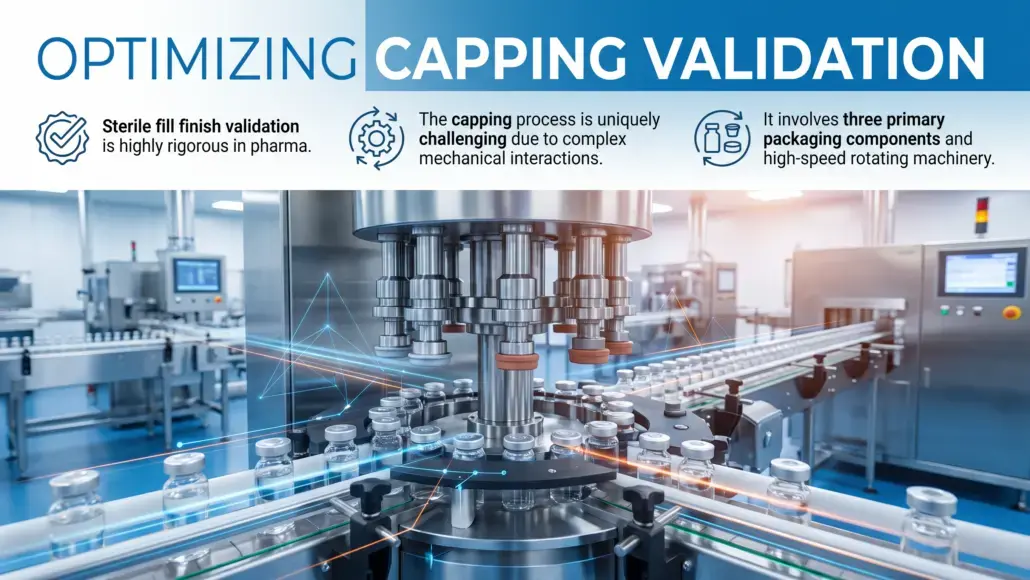
The validation of sterile fill finish operations is one of the most rigorous requirements in pharmaceutical manufacturing, necessitating a comprehensive demonstration that the equipment consistently produces a product meeting its predetermined specifications. Within this framework, the capping process is uniquely challenging because it involves the complex mechanical interaction of three distinct primary packaging components with high speed rotating machinery. Historically, validation was focused primarily on the machine settings themselves, such as head height or spindle speed. However, a more sophisticated approach has emerged that focuses on the container-equipment interface data to provide a much deeper level of process understanding. By capturing the actual physical interactions at the point of contact, manufacturers can build a more comprehensive validation package that is grounded in empirical science rather than just machine setpoints. This data allows for the visualization of the invisible stresses and strains that occur at the millisecond level during the formation of the seal.
Mechanical Interactions at the Point of Seal
To establish a truly validated state, it is necessary to understand exactly what happens at the interface between the vial, the stopper, and the capping head. This interface is where the critical quality attribute of container closure integrity is established. Container-equipment interface data provides insights into the distribution of forces and the deformation of the elastomeric material during the window when the seal is formed. By measuring the displacement of the stopper and the resistance offered by the aluminum cap, engineers can map the energy transfer from the machine to the package. This is essential for ensuring that the mechanical energy is sufficient to create a seal but not so high as to cause damage to the glass or the closure itself. The measurement of these forces must account for the elastic recovery of the rubber and the plastic deformation of the aluminum shell to be accurate.
In addition to vertical forces, analyzing these interactions allows for the identification of subtle variations in component geometry that can impact the seal quality. For example, if a batch of vials has a slightly different finish diameter or neck radius, the container-equipment interface data will reflect a change in the way the stopper seats during compression. By capturing this data during the Installation Qualification (IQ) and Operational Qualification (OQ) phases, manufacturers can establish a clear baseline of performance that accounts for the real world variability of the components. This moves validation beyond a simple “pass fail” check and toward a comprehensive characterization of the process design space. The data provides a quantitative link between the mechanical settings of the machine and the physical integrity of the finished vial, ensuring a higher level of confidence in the final product.
Data Driven Validation for Complex Container Systems
As the pharmaceutical industry moves toward more complex delivery systems, such as large volume cartridges or specialized dual chamber vials, the requirements for capping validation become even more stringent. These systems often feature unique geometries and material combinations that do not behave like standard vials under mechanical load. In these cases, relying solely on machine settings is insufficient for ensuring quality. Container-equipment interface data allows for the development of customized validation protocols that are tailored to the specific mechanics of the container. By mapping the force and displacement profiles of these complex systems, engineers can ensure that the capping process is optimized for the unique requirements of the device. This approach is particularly valuable for biologics that may be sensitive to the small pressure changes that occur during the sealing of specialized containers.
This data driven approach is also instrumental when introducing new packaging materials, such as cyclic olefin polymers (COP) or advanced elastomer formulations with low extractable profiles. These materials have different physical properties than traditional borosilicate glass and halobutyl rubber, and their behavior under compression must be carefully validated to ensure sterility. The use of container-equipment interface data provides a common language for comparing the performance of different material combinations, allowing for a more streamlined selection process and a faster time to market for new drug products. By quantifying the mechanical performance at the interface, manufacturers can provide a higher level of assurance that the package will remain sterile throughout its intended shelf life. The insights gained from this data can also be used to optimize the design of the packaging components themselves, ensuring that they are perfectly suited to the mechanical requirements of the production line.
Optimizing Stopper Compression via Interface Analysis
The degree of stopper compression is perhaps the single most important factor in establishing a reliable pharmaceutical seal. If the compression is too low, the risk of microbial ingress increases: if it is too high, the stopper may undergo permanent deformation or lose its ability to reseal after needle penetration during clinical administration. Container-equipment interface data provides the precision needed to optimize this parameter with extraordinary accuracy. By monitoring the force required to achieve a specific displacement of the stopper, manufacturers can identify the optimal point for seal integrity. This analysis also helps in identifying the “break in” force required to initiate the compression, which is a key indicator of the friction between the stopper and the glass vial.
Interface analysis also reveals the impact of different stopper coatings, such as fluorocarbon films or silicone oil treatments, on the capping process. These coatings can significantly alter the friction between the stopper and the glass vial, affecting how the rubber flows and seats during compression. By analyzing the container-equipment interface data, engineers can adjust the machine settings to account for these changes in friction, ensuring a consistent and repeatable seal quality across different production runs. This level of detail is particularly important for high speed production lines where even a minor change in the friction profile can lead to a significant increase in the number of unseated stoppers or deformed caps. The ability to optimize compression through data driven analysis is a hallmark of a modern, science based validation strategy, ensuring that the packaging process is both efficient and reliable.
Streamlining Regulatory Submission for New Product Launches
When filing a New Drug Application (NDA) or a Biologics License Application (BLA), pharmaceutical companies must provide extensive evidence that their manufacturing processes are stable and well controlled. The inclusion of container-equipment interface data in the CMC (Chemistry, Manufacturing, and Controls) section of the submission can significantly strengthen the case for process consistency. Regulatory reviewers are increasingly looking for a science based understanding of the manufacturing process, and interface data provides exactly the kind of objective, quantitative evidence they require. It demonstrates that the manufacturer has a deep understanding of the mechanical forces at play and has designed a process that is capable of consistently producing a safe and effective product. The use of this data can also help in addressing specific reviewer questions about seal integrity and the impact of component variability on product safety.
In addition to supporting the initial submission, the use of this data can help to justify wider process control limits, providing the manufacturer with more operational flexibility during commercial production. If a company can prove that their seal integrity is maintained even when the machine settings vary within a certain range, they can avoid the need for frequent revalidation studies when minor adjustments are made to the equipment. This leads to a more efficient and cost effective manufacturing operation, while still maintaining the highest standards of quality. In an increasingly competitive global market, the ability to streamline the regulatory process and get new products to patients faster is a major strategic advantage. The data generated through interface analysis becomes a permanent part of the product’s quality record, providing a foundation for all future lifecycle management activities.
Enhancing Lifecycle Management and Continuous Verification
Validation is not a one time event but a continuous process that spans the entire lifecycle of the drug product. The latest regulatory guidelines, such as the FDA’s guidance on Process Validation, emphasize the importance of Stage 3: Continued Process Verification. Container-equipment interface data is the ideal tool for this phase of the lifecycle. By continuously monitoring the interface interactions during routine commercial manufacturing, companies can ensure that their process remains in a state of control over months and years of production. Any shift in the interface data can serve as an early warning sign of equipment wear or changes in component quality, allowing for proactive intervention before a quality deviation occurs. The integration of this data with the facility’s quality management system allows for the automatic detection of trends that might indicate a move away from the validated state.
This continuous stream of data also provides a valuable resource for troubleshooting quality issues or investigating product complaints that may arise after the product has reached the market. If a seal failure is reported in the field, the manufacturer can go back to the container-equipment interface data for that specific batch to see if there were any unusual mechanical interactions during the capping process. This level of traceability is invaluable for protecting the reputation of the company and ensuring the continued safety of the patient. The data can also be used to evaluate the impact of process changes, such as the installation of a new capping head or a change in the sterilization method for the packaging components. Ultimately, the integration of interface data into the validation and lifecycle management process represents a significant step forward for the pharmaceutical industry, providing the tools needed to master the complexity of modern sterile packaging. By embracing these data driven methods, manufacturers can achieve a level of operational excellence that ensures a reliable supply of high quality medicines for years to come. Each batch produced adds to the collective knowledge of the process, leading to a more stable and predictable manufacturing environment.