













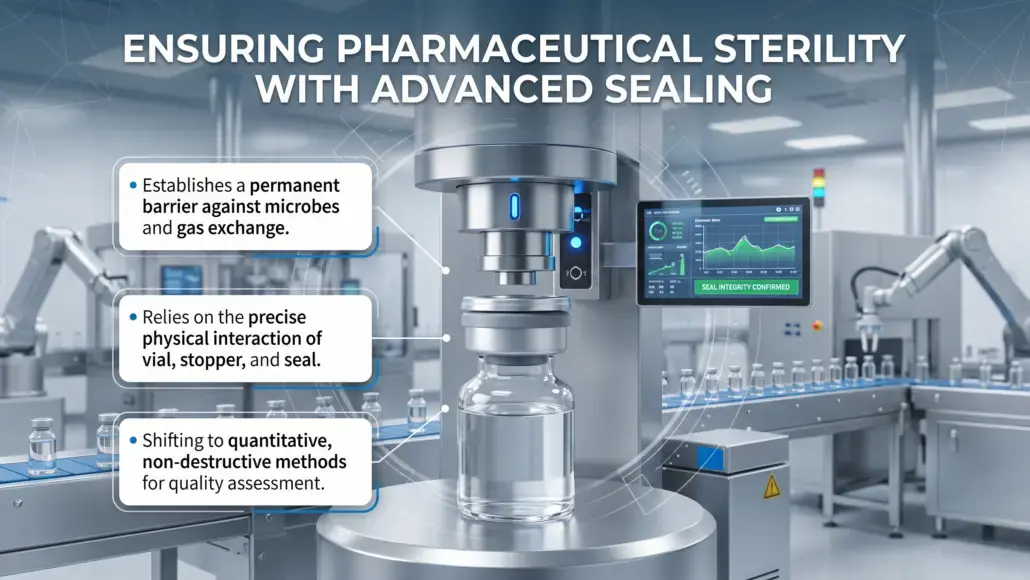
The maintenance of sterility in pharmaceutical products depends fundamentally on the physical relationship between the vial, the elastomeric stopper, and the aluminum seal. Within the sterile fill finish environment, the objective is to establish a permanent barrier against microbial ingress and gas exchange. While traditional methods of assessing seal quality often relied on visual inspection or destructive leak testing, the industry has shifted toward more quantitative, non-destructive methodologies. Residual seal force monitoring has emerged as a critical analytical tool for ensuring that the initial compression applied during the capping process translates into a reliable, long term seal. This measurement quantifies the stress remaining in the compressed stopper after the capping operation is complete, providing a direct indicator of the potential for leakage or contamination throughout the shelf life of the medicine. The physics of this interaction is governed by the compression of the rubber flange against the glass rim, creating a localized pressure that must exceed the internal pressure of the container and any external atmospheric fluctuations to remain effective.
Technical Mechanics of Elastomeric Stress Relaxation
To understand why quantitative measurement is necessary, one must examine the viscoelastic properties of the materials used in primary packaging. Pharmaceutical stoppers are typically composed of halobutyl rubber, a material selected for its chemical inertness and gas barrier properties. However, rubber is not a perfectly elastic material: it exhibits stress relaxation over time. When a capping machine applies a vertical force to the aluminum shell, it compresses the flange of the stopper against the rim of the glass vial. The resulting pressure creates the seal. Immediately after the capping head retracts, the elastomeric material begins to relax, and the internal stress within the rubber decreases. This phenomenon is critical because the integrity of the container closure system is maintained not by the initial force of the machine, but by the permanent residual tension that holds the stopper in contact with the glass surface. The rate of this relaxation is influenced by the molecular structure of the polymer, the concentration of fillers in the rubber compound, and the ambient temperature of the storage environment.
Residual seal force monitoring allows manufacturers to characterize this relaxation curve with extreme precision. By measuring the force that the compressed stopper continues to exert upward against the aluminum cap, quality control teams can predict how the seal will perform over months or years of storage. If the initial compression is too low, the stress relaxation may eventually lead to a force that is insufficient to prevent microbial bypass. Conversely, excessive force can lead to stopper coring or even glass breakage during the capping process. Data acquired through these monitoring systems provides a window into the physical state of every unit in a batch, ensuring that the mechanical parameters of the production line are aligned with the material properties of the components. This technical insight is particularly important when dealing with high speed lines where mechanical variability is naturally higher due to the rapid movement of the capping heads and the vibrations of the filling machinery.
Quantitative Assessment of Seal Quality and Stability
The transition from qualitative to quantitative assessment represents a significant advancement in pharmaceutical manufacturing science. In the past, the “tightness” of a cap was often judged by the manual torque required to rotate the aluminum shell or by visual checks for skirt deformation. These methods are inherently subjective and fail to account for the internal dynamics of the seal. Residual seal force monitoring replaces these approximations with a defined value in Newtons or pounds force. This data enables a much higher degree of process control, allowing for the establishment of upper and lower control limits that are backed by empirical evidence. When a manufacturer can demonstrate that every vial in a lot maintains a residual seal force within a specified range, the risk of container closure failure is drastically reduced. The ability to generate a distribution curve for a full batch provides a statistical confidence level that is far superior to spot checking or manual inspection protocols.
In addition to initial quality checks, this monitoring methodology is instrumental during the stability testing phase of drug development. As vials are subjected to different temperature cycles, the elastomeric components may undergo additional physical changes. Cold chain storage, for instance, can affect the modulus of the rubber, potentially altering the seal integrity. By using residual seal force monitoring at various time points during a stability study, researchers can confirm that the container closure system remains effective even under adverse environmental conditions. This level of detail is particularly important for high value biologics and oxygen sensitive formulations where even a minute breach in the seal could lead to product degradation or loss of potency. The monitoring systems can detect even the slightest decay in seal force, allowing for the adjustment of packaging specifications long before the product reaches the commercial market.
Correlation Between Force and Microbial Ingress
The primary regulatory requirement for any parenteral packaging system is the prevention of microbial contamination. While residual seal force is a mechanical measurement, its value is directly correlated with the biological performance of the vial. Extensive studies have shown that there is a threshold of residual force below which the probability of microbial ingress increases significantly. By establishing this correlation, pharmaceutical companies can use residual seal force monitoring as a validated surrogate for sterility testing. This is a major benefit in a production environment, as mechanical monitoring is faster, cleaner, and more easily integrated into an automated workflow than traditional vacuum decay or dye ingress tests. The correlation is not linear: rather, it typically follows a sigmoidal pattern where the risk of failure drops sharply once a minimum force threshold is surpassed.
The interface between the glass finish and the stopper surface is where the actual barrier exists. If the residual force is high enough, the rubber conforms to the microscopic irregularities of the glass, creating a continuous seal. If the force drops too low, micro channels can form, providing a pathway for bacteria or viruses. High speed cameras and pressure sensors used in conjunction with monitoring equipment allow for a holistic view of the capping station performance. By analyzing the data, engineers can identify if a particular capping head is consistently producing seals with lower force values, indicating a need for calibration or maintenance before a quality excursion occurs. This proactive approach to sterility assurance is a cornerstone of modern Quality by Design principles. It shifts the focus from detecting failures to preventing them through a rigorous understanding of the mechanical requirements for biological safety.
Strategic Integration in High Speed Fill Finish Lines
Integrating analytical tools into high speed production lines requires a balance between data granularity and throughput. Modern residual seal force monitoring systems are designed to operate at speeds compatible with the most advanced filling suites, often processing hundreds of vials per minute. These systems utilize sophisticated sensors to measure the deflection of the aluminum cap or the resistance of the stopper assembly in real time. The resulting data is then fed into centralized control systems that can automatically reject units that fall outside of the validated specifications. This automation removes the human element from seal inspection, providing a consistent and repeatable standard for every batch produced. The high frequency of data collection allows for the detection of cyclical variations, such as those caused by an eccentric rotating component or a misaligned vial transport belt.
The implementation of such systems also facilitates the move toward continuous manufacturing and real time release testing. When the integrity of the seal is confirmed at the moment of creation through residual seal force monitoring, the need for extensive post production quarantine and testing is minimized. This not only improves the efficiency of the supply chain but also enhances patient safety by ensuring that only perfectly sealed containers reach the market. The ability to archive the force data for every single unit provides an invaluable resource during regulatory audits or in the event of a product complaint, allowing manufacturers to prove that the mechanical integrity of the packaging was verified at the time of manufacture. This level of data density supports a more transparent relationship with regulatory authorities, as it provides a clear record of process compliance for every second of the production run.
Lifecycle Stability and Regulatory Compliance Benchmarks
Regulatory bodies, including the FDA and EMA, have placed increasing emphasis on the validation of container closure integrity (CCI) throughout the product lifecycle. Revised guidelines, such as Annex 1 of the EU GMP, explicitly require manufacturers to employ scientifically sound methods for ensuring the sterility of parenteral products. Residual seal force monitoring aligns perfectly with these expectations by providing a science based approach to seal validation. It moves beyond the “snapshot” approach of end of line testing and provides a continuous stream of data that reflects the health of the packaging process. The data also assists in the qualification of secondary packaging, such as cartons or trays, by ensuring that the primary seal is not compromised during subsequent handling and transport operations.
Achieving compliance requires not just the hardware for measurement, but also the software infrastructure to manage and interpret the resulting data. Advanced analytics can identify trends in seal force over a production shift, highlighting issues such as tool wear or variations in component dimensions. For example, if a batch of aluminum caps has a slightly different temper or thickness, the residual seal force monitoring system will detect the resulting change in the compression profile. This allows for immediate adjustments to be made to the equipment, maintaining the process within the validated state. The use of these technologies demonstrates a commitment to operational excellence and a rigorous approach to protecting the end user from the risks of compromised packaging. By maintaining a high degree of precision in seal monitoring, pharmaceutical companies can ensure that their products remain safe and effective from the moment of manufacture until they are administered to the patient.
Impact of Component Variability on Long Term Performance
The physical dimensions of glass vials and elastomeric stoppers are subject to manufacturing tolerances that can influence the final seal quality. Even within the specified ranges, a combination of a vial with a slightly lower finish height and a stopper with a slightly thinner flange can result in a significant reduction in the initial seal force. Residual seal force monitoring is the only way to detect these cumulative effects in a non-destructive manner. By tracking the force values across different lots of components, manufacturers can identify which combinations are most likely to lead to potential integrity issues. This information is critical for managing the supply chain and ensuring that the assembly process is resilient to the natural variability of the raw materials.
The long term performance of the seal is also influenced by the chemical environment inside the vial. Some formulations can interact with the elastomeric material, causing it to swell or harden over time. These changes can alter the residual force and impact the integrity of the closure. By integrating residual seal force monitoring into long term stability programs, pharmaceutical scientists can gain a better understanding of these interactions. This knowledge allows for the selection of more compatible packaging materials and the optimization of the capping process to ensure that the seal remains secure throughout the shelf life of the product. The ability to monitor these subtle physical changes over time provides a level of quality assurance that is essential for the modern pharmaceutical industry, where the complexity of drug formulations and delivery systems continues to grow. Each data point collected serves as a building block for a more comprehensive understanding of the total package performance, leading to safer and more reliable medicines for patients worldwide.