













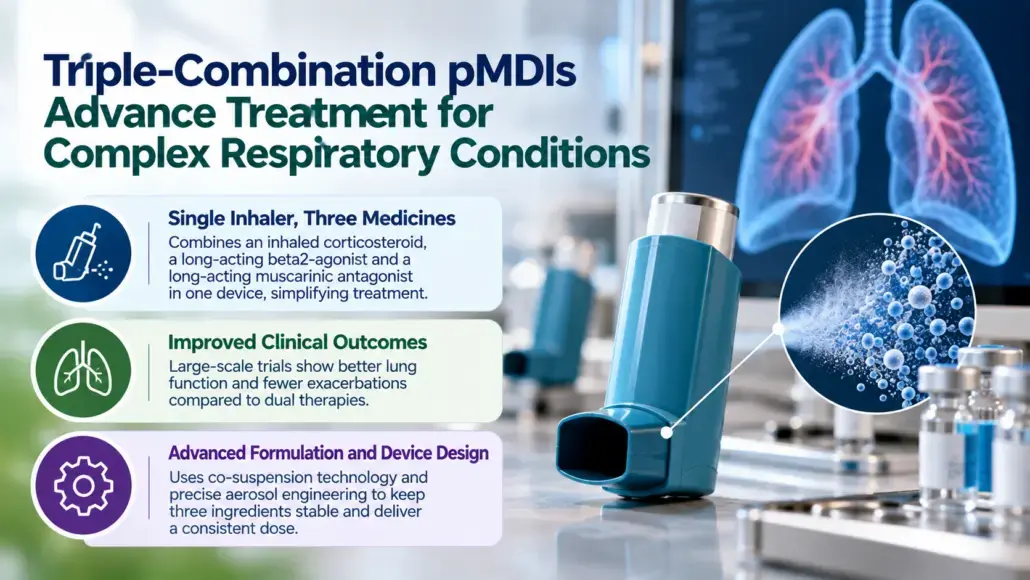
The management of complex respiratory conditions, such as chronic obstructive pulmonary disease and severe asthma, has undergone a significant transformation with the introduction of triple-combination therapies. By combining an inhaled corticosteroid, a long-acting beta2-agonist, and a long-acting muscarinic antagonist into a single device, pharmaceutical manufacturers have simplified the treatment regimen for millions of patients. This consolidation not only improves patient adherence by reducing the number of inhalers required each day but also ensures that all three active ingredients are delivered simultaneously to the target tissues. The technical challenge of stabilizing three distinct chemical entities within a single pressurized canister represents a major milestone in the field of inhalation drug delivery.
Achieving chemical and physical stability in a triple-combination product requires sophisticated formulation strategies. Each of the three active pharmaceutical ingredients may have different solubility profiles and sensitivities to environmental factors. Scientists must carefully select the appropriate propellants and co-solvents to ensure that the ingredients remain in a uniform suspension or solution throughout the shelf life of the product. The use of co-suspension technology has emerged as a particularly effective method for managing these complex formulations. By using low-density phospholipid microparticles to carry the drug crystals, manufacturers can create a stable suspension that resists settling and ensures a consistent dose with every actuation.
The clinical benefits of triple therapy are well-documented in large-scale trials, which show significant improvements in lung function and a reduction in the rate of exacerbations compared to dual therapies. These outcomes are driven by the synergistic effect of the three classes of medication, each targeting a different aspect of the disease pathology. While dual combinations are effective for many patients, those with more advanced disease often require the additional bronchodilation provided by the muscarinic antagonist. The ability to deliver this comprehensive treatment through a single, easy-to-use device has changed the way clinicians approach the management of severe respiratory illness.
Engineering Precision in Triple-Combination Aerosols
Delivering three drugs in a single puff requires an extraordinary level of control over the aerosolization process. The device must be capable of generating a plume that contains a precise ratio of the three active ingredients, with a particle size distribution that optimizes deposition in both the large and small airways. This requires meticulous engineering of the valve and actuator components, as well as a deep understanding of the fluid dynamics within the canister. Any variation in the spray pattern or the droplet size could lead to an imbalance in the delivered dose, potentially compromising the efficacy of the treatment.
Particle engineering plays a vital role in ensuring that the drugs reach the deep lung where they are most needed. The size of the aerosol particles must be small enough to avoid being trapped in the upper respiratory tract but large enough to settle in the alveoli. For triple-combination products, the challenge is to maintain this optimal size range for all three components, even if they have different physical properties. Advanced manufacturing techniques, such as spray drying and micronization, are used to create drug particles with the precise dimensions and surface characteristics required for efficient delivery. These engineered particles are then carefully blended with the propellant and other excipients to create the final formulation.
Validation of aerosol performance is conducted using sophisticated laboratory equipment that measures the mass distribution of the drug across different particle size ranges. These tests are essential for ensuring that each batch of the product meets the stringent quality standards required for regulatory approval. Manufacturers also perform extensive stability testing to assess how the aerosol performance changes over time and under different storage conditions. By maintaining a high level of precision in both the formulation and the device engineering, the pharmaceutical sector can ensure that inhalation drug delivery remains a reliable and effective method for managing complex respiratory conditions.
Overcoming Formulation and Manufacturing Challenges
One of the primary hurdles in the development of triple-combination pMDIs is the potential for chemical interactions between the different active ingredients. Some drugs may be incompatible when stored together in a concentrated form, leading to the formation of impurities or the degradation of the active components. To mitigate these risks, pharmaceutical scientists perform exhaustive compatibility studies during the early stages of development. In some cases, specialized coatings or stabilizers may be added to the formulation to protect the drug particles and prevent unwanted reactions. The goal is to create a product that remains potent and safe for the duration of its shelf life.
Manufacturing triple-combination products also requires specialized equipment and processes. The filling of the canisters must be conducted in a highly controlled environment to prevent cross-contamination and ensure the accuracy of the fill weight. Because the doses of the three drugs are often very small, even minor variations in the filling process can have a significant impact on the final product quality. Advanced automation and real-time monitoring systems are used to verify the consistency of each canister, allowing for immediate adjustments to the production line. This level of precision is essential for producing high-quality combination products at a commercial scale.
The transition from dual to triple combinations also has implications for the device hardware. The valve must be capable of delivering a larger volume of formulation without clogging or leaking, and the actuator must be designed to accommodate the specific spray characteristics of the triple therapy. Incorporating Integrated Dose Counters ensures that patients can easily monitor their remaining medication, which is particularly important for those on complex multi-drug regimens. By addressing these technical and manufacturing challenges through a unified development framework, pharmaceutical companies can bring these innovative therapies to market more efficiently and safely.
Regulatory Pathways for Combination Products
Regulatory authorities, such as the Food and Drug Administration and the European Medicines Agency, view triple-combination pMDIs as complex combination products. This means that the marketing application must include comprehensive data on the safety and efficacy of each individual component, as well as the combination as a whole. While the use of established drugs can streamline the process, the burden of proof regarding the synergy and the safety of the triple therapy remains high. Manufacturers must conduct extensive clinical trials to demonstrate that the combination provides a significant benefit over existing treatments and that the risks are appropriately managed.
The regulatory environment also places a strong emphasis on the quality and consistency of the manufacturing process. Manufacturers must demonstrate that they have a robust quality management system in place and that they can consistently produce the product according to the approved specifications. This involves regular inspections of the manufacturing facilities and the review of detailed production records. Any deviations from the approved process must be thoroughly investigated and corrected to ensure that no substandard units reach the market. By maintaining a high standard of compliance, pharmaceutical companies can build trust with regulators and ensure the long-term success of their products.
Furthermore, the evolving focus on environmental sustainability is influencing the regulatory landscape for all aerosol delivery platforms. The transition to low-global-warming-potential propellants is a significant challenge for the industry, as it requires the reformulating of existing products and the development of new device hardware. Manufacturers must demonstrate that the new propellants do not affect the safety or efficacy of the triple therapy. This ongoing need for innovation and adaptation highlights the dynamic nature of the pharmaceutical sector and the importance of staying ahead of regulatory trends.
The Future of Triple Therapy and Patient Care
The success of triple-combination pMDIs has paved the way for further innovations in the field of respiratory medicine. Researchers are exploring the potential for adding fourth or even fifth components to the combination, potentially targeting even more aspects of the disease pathology. There is also a growing interest in the use of biologics and other advanced therapies in aerosol delivery platforms. These large molecules present new challenges for formulation and delivery, but they also offer the potential for more targeted and personalized treatments. As our understanding of respiratory diseases continues to grow, so too will the sophistication of the delivery systems we use to treat them.
Digital health technology is also expected to play an increasingly important role in the management of complex respiratory conditions. Smart inhalers that track usage and provide feedback on technique can help patients to get the most benefit from their triple therapy. These devices can also provide valuable data to clinicians, enabling more personalized and proactive care. By integrating these digital tools with the latest pharmacological innovations, the industry can create a more holistic and effective approach to respiratory health. The ultimate goal is to provide every patient with a treatment plan that is tailored to their specific needs and that helps them to live a full and active life.
The commitment to improving inhalation drug delivery is driven by a desire to address the significant global burden of respiratory disease. As the population ages and environmental factors continue to impact lung health, the need for effective and easy-to-use treatments will only grow. The pharmaceutical sector will continue to invest in the research and development of new technologies that push the boundaries of what is possible in respiratory care. By combining the latest scientific insights with a deep understanding of patient needs, the industry can ensure that the next generation of inhalation therapies is even more effective and accessible than the last.