













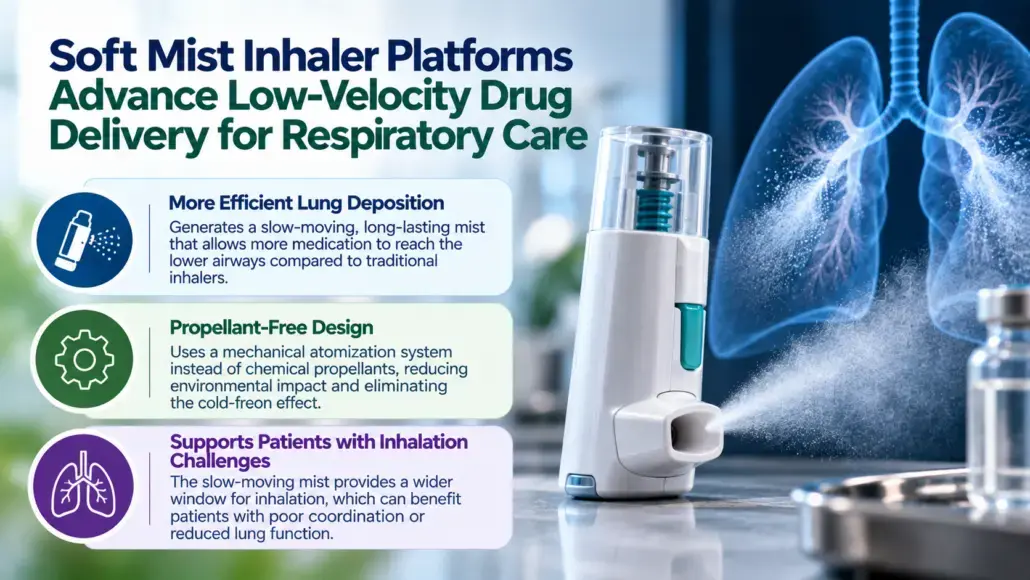
The transition from traditional pressurized metered-dose inhalers to soft mist platforms marks a significant advancement in the treatment of chronic respiratory conditions. Traditional inhalers often deliver medication at a high velocity, which can result in a significant portion of the dose impacting the back of the throat rather than reaching the lower airways. In contrast, soft mist inhaler platforms are engineered to generate a slow-moving, long-lasting mist that allows for more efficient pulmonary deposition. This improvement in low-velocity drug delivery is achieved through the mechanical atomization of the liquid formulation, producing a fine aerosol that remains suspended in the air for a longer duration, giving the patient more time to inhale.
The mechanics of soft mist generation rely on a sophisticated uniphase or multiphase nozzle system. Instead of using chemical propellants, these devices utilize a spring-powered mechanism to force the liquid through two micro-structured channels. The resulting streams collide at a precise angle, breaking the liquid into millions of tiny droplets. This propellant-free approach not only reduces the environmental impact of the treatment but also avoids the cold-freon effect that can cause patients to stop breathing momentarily during actuation. By creating a mist that moves at a fraction of the speed of traditional aerosols, manufacturers can ensure that a higher percentage of the medication reaches the peripheral regions of the lung.
The clinical benefits of this technology are particularly evident in patients with poor inhalation coordination or reduced lung function. For individuals who struggle to synchronize their breath with the actuation of a device, the slow-moving mist provides a wider window of opportunity for successful delivery. Studies have consistently shown that soft mist platforms achieve higher lung deposition rates compared to both metered-dose and dry powder systems. This increased efficiency can lead to a reduction in the required dose, potentially lowering the risk of systemic side effects while maintaining therapeutic efficacy. The optimization of low-velocity drug delivery is therefore a key focus for pharmaceutical companies seeking to improve the real-world performance of their respiratory products.
Engineering Challenges in Propellant-Free Atomization
Developing a soft mist inhaler that provides consistent performance over hundreds of doses is a formidable engineering challenge. The micro-structured nozzle must be manufactured with extreme precision to ensure that the droplets are of the correct size and that the spray pattern remains stable. Any slight deviation in the nozzle geometry could lead to an increase in droplet size or a change in the mist velocity, compromising the effectiveness of the treatment. To maintain this level of quality, manufacturers use advanced lithography and etching techniques similar to those used in the semiconductor industry. These processes allow for the creation of intricate internal structures that are essential for the uniphase atomization process.
The formulation itself must also be carefully optimized for use in a soft mist system. Factors such as viscosity, surface tension, and the presence of excipients can all influence the atomization process and the resulting aerosol characteristics. Pharmaceutical scientists perform extensive rheological studies to ensure that the drug solution or suspension remains stable and can be efficiently aerosolized by the device. The absence of propellants simplifies some aspects of the formulation, but it also means that the device must provide all the energy required for atomization. This requires a robust and reliable mechanical design that can withstand the high pressures generated during the actuation cycle.
Validation of the device performance involves a combination of laboratory testing and computer simulations. Computational fluid dynamics can model how the soft mist travels through the device and the human respiratory tract, providing insights into the deposition patterns and the impact of different inhalation maneuvers. These models are supported by empirical data from laser diffraction and cascade impaction tests, which measure the droplet size distribution and the mass of the drug delivered to different regions of the lung. By establishing a high bar for technical excellence, the pharmaceutical sector ensures that every soft mist inhaler provides a dependable and effective platform for low-velocity drug delivery.
Regulatory Standards and Environmental Sustainability
The regulatory environment for soft mist inhalers is complex, as these devices are classified as combination products that require simultaneous evaluation of the drug and the delivery system. Manufacturers must provide comprehensive data on the safety, efficacy, and consistency of the device, as well as the results of clinical trials that demonstrate the benefit to patients. The Food and Drug Administration and other global regulatory bodies place a strong emphasis on the reliability of the mechanical components and the accuracy of the dose delivery. Any changes to the device design or the manufacturing process must be supported by detailed validation studies to ensure that the product remains compliant with the approved specifications.
One of the most significant trends in the respiratory field is the growing focus on environmental sustainability. The traditional use of hydrofluoroalkane propellants in metered-dose inhalers contributes to greenhouse gas emissions, prompting a search for more eco-friendly alternatives. Soft mist platforms, being propellant-free, offer a highly sustainable alternative for the delivery of respiratory medications. By reducing the carbon footprint of pulmonary treatments, these devices align with the broader goals of the pharmaceutical industry to minimize its environmental impact. This sustainability advantage is an increasingly important factor for healthcare systems and patients when selecting treatment options.
Furthermore, the documentation required for regulatory submission must address the long-term stability and durability of the device. Manufacturers must demonstrate that the spring mechanism and the nozzle system remain functional throughout the shelf life of the product and that the aerosol performance does not degrade over time. This involves extensive stress testing under a variety of environmental conditions, including exposure to high humidity and temperature fluctuations. By maintaining a rigorous quality management system, pharmaceutical companies can ensure that their soft mist products meet the highest standards of safety and compliance in the global market.
Improving Patient Outcomes Through Intuitive Design
The success of any inhalation therapy is ultimately determined by the patient’s ability to use the device correctly. Soft mist inhalers are designed with a focus on ergonomics and ease of use, featuring intuitive actuation mechanisms and clear dose indicators. The slow-moving mist itself is a major factor in improving the user experience, as it reduces the discomfort and coordination challenges associated with high-velocity sprays. By making the delivery process more comfortable and reliable, manufacturers can increase the likelihood that patients will adhere to their treatment plans, leading to better long-term clinical outcomes.
Patient education and training are also vital components of a successful respiratory therapy program. While soft mist devices are designed to be intuitive, patients still need to understand the importance of proper inhalation technique to maximize the benefit of the medication. Many manufacturers provide educational materials and training devices to help patients and healthcare providers master the use of the inhaler. The goal is to ensure that every patient feels confident in their ability to manage their condition and that they receive the full therapeutic dose with every actuation. The role of low-velocity drug delivery in facilitating this education and improving adherence is a significant benefit of the technology.
Moreover, the clinical performance of these systems benefits from Triple-Combination pMDIs research which highlights the need for coordinating multiple active ingredients. While soft mist platforms are often used for monotherapies, there is growing interest in their potential for delivering combination treatments. The ability to aerosolize multiple drugs in a single slow-moving mist could offer a powerful new tool for managing complex respiratory diseases. By leveraging the insights gained from combination therapy research, manufacturers can continue to refine their soft mist platforms and expand their therapeutic applications.
Future Horizons for Soft Mist Technology
The future of soft mist delivery lies in the integration of smart technology and the development of new therapeutic applications. Researchers are exploring the use of soft mist platforms for the delivery of biologics and other large-molecule drugs, which may benefit from the gentle atomization process and high lung deposition rates. These advanced therapies require specialized formulations and devices that can protect the delicate molecules from degradation during the aerosolization process. There is also a growing interest in the use of electronic soft mist devices that can provide even greater control over the mist characteristics and the delivery timing.
Digital health integration is another area of active development, with smart inhalers that track usage and provide real-time feedback to patients and clinicians. These tools could help to identify patients who are struggling with their technique or who are not adhering to their treatment plans, enabling earlier interventions and more personalized care. As the field of digital medicine continues to grow, the combination of soft mist technology and smart sensors will become a powerful tool for improving respiratory health globally. The ultimate goal is to create a truly patient-centered delivery system that maximizes the benefit of every dose.
The ongoing commitment to innovation in this field is driven by a desire to address the unmet needs of patients with chronic respiratory conditions. As the global burden of lung disease continues to rise, the importance of efficient and user-friendly delivery systems will only grow. The pharmaceutical sector will continue to invest in the research and development of new technologies that push the boundaries of what is possible in pulmonary medicine. By combining the latest scientific insights with a deep understanding of patient needs, the industry can ensure that low-velocity drug delivery remains a cornerstone of effective respiratory care.