












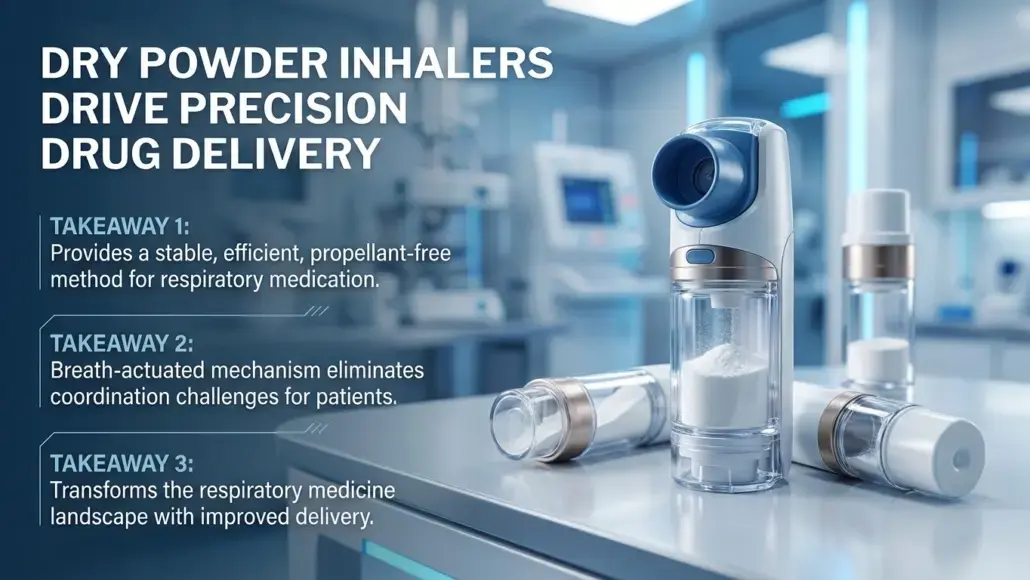
The development of dry powder systems has transformed the landscape of respiratory medicine by providing a stable and efficient method for delivering medications to the lungs. Unlike pressurized inhalers that rely on chemical propellants, the dry powder inhaler is a breath-actuated device that uses the patient’s own inhalation to disperse the medication. This mechanism eliminates the need for coordination between actuation and inhalation, which is a common challenge for many patients. The success of these devices depends on the precise engineering of the drug powder, which must be formulated to ensure that it can be easily aerosolized and deposited deep in the pulmonary tract.
Achieving high-precision delivery with a dry powder system requires a deep understanding of particle physics and surface chemistry. Most formulations consist of the active pharmaceutical ingredient blended with a larger carrier particle, typically lactose. The drug particles must adhere to the carrier during storage and handling but must be able to detach and form a fine aerosol during inhalation. The strength of the interaction between the drug and the carrier is a critical factor that is influenced by the particle size, shape, and surface roughness. Manufacturers spend significant resources optimizing these blends to ensure that the delivered dose remains consistent across a wide range of inhalation flow rates.
The transition toward carrier-free formulations represents the next frontier in powder engineering. By creating drug particles with specific physical properties, such as low density and high porosity, scientists can develop formulations that do not require a carrier. These engineered particles are often produced using spray-drying techniques, which allow for precise control over the particle size distribution and surface characteristics. Carrier-free systems offer the potential for delivering higher doses of medication, which is particularly important for antibiotics and other therapies that require large amounts of the active ingredient. The role of the dry powder inhaler in supporting these advanced treatments is a key focus for pharmaceutical research and development.
Engineering Reliability and Dose Consistency in DPI Hardware
The design of the hardware is just as important as the formulation in ensuring the success of a dry powder system. The device must be capable of generating a turbulent airflow that is sufficient to de-aggregate the powder and create a fine aerosol. This requires a sophisticated internal geometry that optimizes the fluid dynamics of the inhalation. Engineers use computational fluid dynamics to model how the air travels through the device and how the powder particles are dispersed. These simulations allow for the refinement of the design to ensure that the device provides consistent performance even at lower inhalation flow rates, which is essential for patients with compromised lung function.
Maintaining dose consistency throughout the life of the inhaler is a major technical challenge. The device must be capable of delivering a precisely measured amount of powder with every actuation, regardless of environmental factors like humidity. Moisture is a significant enemy of dry powder systems, as it can cause the powder to clump and prevent effective aerosolization. To mitigate this risk, manufacturers incorporate advanced moisture protection features, such as desiccants and foil-sealed blisters, into the device design. The dry powder inhaler must also be robust enough to withstand accidental drops and other physical stresses without compromising the integrity of the dosing mechanism.
Validation of the hardware performance involves extensive laboratory testing using standardized equipment. Cascade impaction tests are used to measure the mass distribution of the drug across different particle size ranges, providing a definitive assessment of the aerosol quality. Manufacturers also perform stability testing to ensure that the device remains functional and the powder remains potent over its entire shelf life. By maintaining a high standard of engineering excellence, the pharmaceutical sector ensures that dry powder systems provide a reliable and effective platform for high-precision drug delivery. The commitment to technical precision is what allows these devices to meet the stringent requirements of global regulatory agencies.
Regulatory Standards and Compliance for Powder-Based Therapies
Regulatory authorities, including the Food and Drug Administration and the European Medicines Agency, have established rigorous standards for the characterization and validation of dry powder inhalers. Manufacturers must provide detailed data on the aerodynamic particle size distribution, the delivered dose uniformity, and the impact of inhalation flow rate on device performance. Compliance with these standards is a complex process that requires a multi-disciplinary approach, involving experts in powder science, mechanical engineering, and regulatory affairs. The technical file must demonstrate that the product is safe, effective, and consistently manufactured according to the approved specifications.
The regulatory environment also places a strong emphasis on the human factors associated with the use of these devices. Manufacturers must conduct usability studies with representative patient populations to identify and mitigate potential user errors. For example, if a patient is unable to generate a sufficient inhalation flow rate, how will that affect the delivered dose? Addressing these questions through a proactive design process is essential for securing market approval. By ensuring that their devices are both technically sound and easy to use, pharmaceutical companies can maintain a strong position in the competitive respiratory market. The documentation must also cover the manufacturing process, including the controls used to ensure the quality of the raw materials and the consistency of the final product.
Furthermore, the evolving focus on environmental sustainability is influencing the regulatory landscape for all inhalation systems. While dry powder inhalers are naturally propellant-free, the materials used in their construction must be evaluated for their environmental impact. There is a growing interest in developing recyclable or reusable components to reduce the carbon footprint of respiratory treatments. By balancing the need for technical innovation with the imperative of environmental responsibility, the industry can create a more sustainable future for pulmonary care. The role of the dry powder inhaler in this transition is a significant advantage of the technology, as it offers a highly effective and eco-friendly alternative to traditional pressurized systems.
Improving Patient Adherence Through User-Centric Design
The success of any chronic respiratory treatment is heavily dependent on patient adherence, and the design of the inhaler plays a vital role in this. Dry powder systems are often favored for their simplicity, as they do not require the coordination of actuation and inhalation. Many devices also feature intuitive dose indicators and audible cues that confirm when a dose has been successfully delivered. By making the delivery process as straightforward as possible, manufacturers can increase the likelihood that patients will take their medication as prescribed. The portability and durability of these devices also allow patients to manage their condition effectively in their daily lives.
Human factors engineering is a critical part of the design process, focusing on the ergonomics and usability of the inhaler. Engineers focus on making the device easy to load, prime, and clean, ensuring that patients of all ages and physical abilities can use it effectively. Features such as low-resistance airflows can also improve the experience for patients with severe respiratory illness who may struggle to generate a strong inhalation. By prioritizing the needs of the end-user, the pharmaceutical industry can create products that are not only clinically effective but also a positive part of the patient’s treatment regimen. The dry powder inhaler is therefore an essential tool for improving the quality of life for individuals with chronic lung disease.
Unlike Nasal Unit-Dose Devices which target the nasal mucosa, these pulmonary systems must navigate the complex architecture of the bronchial tree. The two routes of administration require fundamentally different formulation and device strategies to ensure successful delivery. By understanding these differences, pharmaceutical companies can select the most appropriate platform for each therapeutic application, maximizing the benefit for the patient. This strategic approach to device selection ensures that every drug is delivered with the highest possible precision to its intended target. The ongoing refinement of both nasal and pulmonary systems represents the cutting edge of modern drug delivery science.
Future Innovations in Dry Powder Technology
The future of dry powder delivery lies in the development of even more sophisticated formulations and devices. Researchers are exploring the use of these systems for the delivery of biologics, vaccines, and other advanced therapies that require stable and precise aerosolization. These molecules often present significant challenges for powder engineering, but they also offer the potential for more targeted and personalized treatments. There is also a growing interest in the use of electronic dry powder inhalers that can provide real-time feedback to patients on their inhalation technique and track their medication usage.
Digital integration is expected to play an increasingly important role in the management of respiratory conditions. Smart inhalers that sync data with mobile applications can help patients and clinicians to monitor disease progression and make more informed decisions about treatment. These tools can also help to identify patients who are at risk of an exacerbation, enabling earlier interventions and better clinical outcomes. As the field of digital health continues to evolve, the combination of powder-based delivery and smart sensors will become a powerful tool for improving respiratory health globally. The ultimate goal is to create a seamless and integrated treatment experience that empowers patients and improves their overall well-being.
The ongoing commitment to innovation in the dry powder field is driven by the significant global burden of respiratory disease. As the population ages and environmental factors continue to impact lung health, the need for effective and easy-to-use treatments will only grow. The pharmaceutical sector will continue to invest in the research and development of new technologies that push the boundaries of what is possible in pulmonary medicine. By combining the latest scientific insights with a deep understanding of patient needs, the industry can ensure that the dry powder inhaler remains a vital and growing component of the modern therapeutic toolkit.