














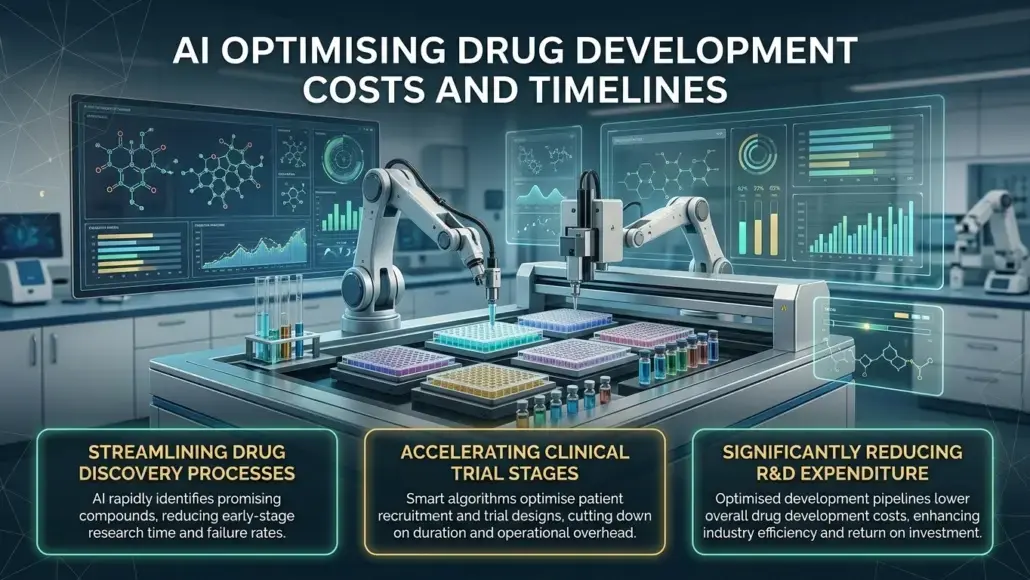
The pharmaceutical industry is currently facing a period of intense structural adjustment as the costs associated with bringing a new therapy to market continue to rise. For decades, the industry has operated under a model where the average cost of developing a successful drug was estimated at approximately $2.6 billion, a figure that includes the cost of the many failures that occur along the way. This high financial burden, coupled with the long duration of the development cycle, has created a significant challenge for maintaining the economic sustainability of new research. However, the introduction of advanced computational tools is fundamentally changing this environment. The implementation of AI Optimising Drug Development Costs and Timelines is providing organizations with the analytical depth required to improve the efficiency of their R&D spend and accelerate the journey from the laboratory to the patient.
Strategic R&D management now relies heavily on the ability to make informed decisions at an earlier stage in the development cycle. Traditional research methods were often characterized by a high degree of uncertainty, leading to expensive late-stage failures that significantly impacted the total return on investment. Artificial intelligence systems can now analyze massive datasets from past trials, chemical libraries, and genomic studies to identify the most promising candidates with greater accuracy. This capability is essential for pharmaceutical executives who must prioritize their resources in an environment of increasing competition and regulatory pressure. By reducing the reliance on a trial-and-error approach, the industry is shortening the time required to reach the market and improving the overall productivity of the research team.
Maximizing R&D Spend Through Predictive Analytics
The primary benefit of utilizing predictive analytics in the discovery phase is the ability to identify potential failure points before significant capital has been committed. Traditional methods of candidate selection were often based on incomplete data, leading to the pursuit of molecules that were destined to fail due to poor efficacy or unexpected toxicity. Modern analytical platforms can now simulate the behavior of a molecule in the human body with high fidelity, highlighting the risks and the opportunities associated with different chemical structures. This technical precision allows pharmaceutical firms to focus their R&D spend on the projects with the highest probability of success, thereby reducing the total cost of development.
Furthermore, the integration of these insights into the early stages of the project allows for a more comprehensive understanding of the competitive landscape. By analyzing the data from other trials and market trends, AI can help companies identify unmet needs and avoid redundant research. This strategic focus ensures that the resulting drug pipelines are not only scientifically sound but also economically viable. The ability to provide a clear and data-driven justification for every new investment is a fundamental requirement for earning the trust of the board and the investor community. In this way, AI is not just a technical tool; it is a vital component of modern financial management in the pharmaceutical sector.
Shortening Time-to-Market with AI-Powered Molecule Design
The design and the optimization of a new drug molecule is historically one of the most time-consuming aspects of the development process. Researchers often spent years synthesizing and testing thousands of variations to find the one with the best binding affinity and pharmacokinetic profile. Artificial intelligence, particularly through the use of generative models, is now enabling the de novo design of molecules that meet specific criteria from the start. These tools can explore a much larger chemical space than a human researcher ever could, identifying novel structures that offer superior performance and a clearer path to regulatory approval.
This acceleration of the design phase has a direct impact on the overall Drug Development Costs and Timelines. By reducing the duration of the lead optimization process, companies can move their candidates into the clinic much sooner, providing a significant competitive advantage. Furthermore, the use of AI to predict the manufacturability of a molecule ensures that there are no unexpected delays during the scale-up process. This foresight is especially valuable for companies that are attempting to reach the market as quickly as possible to capture the maximum value from their intellectual property. The commitment to technical excellence in molecular design is a key driver for the long-term success of the organization.
Enhancing ROI via Clinical Trial Optimization
One of the most significant contributors to the high cost of drug development is the complexity and the duration of clinical trials. Finding the right patients, ensuring high levels of compliance, and managing the vast amounts of data generated are immense logistical challenges. Artificial intelligence is now being used to optimize every aspect of the trial design, from patient recruitment to site selection. By analyzing electronic health records and genetic data, these systems can identify the individuals who are most likely to respond to a treatment, thereby reducing the size and the duration of the study. This targeted approach to clinical testing significantly improves the efficiency of the research and the overall return on investment.
Furthermore, the use of real-time monitoring and predictive analytics during the trial allows for the early identification of safety signals or a lack of efficacy. This allows researchers to make adjustments quickly or, if necessary, to terminate a failing trial before additional resources are wasted. This proactive approach to trial management is a hallmark of the modern pharmaceutical sector, ensuring that the research is conducted as efficiently and safely as possible. The reduction in the frequency and the duration of clinical trials is a vital component of the effort to improve the economic sustainability of the industry. The focus remains on achieving the best possible results at the lowest possible cost, ensuring that new therapies remain accessible to the patients who need them.
Strategic Shifts in Pharmaceutical Efficiency and Speed-to-Market
As the pharmaceutical industry continues to evolve, the role of data-intensive management will only grow in importance. The successful implementation of AI Optimising Drug Development Costs and Timelines requires a fundamental reorganization of the operations of the organization. This involves the integration of data scientists and economists into the heart of the research team, ensuring that every project is evaluated for its scientific merit and its economic viability. The focus is no longer just on the biology of the drug, but on the ability to manage the entire development cycle with professional precision.
Looking ahead, the coordination of global research efforts through shared data platforms will be essential for further improving the productivity of the sector. By breaking down the silos that have traditionally separated research institutions and pharmaceutical companies, the industry can leverage a much larger pool of data to identify new opportunities and avoid redundant work. The commitment to transparency and professional collaboration is a key factor in the long-term success of the effort to improve the efficiency of drug development. The goal is the creation of a global research ecosystem that can deliver on the promise of affordable and effective therapies for every patient, regardless of the complexity or the rarity of their condition.


