









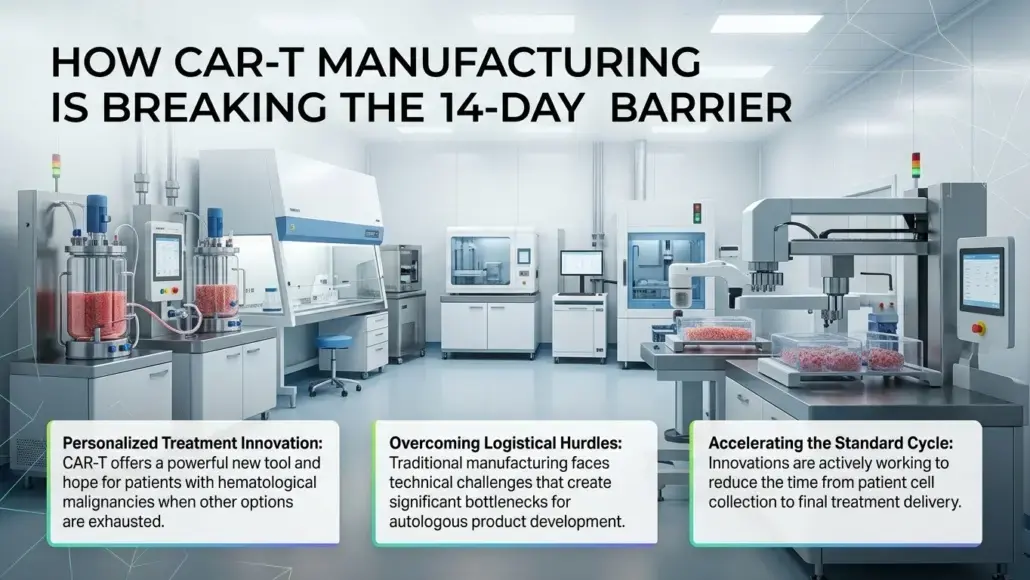
The development of Chimeric Antigen Receptor T-cell (CAR-T) therapy has provided a new and powerful tool for the treatment of hematological malignancies, offering hope to patients who have exhausted all other therapeutic options. However, the logistical and technical challenge of producing these personalized treatments remains a significant hurdle. For many years, the standard manufacturing cycle for an autologous CAR-T product—from the initial collection of the patient’s T-cells to the final infusion—typically lasted between three and four weeks. For a patient with rapidly progressing disease, this timeframe is often too long. The industry is therefore intensely focused on accelerating this process, and recent advancements demonstrate how CAR-T manufacturing is breaking the 14-day barrier to provide more timely and effective care.
The “vein-to-vein” time is the critical metric that defines the success of a CAR-T program. Reducing this interval requires a fundamental rethink of every step in the manufacturing journey, including the transport of the starting material, the genetic modification of the cells, and the final expansion and testing. Modern facilities are utilizing closed-system automation to minimize the manual steps that traditionally added days to the schedule. By integrating these disparate tasks into a single, unified workflow, manufacturers can move the product through the factory with a degree of speed and precision that was previously impossible. This move toward more efficient bioprocessing is the foundation of the effort to make CAR-T therapy more accessible to a wider range of patients.
Rapid Expansion and High-Density Bioprocessing
The most time-consuming stage of the manufacturing process is typically the expansion of the modified T-cells to a therapeutically relevant number. Traditionally, this required several days of culture in large bags or flasks, with frequent monitoring and nutrient adjustments. Newer techniques are focusing on high-density bioprocessing, where cells are grown in more concentrated environments with enhanced oxygenation and nutrient delivery. This allows for a much faster rate of proliferation, significantly shortening the time needed to reach the target dose. By optimizing the media and the environmental conditions within the bioreactor, engineers are demonstrating how CAR-T manufacturing can achieve in days what once took weeks.
Furthermore, some manufacturers are exploring the use of “younger” or more minimally expanded T-cells, which may have superior clinical efficacy and persistence once infused back into the patient. This shift in philosophy not only reduces the manufacturing time but also potentially improves the quality of the therapeutic product. The ability to produce a potent dose of cells with a shorter expansion phase is a significant technical achievement that reflects a deeper understanding of T-cell biology. This focus on the “quality over quantity” of the cell population is a key characteristic of the modern approach to oncology care and bioprocessing.
Decentralized Manufacturing and Point-of-Care Production
The traditional model for CAR-T production involves shipping the patient’s cells to a large, centralized manufacturing facility and then shipping the finished product back to the hospital. While this allows for high standards of quality control, the logistical challenges of transport can add several days to the total vein-to-vein time. To address this, some firms are developing decentralized manufacturing platforms that can be deployed directly within the hospital setting. By performing the T-cell modification and expansion at the point of care, clinicians can eliminate the delays associated with long-distance shipping and provide a much faster response to the patient’s needs.
Decentralized CAR-T manufacturing relies on the use of fully automated, “plug-and-play” systems that can handle the entire production cycle in a small footprint. These systems are designed to be operated by hospital staff with minimal specialized training, while maintaining the same high standards of quality and sterility found in a central factory. This move toward a more distributed model of production is a major trend in the cell therapy sector, as it provides a more scalable and responsive solution for large health systems. The ability to produce a personalized treatment in a matter of days at the site of care is a major milestone in the evolution of modern medicine.
Automated Quality Control and Real-Time Release
The final stage of the manufacturing process involves a battery of quality control tests to ensure that the product is sterile, pure, and potent. In a traditional setting, these tests can take several days to complete, as samples must be cultured and analyzed in a separate laboratory. To break the 14-day barrier, manufacturers are integrating real-time analytical tools directly into the closed-system bioreactor. These sensors provide constant data on the state of the cells, allowing for a “release-by-exception” model where the product is cleared for infusion the moment the manufacturing cycle is finished. This proactive approach to quality assurance is a fundamental requirement for a fast and reliable production environment.
The use of electronic batch records and digital integration also speeds up the administrative part of the release process. Instead of waiting for a manual review of paper-based records, the quality assurance team can access a digital dashboard that provides a comprehensive view of the manufacturing performance for every batch. This transparency allows for faster decision-making and ensures that any potential issues are identified and addressed immediately. By automating both the physical and the administrative aspects of the workflow, firms are demonstrating how CAR-T manufacturing can meet the most aggressive clinical timelines without compromising on safety or compliance.
Strategic Value and Global Patient Access
For pharmaceutical companies, the ability to deliver a CAR-T therapy with a short vein-to-vein time is a major competitive advantage. Patients and physicians are more likely to choose a therapy that can be initiated quickly, especially in the context of late-stage cancer where every day is critical. Many firms are therefore investing heavily in the infrastructure and technology necessary to support rapid manufacturing. This focus on operational excellence is a clear indication of how CAR-T manufacturing is being viewed as a strategic priority for any organization looking to lead the market in oncology.
The global nature of the oncology market also means that manufacturers must be able to scale their operations to meet the needs of patients in different regions. This requires a focus on standardization and the use of modular facility designs that can be replicated easily. As the technology continues to mature, we see the development of more efficient and cost-effective production methods that will make these life-saving treatments accessible to a larger number of people. The ongoing commitment to innovation in bioprocessing and automation is what will ensure that the promise of personalized medicine is realized for everyone who needs it.
Conclusion
The transition toward faster and more efficient manufacturing is a defining feature of the modern cell therapy industry. By replacing traditional, manual processes with automated and high-density platforms, the sector is setting a new standard for what is possible in the treatment of cancer. It is clear that the effort to shorten the production cycle is not just about technical efficiency but about improving the lives of patients who are fighting for their survival.
As we look to the future, the focus will remain on the continued refinement of these processes to further reduce the cost and the complexity of CAR-T production. The ability to manage the increasing complexity of new therapy designs will remain a key challenge for bioprocess engineers. The ongoing evolution of CAR-T manufacturing is a testament to the power of human ingenuity and technical innovation in the service of human health, ensuring that the next generation of cancer treatments is both powerful and timely.