












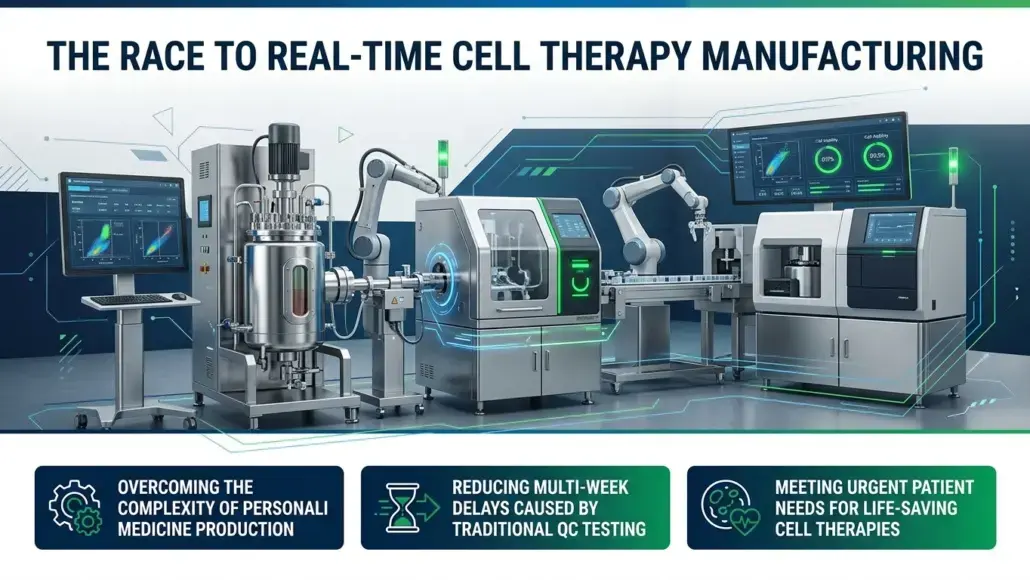
The logistical and technical complexity of producing personalized medicines has reached a point where traditional batch testing methods are no longer sufficient to meet the needs of a growing patient population. In conventional pharmaceutical production, a product is manufactured and then subjected to a series of quality control tests that can take several days or even weeks to complete. For a patient waiting for a life-saving cell therapy, this delay is more than just an administrative hurdle; it is a critical window of time that can dictate the outcome of their treatment. The industry is therefore shifting toward a model where quality is monitored continuously throughout the production cycle, ensuring that the therapeutic product is ready for release the moment the manufacturing process is finished.
This transition toward real-time cell therapy manufacturing is driven by the integration of sophisticated sensors and analytical software directly into the closed-system bioreactors. Instead of taking samples to a separate laboratory for analysis, the system provides constant data on the health, viability, and potency of the cells. This proactive approach allows for immediate adjustments to the nutrient feed or environmental conditions, ensuring that the final product meets the required specifications every time. By removing the lag time associated with retrospective testing, manufacturers can significantly reduce the vein-to-vein time, providing a more responsive and patient-centered service that is essential for the next generation of oncology and regenerative medicine.
Process Analytical Technology and Analytical Precision
The foundation of a real-time release strategy is the application of Process Analytical Technology (PAT) to the bioprocessing workflow. These tools utilize advanced spectroscopy and electronic sensors to measure critical quality attributes without disturbing the sterile environment of the bioreactor. For instance, Raman spectroscopy can provide a detailed metabolic profile of the cell culture, identifying changes in glucose, lactate, and amino acid levels in seconds. This level of granularity allows technical teams to understand the biological state of the therapy with a degree of precision that was previously unattainable outside of a research setting.
Furthermore, the data generated by these sensors is processed by sophisticated algorithms that can identify subtle trends and anomalies before they lead to a full-scale batch failure. This predictive capability is a fundamental requirement for a high-value manufacturing environment where a single lost batch can represent a significant financial loss and a missed opportunity for a patient. By building quality into the process through continuous monitoring, pharmaceutical firms are setting a new standard for operational excellence. The shift toward real-time cell therapy manufacturing is therefore as much about the reliability of the process as it is about the speed of the output.
Digital Integration and Automated Quality Control
The digital infrastructure supporting these advanced factories must be as resilient as the biological processes themselves. When every data point from the bioreactor is used for a release decision, the integrity and security of that information are paramount. Modern facilities are utilizing cloud-based platforms and electronic batch records to ensure that all data is captured and stored in a compliant manner. This digital thread provides a transparent and audit-ready record of the manufacturing journey, which is essential for satisfying the rigorous requirements of regulatory agencies such as the FDA and EMA.
Automated quality control also extends into the interpretation of complex biological data. Instead of relying on manual review of laboratory reports, the system can automatically verify that all critical parameters have been met throughout the production cycle. This reduces the cognitive load on the quality assurance team and minimizes the risk of human error in the release process. By automating the most data-intensive aspects of the workflow, manufacturers can scale their operations more effectively, handling a higher volume of personalized treatments without a corresponding increase in overhead. This scalability is a vital component of the industry’s effort to move beyond niche applications and into the mainstream of clinical practice.
Enhancing Patient Safety and Clinical Outcomes
The ultimate goal of moving toward a real-time release model is the improvement of patient safety and clinical outcomes. When a therapy can be released immediately upon completion of the manufacturing cycle, the risk of product degradation during storage or transport is minimized. This is particularly important for autologous therapies, where the cells are derived from the patient and have a limited shelf life. The ability to deliver a fresh and highly viable product is a key factor in the success of the therapeutic intervention. Real-time cell therapy manufacturing is therefore a fundamental pillar of the industry’s commitment to patient-centered care.
Beyond the immediate technical benefits, this model also provides a more responsive framework for clinical trials. Researchers can receive data on the manufacturing performance of a new therapy in real-time, allowing for faster adjustments to the protocol and a more efficient path to market approval. This agility is essential in a field that is moving with incredible speed and where the competitive advantage depends on the ability to demonstrate both clinical efficacy and manufacturing reliability. The focus of the industry is clearly shifting toward a more integrated and data-driven approach to every aspect of the cell therapy lifecycle.
Future Horizons in Autonomous Bioprocessing
As the technology continues to mature, we see the development of fully autonomous bioprocessing systems that can manage the entire manufacturing journey with minimal human intervention. These “factory-in-a-box” solutions are designed to be deployed in a modular fashion, allowing for decentralized production at the point of care. This would further reduce the logistical challenges associated with transporting live cells and provide even faster access to treatment for patients in remote or underserved areas. The role of real-time cell therapy manufacturing in supporting this decentralization is indispensable, as it provides the necessary oversight to ensure that quality is maintained regardless of where the production takes place.
The continued innovation in sensor technology and data analytics will likely lead to even more sophisticated release criteria, including the real-time assessment of cell function and genomic stability. This will provide an even deeper level of assurance regarding the safety and potency of the therapy. The ongoing collaboration between bioprocess engineers, data scientists, and clinical researchers is the engine that drives this progress. By prioritizing the integration of advanced analytical tools, the pharmaceutical industry is ensuring that the most advanced medicines are also the most reliable and accessible.
Conclusion
In summary, the transition toward real-time release is a fundamental reorganization of the cell therapy manufacturing workflow. By replacing retrospective testing with continuous monitoring and automated quality control, firms can achieve a level of operational precision that supports their most ambitious clinical and commercial goals. It is clear that real-time cell therapy manufacturing is the only path toward a scalable and sustainable future for personalized medicine.
The focus in the coming years will remain on the refinement of the digital and analytical tools that make this model possible. As the regulatory environment continues to evolve to accommodate these innovations, the adoption of real-time release will become the standard of care for the entire industry. This commitment to speed, quality, and patient safety is what will define the next era of pharmaceutical excellence, ensuring that the promise of cell therapy is realized for every patient who needs it.