













The development of a new pharmaceutical manufacturing site has traditionally been a multi-year undertaking, involving a complex sequence of design, construction, and rigorous validation. For companies operating in the fast-moving cell and gene therapy sector, this traditional timeline is often too slow to meet the needs of clinical trials or the demands of a first-to-market commercial launch. To address this, the industry is shifting away from site-built, “stick-and-brick” construction in favor of prefabricated cleanroom systems. This evolution is fundamentally changing the economics of facility development, and it is becoming clear that Modular GMP facilities are scaling faster than ever by providing a standardized and flexible solution for modern biomanufacturing.
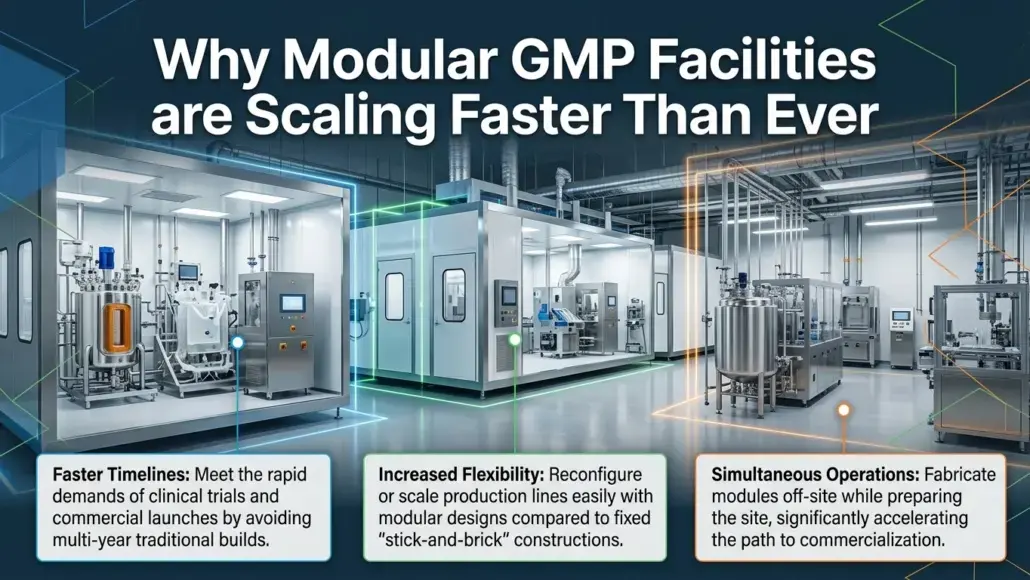
Modular construction involves the prefabrication of cleanroom components, or even entire laboratory units, in a controlled factory environment. These units are then transported to the site and assembled in a fraction of the time required for traditional construction. This parallel workflow—where the facility is being built in the factory while the site is being prepared—reduces the overall project timeline by as much as forty or fifty percent. This accelerated speed to market is a critical competitive advantage for pharmaceutical firms that are looking to secure their manufacturing capacity in a rapidly evolving global landscape.
Standardization and Speed to Market
The primary driver for the adoption of modular systems is the need for speed and predictability in the development process. When a facility is built using standardized components, the risks associated with design errors and construction delays are significantly reduced. Modern manufacturers of modular units provide pre-qualified designs that have already been vetted for GMP compliance, allowing for a much faster validation process. Why Modular GMP facilities are scaling faster than ever is largely explained by this ability to move from concept to a fully operational cleanroom in a matter of months rather than years.
Standardization also simplifies the task of replicating facilities across different geographical locations. A company can design a “copy-exactly” manufacturing template that can be deployed in the United States, Europe, and Asia with minimal adjustment. This global consistency is essential for maintaining high quality standards and for ensuring that the manufacturing process is identical regardless of where the production occurs. For large biopharmaceutical firms, the move toward a more standardized and modular approach to infrastructure is a strategic move that supports their global growth and operational resilience.
Flexibility and the Future of Biomanufacturing
The nature of pharmaceutical manufacturing is changing, with a shift away from large-scale, single-product facilities in favor of smaller, multi-product sites. Modular GMP facilities are scaling faster than ever because they provide the flexibility to adapt to these changing needs. If a particular therapy fails in a clinical trial, a modular facility can be reconfigured or repurposed for a different product with minimal disruption. This “future-proofing” of the manufacturing infrastructure is a vital consideration for companies operating in a market where the product pipeline is often unpredictable and subject to rapid change.
Modular units, often referred to as “PODs,” can also be added to an existing facility in a granular fashion as demand increases. This allows firms to scale their production capacity in line with their commercial success, avoiding the large upfront capital investment associated with building a massive factory from day one. This pay-as-you-grow model is particularly attractive for smaller biotechnology companies that must manage their financial resources carefully. The ability to expand capacity quickly and efficiently is a key factor in the long-term sustainability of any modern biomanufacturing operation.
Quality Control and Controlled Environment Fabrication
Building a cleanroom in a factory setting offers significant advantages in terms of quality control and environmental stability. Traditional construction sites are inherently dirty and subject to the vagaries of weather and local labor availability. In contrast, modular components are manufactured in a controlled environment where every step is monitored and every measurement is precise. Modular GMP facilities are scaling faster than ever as a result of this superior build quality, which leads to fewer issues during the final commissioning and validation phase.
The use of advanced materials and integrated utilities further enhances the performance of these facilities. Many modular units are equipped with pre-installed HVAC systems, electrical wiring, and plumbing that have already been tested and verified. This “plug-and-play” capability ensures that the final assembly on-site is a matter of connecting the utilities rather than a complex engineering task. The resulting cleanrooms are not only built faster but also operate more efficiently, with better airflow and superior contamination control than their traditionally built counterparts.
Strategic Value and Global Manufacturing Resilience
For the pharmaceutical industry, the ability to build and scale manufacturing capacity rapidly is a defining characteristic of operational excellence. The investment in modular infrastructure is a strategic priority that reflects the industry’s focus on agility and responsiveness. Many firms are moving away from centralized mega-factories in favor of a network of smaller, modular sites that are closer to their patient populations. This distributed model of manufacturing improves the resilience of the supply chain and reduces the risks associated with a single point of failure.
The regulatory environment is also evolving to support this move toward modularity. Agencies such as the FDA are increasingly familiar with modular designs and are providing guidance on how to validate these systems effectively. This collaborative approach ensures that the benefits of speed and flexibility do not come at the expense of patient safety or product quality. By embracing these innovative infrastructure solutions, the pharmaceutical industry is demonstrating its commitment to building a more responsive and patient-centered health system. The role of modular facilities in driving this global transformation is indisputable.
Conclusion
The transition toward more standardized and flexible manufacturing infrastructure is a defining trend in the modern biopharmaceutical industry. By replacing traditional construction methods with modular and prefabricated solutions, the sector is setting a new standard for what is possible in facility development. It is clear that the ability to build and scale capacity with speed and precision is an essential requirement for success in the 21st-century health economy.
As we look to the future, the focus will remain on the continued refinement of these systems to handle even more complex and sensitive bioprocesses. The integration of digital twins and real-time monitoring within modular units will provide even greater oversight and control. The ongoing evolution of modular GMP facilities is a vital part of the overall effort to ensure that the next generation of life-changing treatments is delivered safely and effectively to every patient who needs it.