













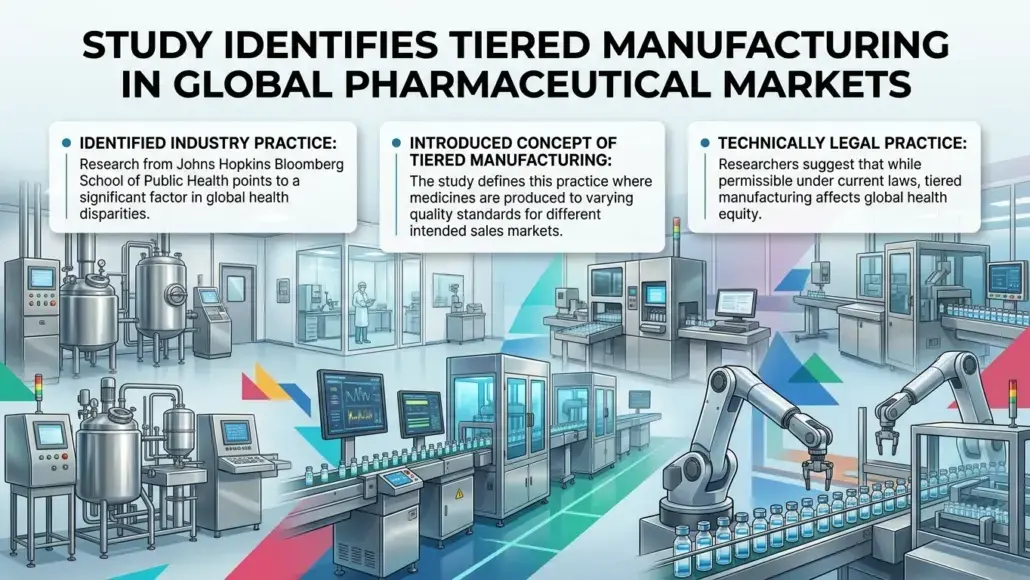
A new research project from the Johns Hopkins Bloomberg School of Public Health has identified a pharmaceutical industry practice that could be a significant factor in global health disparities. Published in PLOS Global Public Health on July 07, 2026, the study introduces and defines the concept of tiered manufacturing, which refers to the production of medicines to varying quality standards depending on their intended sales market. Although the practice is technically legal, researchers suggest it leverages differences in regulatory oversight, particularly within low- and middle-income countries (LMICs). Lead author Jean Christophe Rusatira, MD, PhD, MPH, who serves as a senior program officer at the Bloomberg School’s Department of Population, Family and Reproductive Health, emphasized the gravity of the situation, stating, “Access to a medicine is not access unless it is access to a quality version.”
Observed Quality Disparities and Methodology
The research utilized a series of 31 semi-structured, in-depth interviews conducted via Zoom between May 1 and July 30, 2025, with experts in pharmaceutical quality assurance, regulatory affairs, and procurement. Many participants were based in India, which is currently the primary supplier of generic drugs to LMICs. Respondents indicated that while products destined for highly regulated regions—such as those governed by the European Medicines Agency or the U.S. Food and Drug Administration—use pharmaceutical-grade ingredients and rigorous testing, medicines for less regulated markets might utilize cheaper ingredients and manufacturing equipment susceptible to data manipulation. These disparities often lead to products with shorter shelf lives and higher batch variability. Consequently, tiered manufacturing is frequently observed among smaller generic firms, while larger innovator companies generally maintain more uniform standards.
Implications for Global Health and Regulation
The study provides a new lens through which to view World Health Organization (WHO) data, which indicates that at least 10% of medical products in many LMICs are currently substandard or falsified. Beyond the direct health risks, the practice complicates regulatory reliance, a process where one authority trusts the assessment of another. This system only functions effectively if manufacturers provide identical versions of medicines to every market. To combat these inequities, the authors suggest bolstering national regulatory bodies, improving transparency through independent audits, and adjusting procurement policies to prioritize verified quality over the lowest price. By formalizing this definition, the researchers hope to assist regulators and policymakers in addressing a critical yet previously under-investigated structural determinant of health.