










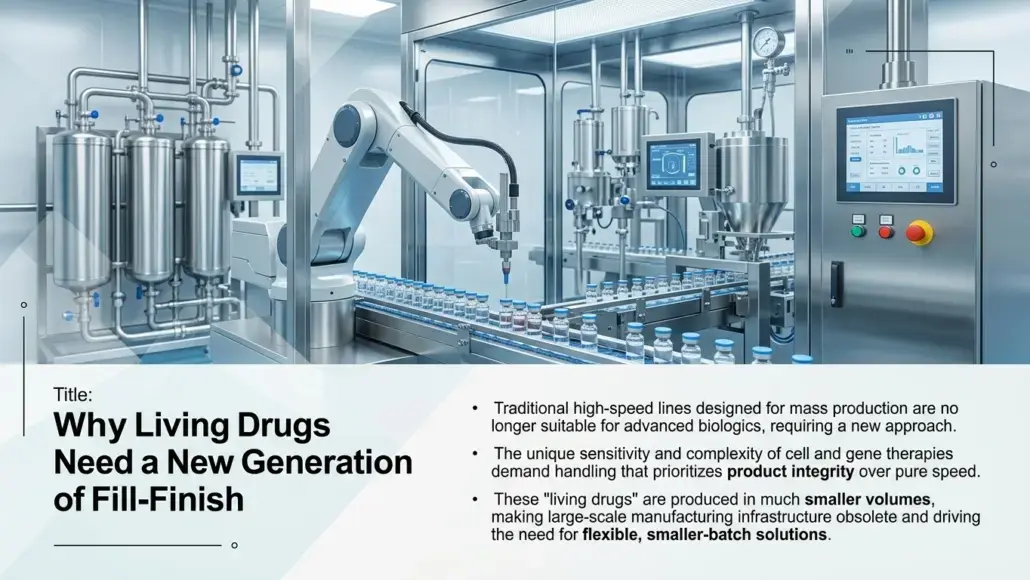
The final stages of the pharmaceutical manufacturing process, where the therapeutic product is filled into its primary container and prepared for delivery, have long been dominated by high-speed lines designed for millions of identical doses. However, the emergence of advanced biologics, often referred to as “living drugs,” has rendered these traditional methods obsolete. Cell and gene therapies are inherently more sensitive, more complex, and produced in much smaller volumes than conventional small molecules or recombinant proteins. To ensure the integrity and the potency of these delicate treatments, the industry is transitioning toward more specialized and agile systems, and it is becoming clear that Living drugs need a new generation of fill-finish that prioritizes precision and safety over raw speed.
Living drugs consist of viable cells or viral vectors that are highly susceptible to environmental stress, including changes in temperature, light, and physical agitation. Unlike traditional drugs that can withstand the mechanical forces of a high-speed filling line, cell therapies require a much gentler touch. Every step of the filling process must be carefully controlled to prevent cellular damage and maintain the therapeutic effect. This shift requires a move away from rigid, multi-product lines in favor of modular, closed-system platforms that are specifically designed for the unique requirements of the cell and gene therapy sector.
Aseptic Integrity and Closed-System Processing
Maintaining the sterility of the final product is the most critical requirement for any pharmaceutical operation, but for living drugs, the stakes are even higher. Because these therapies are often based on the patient’s own cells, there is no opportunity to perform final sterilization steps such as heat or gamma irradiation. Every component of the fill-finish process must therefore be conducted under strict aseptic conditions. Living drugs need a new generation of fill-finish that utilizes fully closed systems and isolator technology to isolate the product from the human operator and the external environment. This minimizes the risk of microbial contamination and ensures the safety of the patient.
The integration of robotic handling within these closed systems is a major advancement that improves both the precision and the consistency of the filling process. Robots can perform the delicate tasks of vial filling and stoppering with a degree of repeatability that human workers cannot match, while working within the cramped and sterile environment of an isolator. This automation reduces the risk of accidental exposure and ensures that every container is handled with the same level of care. By removing the human element from the most critical stages of the workflow, manufacturers can achieve a level of quality assurance that is essential for these high-value treatments.
Small Batch Precision and Material Handling
The volume of a typical cell or gene therapy batch is often measured in dozens or hundreds of doses, rather than thousands. Traditional filling equipment is not designed for these small volumes and often leads to excessive product loss during the startup and shutdown of the line. Living drugs need a new generation of fill-finish that focuses on minimizing “hold-up volume” and maximizing the recovery of every milliliter of the therapeutic product. This is particularly important for autologous therapies, where the entire batch is destined for a single patient and any loss of material could result in an incomplete dose.
Precision in volume delivery is also essential, as the concentrated nature of these therapies means that even a small variation in the fill level can have a significant impact on the total dose received by the patient. Modern fill-finish platforms utilize high-precision pumps and real-time weight checks to ensure that every vial or bag is filled to the exact specification. The handling of specialized containers, such as cryo-vials and flexible bags, also requires a more adaptable approach to material handling. The ability to process a variety of formats on a single, modular line provides the flexibility needed to support a diverse and rapidly changing product pipeline.
Cryopreservation and Temperature-Controlled Fill-Finish
The stability of living drugs is a major concern, as the cells can begin to lose their potency the moment they are removed from the controlled environment of the bioreactor. The fill-finish process must therefore be synchronized with the cryopreservation step to ensure that the product is frozen as quickly and consistently as possible. Living drugs need a new generation of fill-finish that integrates temperature control directly into the filling station, maintaining the product at a cold or ultra-cold state throughout the process. This prevents the formation of ice crystals and other cellular stresses that can occur during the transition to the final frozen state.
Effective cryopreservation is not just about reaching a specific temperature; it is about the rate and the uniformity of the cooling process. Many modern fill-finish lines are designed to move the vials directly from the filling head into a controlled-rate freezer, ensuring a seamless and rapid transition. The data captured during this process provides a critical record of the product’s thermal history, which is essential for proving the stability and the quality of the final unit. This level of environmental control is a fundamental requirement for the successful manufacturing and distribution of advanced biologics on a global scale.
Strategic Investment and Regulatory Compliance
For pharmaceutical companies, the investment in advanced fill-finish technology is a strategic priority that reflects the growing importance of the cell and gene therapy sector. Having control over the final stages of the manufacturing process ensures that the quality and the potency of the product are maintained from the bioreactor to the patient. Many firms are moving away from outsourced fill-finish in favor of internal capabilities that provide greater agility and security. Living drugs need a new generation of fill-finish that is fully integrated into the broader digital manufacturing ecosystem, providing a transparent and audit-ready record of every step.
The regulatory environment is also evolving to address the unique challenges of filling living drugs. Agencies such as the FDA are placing an increasing focus on container closure integrity (CCI) and the avoidance of particulates in the final product. Manufacturers must provide rigorous evidence to demonstrate that their fill-finish processes are robust and reliable. The use of advanced inspection technology, such as high-voltage leak detection and automated vision systems, is becoming a standard requirement for ensuring compliance. By embracing these high standards, the industry is demonstrating its commitment to patient safety and clinical excellence.
Conclusion
The transition toward more specialized and precise filling systems is a defining trend in the modern biopharmaceutical industry. By replacing traditional high-speed methods with agile and intelligent platforms, the sector is setting a new standard for the production of advanced medicines. It is clear that the final stages of the manufacturing journey are just as critical as the biological processes that occur in the bioreactor.
As we look to the future, the focus will remain on the continued refinement of these systems to handle even more complex and sensitive therapies. The ability to manage the increasing diversity of container formats and cryopreservation protocols will remain a key challenge for bioprocess engineers. The ongoing evolution of fill-finish technology is a vital part of the overall effort to ensure that the promise of living drugs is delivered safely and effectively to every patient who needs it.