









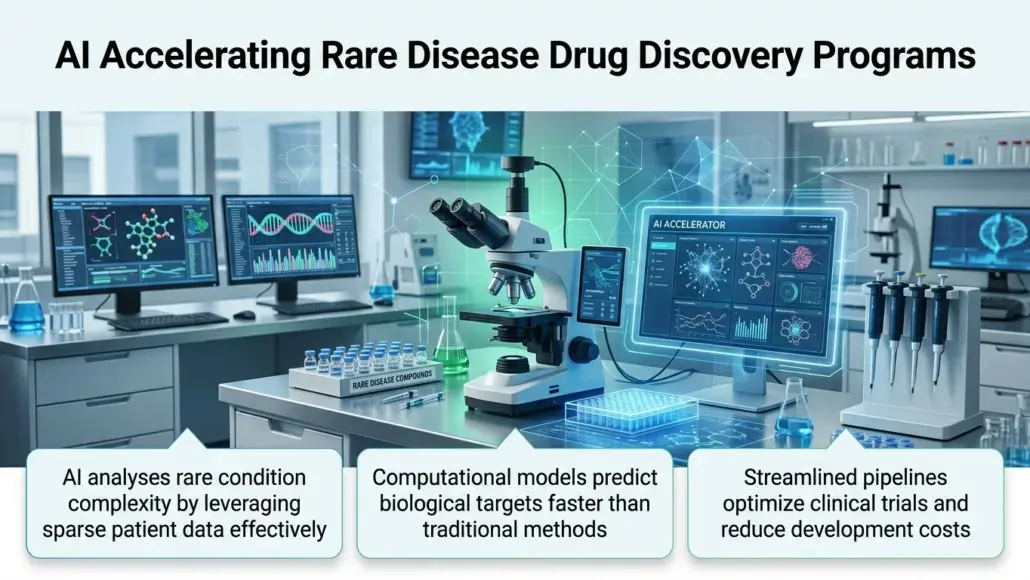
The pharmaceutical sector is currently witnessing a fundamental shift in how orphan drugs are identified and moved through the clinical pipeline. For decades, the primary challenge for researchers has been the sheer scarcity of patient data and the immense biological complexity inherent in thousands of distinct rare conditions. Traditional methods of drug development often failed in this arena because the economic incentives did not align with the high costs of conventional research and development. However, the introduction of sophisticated computational tools has changed this equation. The implementation of AI accelerating rare disease drug discovery programs provides a path forward by allowing for the analysis of vast genomic datasets that were previously too dense for manual interpretation.
Central to this advancement is the ability to aggregate and interpret fragmented patient data from around the world. Because rare diseases affect small populations, the data is often siloed in disparate research institutions and hospitals. Artificial intelligence systems can now bridge these gaps, identifying common molecular pathways across different conditions. This capability is essential for pharmaceutical executives who must make strategic decisions about which drug pipelines to fund and which small molecules show the most promise for treating conditions that currently lack any approved therapy. By moving toward a data-driven model, the industry is reducing the time required to move from initial lead identification to the start of clinical trials.
Breaking the Genomic Data Bottleneck in Orphan Research
The volume of information generated by whole-genome sequencing is immense, yet its utility in the rare disease sector has historically been limited by the speed of analysis. Researchers often spent years attempting to correlate specific genetic variants with clinical symptoms. Modern analytical platforms change this dynamic by utilizing pattern recognition to highlight potential causal mutations in a fraction of the time. These systems do not merely speed up the process; they provide a level of depth that allows for the identification of rare disease drug discovery programs that can target the underlying genetic cause rather than just managing symptoms. This shift toward curative intent is a cornerstone of the next generation of orphan drug development.
Furthermore, the integration of real-world evidence into the early stages of discovery allows for a more comprehensive understanding of disease progression. By analyzing digital health records and registries, AI can help researchers define more accurate endpoints for clinical trials. This is particularly vital in the orphan drug space, where the small number of participants makes every data point critical. The ability to predict how a disease will evolve in a specific patient population ensures that the resulting therapeutic interventions are as targeted as possible. This technical precision is what earns the trust of investors and regulatory bodies alike, providing a clear justification for the high capital investment required in these programs.
Strategic AI Driven Drug Repurposing for Rare Conditions
One of the most efficient strategies for addressing the high attrition rate in drug development is the identification of new uses for existing molecules. Drug repurposing has become a vital component of many rare disease drug discovery programs, as it allows researchers to bypass many of the safety and toxicology hurdles associated with novel compounds. Artificial intelligence plays a pivotal role here by scanning massive libraries of approved drugs and clinical candidates to identify off-target effects that might be beneficial for a rare condition. This approach significantly lowers the financial risk for pharmaceutical companies while providing patients with access to potentially life-saving treatments much sooner.
The process involves creating digital twins of molecular pathways and simulating how different small molecules interact with them. These simulations can identify hidden correlations that a human researcher might overlook, such as a drug for a common cardiovascular condition showing potential in a rare metabolic disorder. By validating these findings in silico before moving to the laboratory, companies can focus their resources on the most viable candidates. This optimization of the research process is a fundamental requirement for the economic sustainability of orphan drug pipelines, ensuring that the cost of discovery does not become a barrier to patient access.
Accelerating Lead Identification and Small Molecule Design
The design of new small molecules has traditionally been a process of trial and error, involving the synthesis and testing of thousands of variations. Computational chemistry, augmented by machine learning, is now enabling the de novo design of molecules with specific binding affinities. In the context of rare diseases, where the target protein may be poorly understood, these tools allow researchers to model the protein structure and design a companion molecule that fits perfectly. This level of technical accuracy reduces the time spent in the lead optimization phase, which is often one of the most significant delays in any drug development project.
These advanced discovery programs are also capable of predicting the pharmacokinetic properties of a molecule before it is even synthesized. By anticipating how a drug will be absorbed, distributed, and metabolized, researchers can eliminate candidates that are likely to fail in the clinic due to poor bioavailability or unexpected toxicity. This foresight is especially valuable in rare disease research, where the ethical implications of a failed trial are magnified by the vulnerability of the patient population. The commitment to using the best available technology ensures that the molecules moving into clinical testing are the ones with the highest probability of success.
The Regulatory and Strategic Future of Orphan Drug Pipelines
As the pharmaceutical industry continues to evolve, the role of data-intensive discovery will only grow in importance. Regulatory agencies are increasingly receptive to computational data and simulations as part of the submission package for orphan drugs. This receptivity is driven by the recognition that traditional trial models are often impractical for rare conditions. Organizations that have successfully implemented AI-accelerating rare disease drug discovery programs are finding themselves in a stronger position during the approval process, as they can provide a more comprehensive justification for their dosing and safety profiles.
Looking ahead, the success of the rare disease sector will depend on the continued integration of genomics and patient data into every stage of the discovery cycle. The ability to coordinate international research efforts through a unified data platform will be a key differentiator for leading pharmaceutical firms. By prioritizing transparency and technical depth, the industry can ensure that the transition to a more data-driven discovery model is managed professionally and ethically. The ultimate goal remains the delivery of effective therapies to patients who have historically been underserved by the traditional drug development model.