













In the contemporary pharmaceutical landscape, where the complexity of molecular structures is matched only by the stringency of global regulations, the demand for absolute analytical accuracy has never been higher. The delivery of a safe and effective medication is a multi-layered process that begins with the precise characterization of every raw material and ends with the final verification of the finished dosage form. Central to this mission is the deployment of high-performance spectrophotometers drug quality protocols. These sophisticated instruments have moved beyond their traditional role in research and development to become the primary gatekeepers of quality in the modern manufacturing environment. By providing a deep, quantitative understanding of how light interacts with chemical compounds, spectrophotometry allows for the identification of minute variations in purity and composition that could compromise a drug’s performance or safety profile.
The Technical Evolution and Capability of Modern Spectroscopy
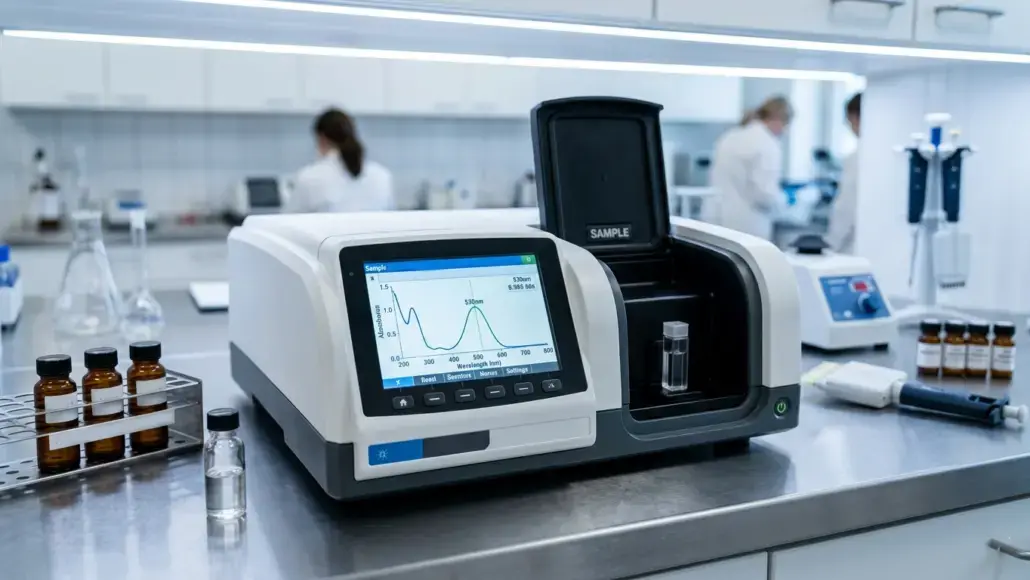
The evolution of spectroscopy in the pharmaceutical sector is a journey from subjective, manual processes to high-speed, digital precision. In decades past, assessing the identity or concentration of a substance often relied on visual titration or basic colorimetric methods that were prone to error and required significant sample preparation. Today, the integration of advanced spectrophotometers drug quality systems has redefined what is possible in the quality control laboratory. Modern instruments utilize solid-state detectors and high-stability light sources to capture spectral data across the ultraviolet, visible, and near-infrared ranges. This broad-spectrum capability allows analysts to perform a wide variety of tests from identifying unknown impurities to quantifying the concentration of active pharmaceutical ingredients (APIs) with a single, rapid scan. The ability to analyze samples in their native state, often without the need for destructive chemical processing, represents a significant leap forward in both laboratory efficiency and data reliability.
Achieving Validation Excellence and Regulatory Harmonization
In a highly regulated industry, an analytical result is only as good as the method used to generate it. The implementation of spectrophotometers drug quality tools must be accompanied by a rigorous and documented validation process that adheres to the guidelines set forth by agencies such as the FDA, EMA, and ICH. Validation is the formal process of proving that an analytical procedure is suitable for its intended purpose, involving a series of experiments that test for accuracy, precision, specificity, linearity, and robustness. For a pharmaceutical lab, this means demonstrating that the spectrophotometer can consistently and correctly identify the target analyte even in the presence of complex excipients and potential degradation products. By adhering to these strict validation protocols, manufacturers ensure that their quality control findings are scientifically sound and can withstand the intense scrutiny of regulatory audits. This level of rigor is essential for maintaining the transparency and trust that are the hallmarks of a leading pharmaceutical organization.
The Foundation of Instrument Qualification and Performance Verification
The absolute reliability of data in a GMP-compliant laboratory is built on a foundation of rigorous instrument qualification. When a new spectrophotometer is introduced into the workflow, it must undergo a structured qualification process that includes Installation Qualification (IQ), Operational Qualification (OQ), and Performance Qualification (PQ). This multi-stage approach ensures that the instrument is installed correctly, operates according to the manufacturer’s technical specifications, and delivers the required performance for the specific needs of the laboratory. Beyond the initial setup, a routine program of performance verification using certified reference materials is mandatory. Regular calibration corrects for any natural drift in optical alignment or detector sensitivity, ensuring that the data remains accurate over the entire lifespan of the instrument. This commitment to technical excellence provides the confidence necessary for the final release of a pharmaceutical batch, knowing that every measurement is grounded in a state of controlled and verifiable precision.
Enhancing Formulation Development Through Granular Data Insights
While spectrophotometers are vital for routine quality control, their value during the initial stages of drug formulation and process development is equally significant. Scientists use advanced spectral data to study the physical and chemical behavior of new drug candidates under a wide variety of environmental conditions. By observing how a substance absorbs or reflects light when exposed to different pH levels, temperatures, or humidity ranges, researchers can gain early insights into its potential stability and shelf-life. This information is critical for determining the most effective delivery system whether it be a stable tablet, a protected capsule, or an injectable solution and for optimizing the manufacturing parameters to ensure maximum purity and yield. This proactive, data-driven approach to development reduces the risk of costly failures during clinical trials and ensures that the manufacturing process is robust and repeatable from day one.
Monitoring Coating Uniformity and the Distribution of Active Ingredients
One of the most practical and high-impact applications of spectrophotometers drug quality control is the monitoring of solid dosage forms. The coating of a tablet is not merely an aesthetic choice; it often plays a functional role in controlling the release of the medication or protecting the active ingredient from degradation in the stomach. Through the use of reflectance spectroscopy, manufacturers can non-destructively monitor the thickness and consistency of these coatings in real-time. If the sensors detect a deviation from the established standard, immediate adjustments can be made to the coating process, preventing the loss of valuable materials and ensuring that every tablet delivers a consistent therapeutic dose. Furthermore, near-infrared (NIR) spectroscopy is increasingly used to verify the uniform distribution of the API within a multi-component blend. This ensures that every individual unit in a batch contains exactly the amount of medication specified, a critical requirement for maintaining patient safety and therapeutic efficacy.
The Impact of Laboratory Automation on Testing Efficiency
The global drive toward laboratory automation has significantly transformed how spectrophotometers drug quality data is collected and processed. Modern spectroscopic systems can be fully integrated into automated liquid handling stations and comprehensive Laboratory Information Management Systems (LIMS), creating a seamless and hands-free flow of information. This integration dramatically reduces the likelihood of human error in sample preparation and manual data entry, which are historically the leading causes of out-of-specification results. Automated spectroscopy also allows for a massive increase in testing throughput, enabling laboratories to handle the demands of high-volume manufacturing without sacrificing the depth or accuracy of their analysis. As the pharmaceutical industry continues to move toward more complex and personalized medicines, these operational efficiencies are becoming essential for maintaining a competitive edge and meeting the needs of patients more rapidly.
Data Integrity and the Security of the Analytical Lifecycle
In the modern regulatory environment, the integrity and security of analytical data are of paramount importance. Spectrophotometers drug quality software is now designed from the ground up to comply with global data integrity standards, such as the FDA’s 21 CFR Part 11. These systems include robust, encrypted audit trails that record every single interaction with the instrument, from the initial calibration to the final signature on a release report. This level of transparency ensures that the data is attributable, legible, and contemporaneous, providing a clear and unalterable history of the entire analytical process. For a pharmaceutical company, this is not just a regulatory requirement; it is a vital safeguard that protects the organization from the risks of data tampering or accidental loss. When every result can be traced back to a secure and verifiable raw data file, it reinforces the message that quality is a deeply ingrained value that permeates every level of the organization.
The Silent Role of Spectroscopy in Safeguarding Public Health
The ultimate beneficiary of the precision provided by spectrophotometers drug quality measures is the patient. In a world where the threat of sub-standard or counterfeit medications is a constant concern, the ability to quickly and accurately verify the identity and potency of a drug product is an essential line of defense. High-performance spectrophotometers act as high-tech sentinels, providing a scientific barrier that prevents ineffective or dangerous products from reaching the market. The confidence that healthcare providers and patients have in their medications is built on the invisible work performed by these instruments in laboratories around the world. As the pharmaceutical industry continues to innovate with more targeted therapies and advanced delivery systems, the role of spectroscopy will only become more central to the core mission of delivering safe, effective, and reliable healthcare solutions to a global population.