






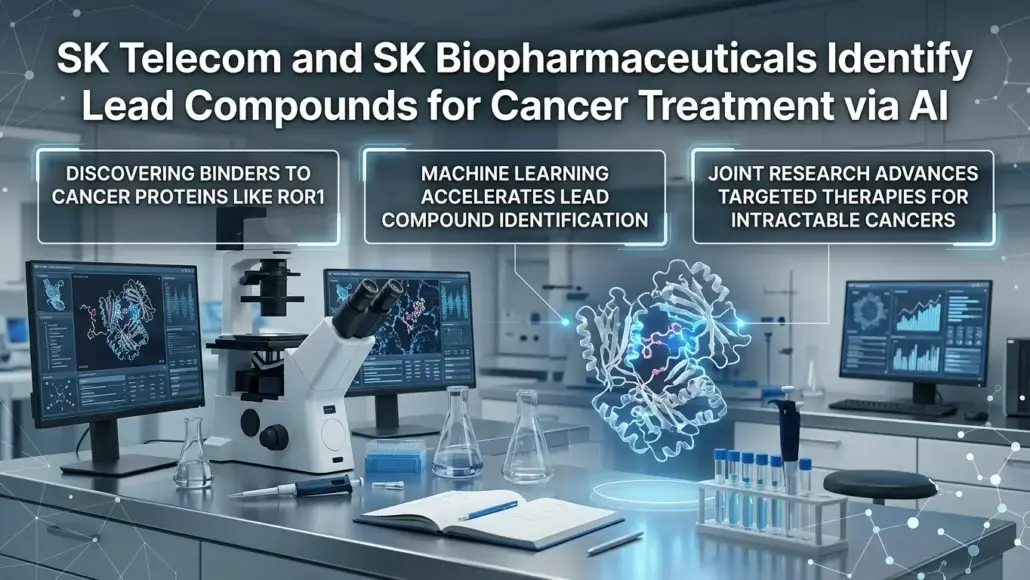
SK Telecom and SK Biopharmaceuticals have announced the successful identification of early lead compounds designed for the development of targeted therapies for intractable cancers. By leveraging AI Drug Discovery, the joint research team discovered two specific substances capable of binding to ROR1, a protein found on the surface of malignant cells. A major highlight of this collaboration was the completion of early-stage research in approximately five months. This timeframe represents a significant reduction of more than 60 percent compared to the traditional research period, which typically requires one to two years under existing methodologies. The results demonstrate how advanced technology can handle the generation and selection of candidate substances to streamline pharmaceutical development.
Technical Integration and Machine Learning in Oncology
The discovery of these lead compounds marks the essential starting point for verifying the potential of new therapeutic candidates. In this study, the companies focused on binders, which are substances engineered to recognize and attach to specific targets such as a cancer cell. Identifying a successful binder requires researchers to consider multiple variables simultaneously, including the structural stability of the substance and its binding strength with the target. SK Biopharmaceuticals established the strategic framework for the project based on its extensive drug development experience, while SK Telecom utilized machine learning to rapidly generate a high volume of candidates. This machine learning approach involved combining and structuring protein fragments in various configurations to identify the most effective options for intractable cancers.
Efficiency Gains and Future Bio-Specialized Technology
To optimize the selection process, the system was programmed to seek the most stable binder structures by awarding higher rewards to combinations that demonstrated superior structural integrity. The potential of these substances was later confirmed through laboratory verification, which narrowed the vast pool of candidates down to the two most promising binders. Following this success, the organizations are exploring ways to expand their technological cooperation. Cho Dong-yeon, head of AI Convergence at SK Telecom, stated, “Based on this achievement, we are also reviewing plans to expand the scope of our technology cooperation across bio AI as a whole, including developing a bio-specialized large language model (LLM) using our proprietary AI foundation model.” The efficiency achieved through AI drug discovery highlights a path toward reducing the time and cost barriers in the early stages of creating a new cancer therapy, ensuring that promising substances reach laboratory verification much faster than previously possible.