







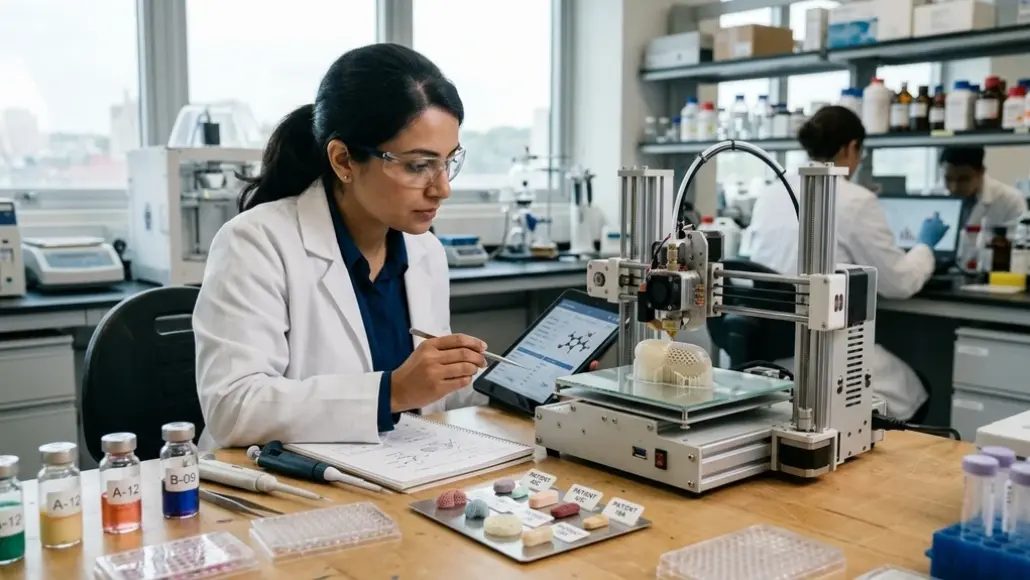
The pharmaceutical industry is currently witnessing a transformative shift from a mass-production model to a patient-centric approach, driven largely by the innovation of 3D printed dosage forms advancing precision medicine. For over a century, the standard of care has relied on “blockbuster” drugs produced in fixed doses, a strategy that often overlooks the profound biological diversity among patients. Factors such as age, weight, genetics, and metabolic rate significantly influence how an individual responds to medication. 3D printed dosage forms represent a breakthrough in additive manufacturing, allowing for the creation of customized medications where the dose, release profile, and physical geometry are tailored to the specific needs of an individual. This transition is not just a technological upgrade; it is a fundamental reimagining of the therapeutic experience.
The core advantage of 3D printed dosage forms advancing precision medicine lies in their ability to produce complex internal architectures that are impossible to achieve through traditional compression methods. By using various additive techniques, researchers can design “smart” tablets with multiple layers or porous cores that control the rate at which the active pharmaceutical ingredient (API) is released into the body. This precision is particularly vital for drugs with a “narrow therapeutic index,” where a slight variation in concentration can mean the difference between a life-saving treatment and a toxic event. Through 3D printing, we can ensure that every patient receives the exact amount of medicine required to achieve the desired clinical outcome, minimizing side effects and maximizing efficacy.
Technological Foundations and Material Science
The rise of 3D printed dosage forms advancing precision medicine is supported by several distinct printing technologies, each offering unique advantages for drug formulation. Fused Deposition Modeling (FDM) is perhaps the most widely utilized, involving the extrusion of drug-loaded thermoplastic filaments. This method is ideal for creating sustained-release tablets, as the polymer matrix can be engineered to degrade slowly over time. Conversely, Stereolithography (SLA) uses a UV laser to solidify liquid resins, enabling the creation of intricate structures like microneedle patches for transdermal delivery. Other methods, such as Selective Laser Sintering (SLS) and Binder Jetting, allow for the production of highly porous, fast-dissolving tablets that melt in the mouth in seconds a critical innovation for patients who struggle with swallowing traditional pills.
The success of these technologies depends heavily on advances in material science. Pharmaceutical-grade “inks” must be carefully formulated to maintain the stability of the API while ensuring the necessary physical properties for printing, such as viscosity and thermal stability. Researchers are currently exploring a wide array of biocompatible polymers and excipients that can be safely used in 3D printed dosage forms advancing precision medicine. The challenge lies in ensuring that the printing process itself which often involves heat or UV light does not degrade the medication. This requires a deep understanding of the thermophysical properties of both the drug and the carrier, leading to the development of “low-temperature” printing techniques and specialized stabilization agents that protect delicate molecules during the fabrication process.
Transforming Care for Pediatric and Geriatric Patients
Pediatric and geriatric populations are among the primary beneficiaries of 3D printed dosage forms advancing precision medicine. Children are not simply “small adults”; their metabolic profiles change rapidly, requiring frequent and precise dosage adjustments that traditional “tablet splitting” cannot accurately provide. 3D printing allows for the creation of chewable, flavored “printlets” that can be adjusted in milligram increments, ensuring that a child receives the exact dose for their current weight and developmental stage. This precision reduces the risk of adverse reactions and improves the overall safety of pediatric care. Furthermore, the ability to print medications in fun shapes or bright colors can significantly improve a child’s willingness to take their medicine, reducing the “medication refusal” that often plagues pediatric treatment.
For the elderly, 3D printed dosage forms advancing precision medicine offer a solution to the “polypharmacy” crisis. Many seniors are required to take five or more different medications daily, leading to complex regimens that are difficult to manage and prone to error. 3D printing enables the creation of “polypills” single tablets that contain multiple active ingredients, each with its own specific release profile. Imagine a single pill that releases a blood pressure medication in the morning, a cholesterol-lowering drug in the afternoon, and a sleep aid at night. By consolidating these treatments into a single unit, we can significantly reduce the “pill burden,” improve adherence, and lower the risk of dangerous drug-drug interactions, leading to a much higher quality of life for aging patients.
Decentralized Manufacturing and Point-of-Care Solutions
The most radical implication of 3D printed dosage forms advancing precision medicine is the potential for decentralized manufacturing. Currently, drugs are produced in massive, centralized facilities and shipped across the globe. 3D printing could move the “factory” to the hospital pharmacy or even the local clinic. In this model, the “blueprint” for a drug is sent digitally to a local printer, which then produces the medication on-demand. This “point-of-care” approach eliminates the need for large inventories of various strengths and reduces the waste associated with expired medications. It also makes the supply chain more resilient to disruptions, as medications can be printed locally whenever and wherever they are needed, including in remote or disaster-stricken areas.
However, the shift toward decentralized production of 3D printed dosage forms advancing precision medicine introduces significant regulatory and security challenges. How do we ensure that a 3D printer in a small clinic produces the same high-quality medication as a pharmaceutical giant? This requires the development of robust “quality-by-design” frameworks and automated verification systems that check the dosage and purity of every printed tablet. Furthermore, digital security is paramount; the proprietary “recipes” for medications must be protected from cyberattacks, and the printers themselves must be secure to prevent the production of counterfeit or illicit substances. Regulatory bodies like the FDA are currently working with the industry to establish these standards, paving the way for a future where personalized medicine is the global norm.
Future Perspectives: The “Digital Pharmacy” and Beyond
As we look to the future, the integration of 3D printed dosage forms advancing precision medicine with digital health data will create a “closed-loop” therapeutic system. Wearable sensors could monitor a patient’s vital signs or drug levels in real-time, feeding this data into an AI algorithm that then “orders” a newly adjusted 3D printed dose for the next day. This level of responsiveness would allow for “dynamic dosing,” where the medication is constantly optimized to match the patient’s changing condition. We are moving away from a world of static treatments toward a future of “living” therapies that adapt to the patient.
In conclusion, 3D printed dosage forms advancing precision medicine represent the dawn of a new era in healthcare. By combining the precision of additive manufacturing with the insights of genomics and digital health, we are finally moving past the limitations of mass production. This technology empowers clinicians to treat patients as individuals, ensuring that everyone receives the right medicine, at the right dose, at the right time. While there are still hurdles to overcome in terms of regulation and material science, the potential for 3D printing to democratize and personalize medicine is unparalleled. It is the key to a future where healthcare is as unique as the DNA of the people it serves.