











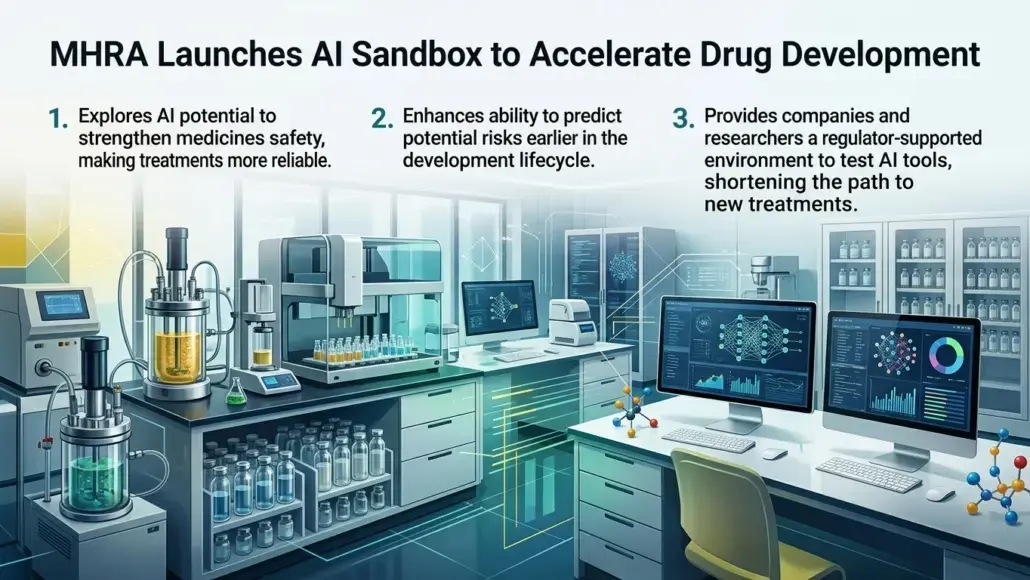
The Medicines and Healthcare products Regulatory Agency (MHRA) has announced the launch of a new AI Sandbox programme designed to explore how artificial intelligence can strengthen medicines safety, improve risk prediction and support faster development of new treatments. Announced by Science Minister Lord Vallance during London Tech Week on 9 June 2026, the initiative will provide companies and researchers with a regulator-supported environment to evaluate AI-driven tools that could help assess how medicines behave in the body and identify potential side effects earlier in the development process. Backed by funding from the UK Government’s Regulatory Innovation Office, the programme will examine whether these technologies can generate reliable evidence to support decisions on the safety of new medicines.
The initiative comes as adverse drug reactions continue to place a significant burden on healthcare systems, with around 250,000 hospital admissions recorded annually in the UK and costs exceeding £2 billion each year for the NHS. Existing development methods also contribute to high failure rates, with around 90% of medicines failing during development because current approaches do not always accurately predict how treatments will perform in people. Through the AI Sandbox, the MHRA will work with developers to test technologies capable of forecasting drug behaviour, including absorption, processing and potential harmful effects. The programme will also investigate how clinical data can be used more effectively to understand medicine performance across different population groups, including children, older people and individuals from diverse backgrounds.
The first phase will evaluate up to five AI-driven approaches, with collaboration between industry and academic partners expected to begin in summer 2026. The findings will help the regulator determine the reliability of AI-based methods and establish expectations for their safe use in medicines development. The project forms part of wider UK efforts to modernise drug development through advanced modelling and synthetic data, while also supporting government ambitions to reduce reliance on animal testing and accelerate access to innovative treatments. Officials said the work aligns with the Government’s AI for Science Mission One and its broader objective of creating one of the world’s most AI-enabled healthcare systems.
Health Innovation Minister Preet Gill said: “The AI revolution is here, and we want our NHS staff to be the first in the queue, armed with rigorously tested clinical AI tools.”
Science Minister Lord Vallance said: “By leveraging our strengths in life sciences, AI and pro-innovation regulation, this sandbox will help make the UK one of the best places in the world to develop the next generation of medicines safely.”
MHRA Chief Executive Lawrence Tallon said: “These technologies could help us understand medicines better, generate stronger evidence on their safety, and accelerate the development of innovative treatments, especially in areas of unmet need.”