








The traditional pharmaceutical research and development model has long been characterized by high costs, long timelines, and a high rate of failure. For every drug that successfully reaches the market, thousands of candidates fall by the wayside during the discovery and preclinical phases. This inefficiency is a significant burden on the industry, limiting the number of new treatments that can be developed for rare and complex diseases. However, a new era of innovation is emerging as pharmaceutical companies integrate advanced computational tools into their core workflows. By combining high throughput screening with sophisticated algorithms, the sector is effectively accelerating drug discovery at scale, turning a process that once took years into one that can be measured in months.
The driver behind this shift is the application of artificial intelligence to the vast datasets generated by biological and chemical research. Unlike traditional methods that rely on trial and error in a physical lab, AI-enabled R&D allows scientists to simulate millions of molecular interactions in a virtual environment. This computational approach not only speeds up the identification of promising candidates but also provides a deeper understanding of how these molecules will interact with human biology. As a result, the industry is moving away from a linear, manual process toward a highly automated, data driven ecosystem that can handle the complexities of modern drug design with unprecedented efficiency.
The Convergence of Computational Chemistry and Machine Learning
At the heart of this technological revolution is the integration of computational chemistry and machine learning drug design. Computational methods have been used in drug discovery for decades, but their utility was often limited by the immense processing power required to model complex protein structures. The advent of modern GPUs and cloud computing has removed these barriers, allowing for high fidelity molecular simulation that can predict how a drug will bind to its target with a high degree of accuracy.
Machine learning takes this a step further by training models on existing chemical libraries and experimental data. These models can then be used to generate new molecular structures that possess specific desired properties, such as high potency and low toxicity. This generative approach to drug design is a significant departure from traditional methods, where researchers had to rely on a limited set of known chemical scaffolds. By exploring a much larger area of chemical space, AI drug discovery platforms can uncover novel therapeutic agents that might never have been found using manual methods. This ability to search and design at scale is what truly differentiates the modern era of pharmaceutical research.
Automating the Laboratory for High Throughput Experimentation
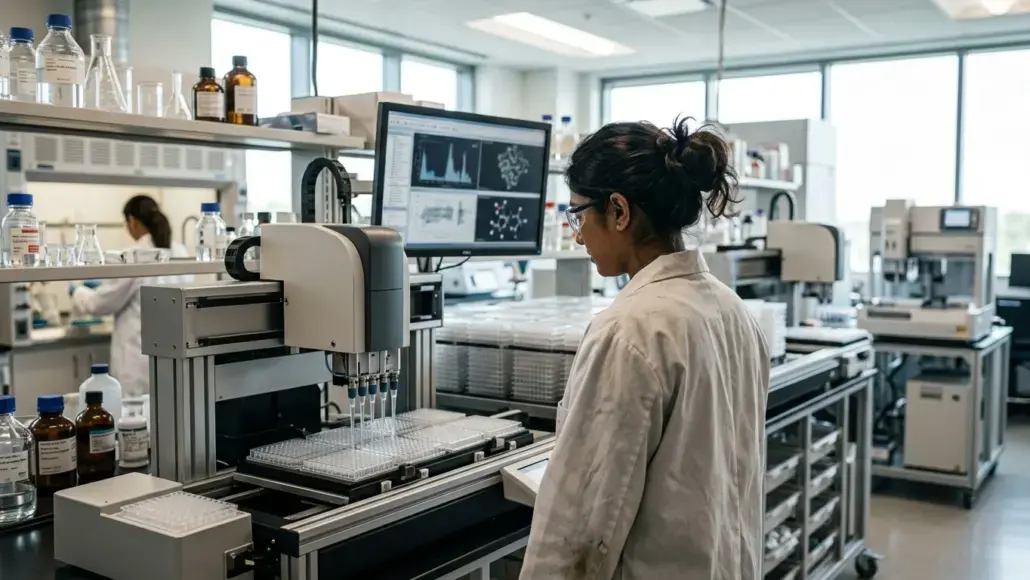
While virtual simulations are incredibly powerful, they must eventually be validated in a physical laboratory. This is where drug automation plays a vital role. Modern labs are increasingly equipped with robotic systems that can perform thousands of experiments simultaneously, from liquid handling and cell culture to high resolution imaging. These automated systems are designed to work in tandem with AI models, creating a closed loop where experimental results are immediately fed back into the algorithm to refine its predictions.
This synergy between digital simulation and physical automation allows for a rapid iteration process known as the design build test learn cycle. Instead of waiting weeks for a human technician to complete a set of experiments, the system can run continuously, testing new hypotheses and optimizing drug leads in real time. This level of operational efficiency is essential for addressing the growing demand for new treatments and for reducing the overall cost of drug development. By removing the manual bottlenecks that have traditionally slowed down research, the industry is better positioned to respond to emerging health threats and to tackle the challenges of personalized medicine.
Enhancing Drug Lead Identification and Optimization
The most critical phase of early stage research is drug lead identification, where a large library of compounds is narrowed down to a few promising candidates for further testing. In the past, this was a labor intensive process that often resulted in “false positives”, compounds that looked good in the lab but failed in the clinic due to poor metabolic profiles or unexpected side effects. AI tools are significantly improving the success rate of this phase by predicting these failures early in the process.
Advanced algorithms can now simulate how a compound will be metabolized by the liver, how it will cross the blood brain barrier, and whether it is likely to interact with off target proteins. This “in silico” screening allows researchers to prioritize only those leads that have the highest probability of clinical success. Additionally, machine learning can assist in the optimization phase, suggesting chemical modifications to a lead compound that could improve its efficacy or reduce its side effects. This level of predictive precision is a fundamental change in how drug candidates are selected, ensuring that only the most viable options move forward into expensive clinical trials.
The Role of Pharma AI Tools in Collaborative Research
The implementation of these technologies is also changing how pharmaceutical companies collaborate with academic institutions and biotech startups. We are seeing a proliferation of specialized pharma AI tools that are designed to facilitate data sharing and joint research efforts. By using standardized platforms, different organizations can pool their data to train more powerful models, leading to faster breakthroughs for everyone involved.
These tools are also democratizing access to high level drug discovery capabilities. Smaller biotech firms that once lacked the resources to build their own computational infrastructure can now access powerful AI models through the cloud. This has led to a surge in innovation, as more players are able to enter the field and contribute to the global drug pipeline. The shift toward a more open and collaborative research environment is a key driver of the industry’s ability to innovate at scale, ensuring that the best ideas can be developed regardless of where they originate.
Overcoming Data Quality and Algorithmic Bias
Despite the clear advantages of AI automation, the industry faces significant challenges related to data quality and algorithmic bias. An AI model is only as good as the data it is trained on, and much of the historical data in the pharmaceutical sector is fragmented, inconsistent, or locked in proprietary silos. To build truly effective models, the industry must invest in rigorous data curation and standardization efforts.
There is also the risk that models trained on biased or incomplete datasets will produce flawed results. For example, if a model is trained only on data from certain ethnic groups, it may not accurately predict how a drug will work in a more diverse population. Addressing these issues requires a commitment to transparency and the use of diverse datasets that reflect the real world variability of human biology. By prioritizing data integrity and ethical AI practices, the industry can ensure that the benefits of accelerated discovery are shared by all patients.
Impact on R&D Timelines and Economic Viability
The most tangible result of these technological advancements is the significant compression of R&D timelines. What used to take five to seven years in the discovery and preclinical phases can now be accomplished in half that time. This speed is not just about bringing drugs to market faster; it is also about making the entire development process more economically viable. By failing faster and cheaper, companies can afford to take more risks on innovative treatments for underserved diseases.
The financial implications are profound. A more efficient discovery process reduces the capital required to bring a new drug to market, which can ultimately lead to lower prices for patients and a more sustainable healthcare system. Additionally, the ability to rapidly develop new treatments for emerging pathogens, as seen during the recent global pandemic, is a vital component of national and global security. The move toward AI-driven automation is not just a trend; it is a necessary evolution for an industry that must meet the increasing demands of a growing and aging population.
Future Directions for an AI Enabled Biopharma Sector
As we look toward the future, the integration of AI and automation will only deepen. We are already seeing the first generation of AI designed drugs entering human clinical trials, and their progress is being closely watched by the entire industry. If these candidates succeed, it will provide a powerful validation of the computational approach and will likely trigger a wave of further investment.
We can also expect to see the application of AI expanded into later stages of the drug development lifecycle, including clinical trial design and manufacturing optimization. By using AI to identify the best patient cohorts for a trial or to predict the best conditions for large scale biologics production, the industry can further reduce the time and cost of bringing life saving treatments to patients. The ultimate goal is a fully integrated digital pipeline where every step of the process is optimized by data and intelligent algorithms.
Consolidating the New Paradigm of Drug Discovery
In concluding this analysis, it is clear that AI automation is not just an incremental improvement; it is a fundamental shift in the way we discover and develop new medicines. The ability to model complex biological systems and to automate physical experiments is effectively accelerating drug discovery at scale, providing a solution to the long standing inefficiencies of the traditional R&D model.
The transition to this new paradigm requires a change in mindset as well as a change in technology. It demands a culture of data sharing, a commitment to rigorous validation, and a willingness to embrace new ways of working. As the pharmaceutical industry continues to adapt to this digital future, the potential for breakthrough innovations that improve human health has never been greater. The era of manual, slow, and expensive drug discovery is coming to an end, replaced by a faster, smarter, and more scalable approach that is fit for the challenges of the 21st century.