













The line at your pharmacy keeps growing while prescriptions stack up and your technicians race the clock on every fill. Today’s volumes have made automation a valuable operational decision, and the best pill counters for retail pharmacies combine fast counts, dependable accuracy, a compact footprint and simple setup.
Why Manual Pill Counting Strains Your Pharmacy Team
Short-staffed teams feel every manual task more sharply. According to a 2022 study of Florida community pharmacists, 57.98% named staffing issues as their primary workplace stressor.
When each prescription is counted by hand, a repetitive step lands on a team that’s already stretched thin.
Stress also appears to affect the quality of care. In the same survey, 78.4% said job related stress made it difficult to deliver quality care. Hours spent manually tallying tablets may leave your pharmacists and technicians with less time for patient-facing duties.
Why Pharmacies Need an Automatic Pill Counter
In 2022, outpatient pharmacies in the United States dispensed roughly 4.5 billion prescriptions. Even a small error rate multiplies at that volume, and applying the commonly cited 1.5% rate points to an estimated 67.5 million dispensing errors in a single year.
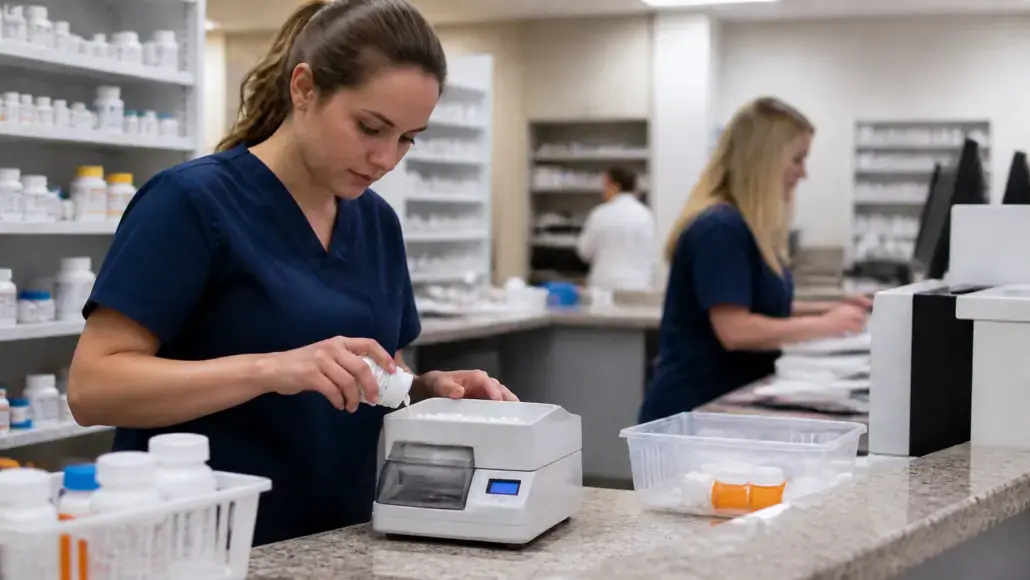
Counting is a single step in dispensing, yet it involves repeated hand handling. An automatic pill counter takes over that task, which may lower your exposure to errors. The reclaimed minutes could go toward verification and counseling, tasks that call for professional judgment.
4 Top Retail Pharmacy Pill Counter Options
A retail pharmacy pill counter balances speed, accuracy and ease of integration with the space and volume of a community setting.
1. Capsa Healthcare KL1v Tablet Counter
Built on the Kirby Lester platform from Capsa Healthcare, the KL1v Tablet Counter can process up to 15 pills per second, helping ease fill-time bottlenecks during staffing shortages. Kirby Lester devices have helped define pharmacy automation across North America since 1971.
2. McKesson CountAssist
For pharmacies not yet ready for full robotics, McKesson CountAssist offers a semi automated, cabinet-based path into automation at a lower cost. You can link up to 10 of these units, each holding 18 canisters, so capacity grows with prescription volume.
3. Outcomes PillCount
Outcomes PillCount counts tablets with computer vision and AI rather than a mechanical mechanism. Powered by an iPad, it occupies little space and can integrate with existing pharmacy management systems.
4. RxCount Rx-4
RxCount is a U.S. manufacturer that has made pill counters since 1967. The Rx-4’srotating turntable feeds tablets and capsules past an optical sensor, and at seven pounds, the unit is compact enough for workstations.
Preparing Your Pharmacy for a Pharmacy Tablet Counter
A smooth rollout starts with planning. Before bringing a pharmacy tablet counter into your workflow, identify the points where counting slows prescriptions down today. These factors can guide your decision:
- Volume and space: Daily fill counts and the open area beside your workstation determine which size and speed make sense.
- Staff training: Technicians often need a short adoption period to adjust their routines.
- System integration: Some machines connect to your pharmacy management system, while others run independently, so confirm which approach your team needs.
Count Smarter and Serve Patients Faster
Hand counting asks a great deal of teams that already carry heavy workloads, while automation may return accuracy and time to the day. The right investment could pay off in faster fills and fewer errors. Start by measuring how much time counting costs your team each week, then compare machines against that number. A well-chosen counter can ease pressure across your entire pharmacy.