









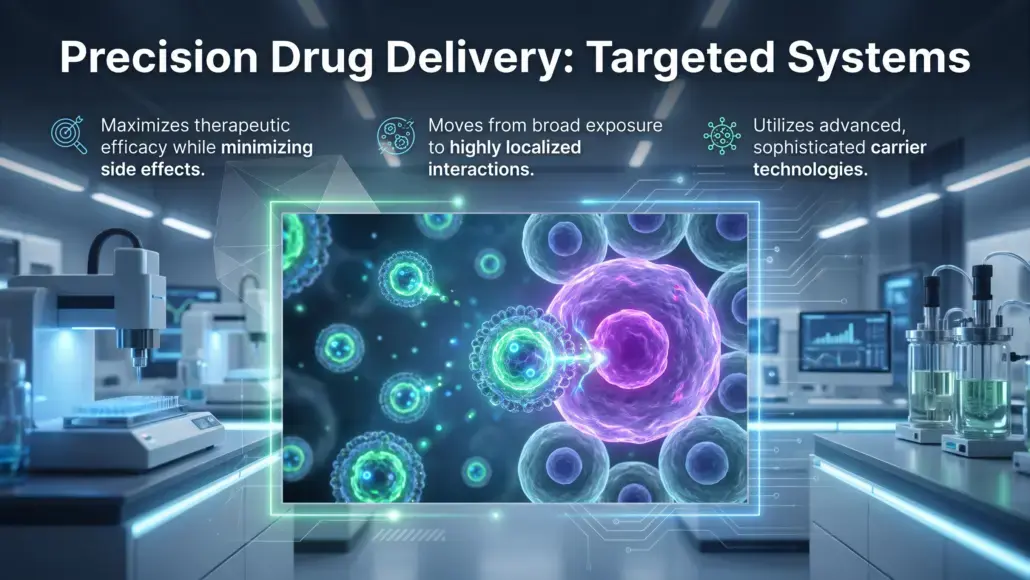
Precision in the delivery of therapeutic compounds remains a primary objective for pharmaceutical scientists seeking to maximize efficacy while minimizing the potential for systemic toxicity. The development of targeted delivery systems improving pharmacological agent localization represents a significant shift in how pharmacological interventions are administered, moving away from broad-spectrum systemic exposure toward highly localized cellular interactions. By utilizing sophisticated carrier platforms that respond to specific biological triggers or recognize unique surface markers, developers can ensure that active ingredients are concentrated at the site of pathology. This approach is particularly critical in fields like oncology and immunology, where the therapeutic window is often narrow and the consequences of off-target effects can be severe for the patient.
Molecular Recognition and the Engineering of Ligand-Receptor Affinities
The foundation of modern localized delivery lies in the precise engineering of molecular recognition elements that guide a therapeutic payload to its intended destination. Researchers are increasingly focusing on the identification of receptors that are overexpressed on the surface of diseased cells, such as certain proteins found on malignant tumors or inflamed vascular endothelium. By decorating the surface of delivery vehicles with specific ligands, including antibodies, peptides, or small molecules, it becomes possible to achieve high-affinity binding that tethers the drug carrier to the target cell. This specific interaction is the primary driver behind targeted delivery systems improving pharmacological agent localization, as it allows for the accumulation of the drug in the desired tissue even when systemic concentrations are kept low.
Additionally, the affinity of these ligands must be carefully balanced to ensure that the delivery system can penetrate deeply into the target tissue. If the binding affinity is too high, the carriers may become trapped at the periphery of the tissue, a phenomenon often referred to as the binding site barrier. Conversely, if the affinity is too low, the localization will be insufficient to achieve a therapeutic effect. Pharmaceutical engineers use advanced computational modeling and surface plasmon resonance techniques to fine-tune these interactions, ensuring that the carriers can bypass healthy tissues and selectively accumulate where they are needed most. This level of control over molecular interaction is essential for the next generation of biopharmaceuticals, where the complexity of the drug itself requires a more sophisticated delivery strategy.
Physicochemical Properties Governing Targeted Delivery Systems Improving Pharmacological Agent Localization
The physical and chemical characteristics of the delivery vehicle play a vital role in determining how effectively a drug can be localized within the body. Factors such as particle size, surface charge, and shape influence the circulation time and the eventual biodistribution of the therapeutic agent. Small nanoparticles, for example, are often able to exploit the leaky vasculature of tumors through the enhanced permeability and retention effect, allowing for a passive form of localization. However, to achieve active targeted delivery systems improving pharmacological agent localization, the surface properties must be modified to avoid rapid clearance by the mononuclear phagocyte system. The use of hydrophilic coatings, such as polyethylene glycol, helps to shield the particles from detection by the immune system, thereby extending their window of opportunity to reach the target site.
Beyond size and surface chemistry, the shape of the delivery vehicle has emerged as a critical parameter in localization efficiency. Non-spherical particles, such as rods or disks, exhibit different margination behaviors in the bloodstream, which can enhance their interaction with the vessel walls in the vicinity of the target tissue. This increased contact time facilitates the binding of ligands to their respective receptors, leading to higher rates of cellular uptake. By optimizing these physicochemical parameters, developers can create delivery platforms that are specifically tailored to the anatomical and physiological requirements of the target organ. This customization is a key component of the strategic effort to improve the localization of pharmacological agents across a wide range of therapeutic categories. The ability to manipulate the surface energy and hydrophobicity of these carriers allows for the creation of barriers that prevent non-specific protein adsorption, a process known as opsonization. By minimizing the formation of a protein corona, the delivery system can maintain its targeting functionality for a longer duration, increasing the likelihood of successful localization. Additionally, the use of microfluidic technologies in the production of these carriers ensures a high degree of monodispersity, which is essential for consistent pharmacokinetic behavior in a clinical setting. This precision in manufacturing is directly linked to the predictability of the localized delivery effect, providing a more reliable foundation for the development of new therapeutic protocols. By integrating these advanced physicochemical strategies, the pharmaceutical industry is better equipped to address the complexities of drug delivery in an increasingly sophisticated biological environment.
Overcoming Microenvironmental Barriers in Solid Tumor Localization
Localized delivery in solid tumors presents a unique set of challenges due to the complex and often hostile microenvironment of the cancerous tissue. High interstitial fluid pressure, dense extracellular matrix, and irregular vascular patterns all act as significant barriers to the effective penetration of drug carriers. To address these issues, pharmaceutical scientists are developing responsive targeted delivery systems improving pharmacological agent localization that can adapt to the specific conditions within the tumor. For instance, pH-sensitive carriers can be designed to release their payload only in the acidic environment typical of the tumor interstitium, while enzyme-responsive systems can be triggered by the presence of specific proteases that are upregulated by cancer cells.
These responsive technologies allow for a multi-stage delivery process, where the carrier first accumulates in the tumor via passive or active targeting and then undergoes a structural change to facilitate deeper tissue penetration or intracellular release. This approach helps to overcome the physical barriers that often limit the efficacy of conventional chemotherapy. Additionally, the use of ultrasound or magnetic fields to physically guide the carriers to the target site is being explored as a means of further enhancing localization. By combining biological targeting with physical triggers, the industry is moving toward a more integrated model of drug delivery that can tackle the most difficult-to-treat diseases with greater precision and reduced risk to the patient.
Intracellular Trafficking and Controlled Release Mechanisms
Once a delivery vehicle has successfully reached the target cell and been internalized, the challenge shifts to ensuring that the drug is released in the correct intracellular compartment. The pathway of endocytosis and subsequent trafficking through endosomes and lysosomes can significantly impact the stability and activity of the pharmacological agent. For many therapeutics, such as nucleic acids or certain proteins, escaping the endosomal compartment before degradation occurs is vital for success. Targeted delivery systems improving pharmacological agent localization are therefore being engineered with endosomal escape motifs, such as pH-responsive peptides or lipids that disrupt the endosomal membrane upon acidification.
The timing of drug release is also a critical factor in maintaining therapeutic efficacy. Controlled release mechanisms, such as biodegradable polymer matrices or stimulus-responsive linkers, allow for a sustained release of the drug over an extended period. This reduces the need for frequent dosing and helps to maintain a steady concentration of the drug at the site of action. By synchronizing the release profile with the biological rhythm of the target cell, developers can enhance the pharmacodynamic response while minimizing the potential for intracellular toxicity. This level of sophisticated engineering at the cellular level is a testament to the progress being made in the field of localized drug delivery, where every step of the process is optimized for maximum therapeutic impact. The complexity of these systems often requires a multidisciplinary approach, combining insights from materials science, cell biology, and pharmacology to create a cohesive delivery platform. By understanding the kinetics of intracellular transport, researchers can design carriers that are not only efficient in their delivery but also biocompatible and non-immunogenic. This ensures that the therapeutic intervention does not trigger an adverse immune response, which is a common challenge when introducing foreign particles into the systemic circulation. Additionally, the development of synthetic organelles and biomimetic carriers offers new opportunities for even more precise localization, potentially allowing for the repair of specific cellular functions in situ.
Clinical Validation and the Path to Precision Pharmaceutical Delivery
The transition from preclinical success to clinical application requires rigorous validation of the localization strategies in human subjects. Clinical trials must not only demonstrate the safety and efficacy of the drug but also provide evidence that the targeted delivery systems improving pharmacological agent localization are performing as intended in a complex biological environment. The use of advanced imaging techniques, such as positron emission tomography or magnetic resonance imaging, allows researchers to track the biodistribution of the carriers in real-time. This provides invaluable data on the efficiency of the localization process and helps to identify any potential off-target accumulation that could lead to adverse effects.
As the industry moves toward a more personalized approach to medicine, the ability to tailor delivery systems to the specific needs of the individual patient will become increasingly important. This may involve the use of diagnostic tools to identify the presence of specific receptors before initiating treatment, ensuring that the localized delivery strategy is appropriate for the patient’s unique biological profile. The continued refinement of these technologies will play a central role in the development of more effective and safer therapeutics, ultimately improving the outcomes for patients across a broad spectrum of diseases. The focus on localization is not just a technological trend but a fundamental shift in the philosophy of drug development, where the goal is to deliver the right drug to the right place at the right time.