









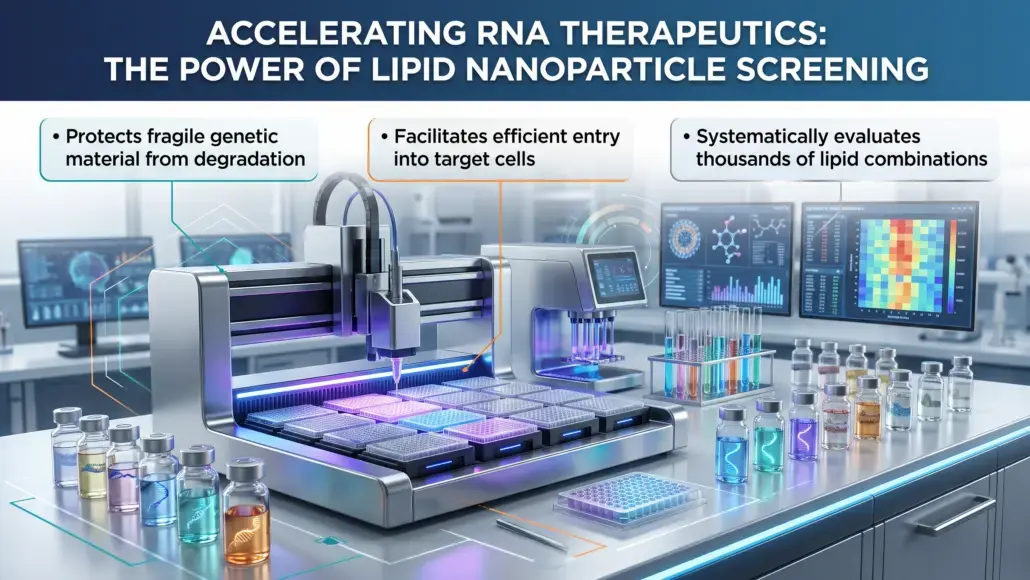
The recent success of ribonucleic acid therapeutics has been largely dependent on the development of effective vehicles capable of protecting fragile genetic material from enzymatic degradation while facilitating its entry into target cells. The process of lipid nanoparticle screening advancing oligonucleotide delivery has emerged as a cornerstone of this technological evolution, allowing researchers to systematically evaluate thousands of lipid combinations to identify the most potent formulations. By optimizing the ratio of ionizable lipids, cholesterol, helper lipids, and polyethylene glycol-lipids, pharmaceutical companies can significantly enhance the bioavailability of messenger RNA and small interfering RNA. This systematic approach is essential for overcoming the biological barriers that have historically limited the clinical application of gene-based therapies, providing a reliable pathway for the delivery of complex genetic payloads.
High-Throughput Methodologies for Ionizable Lipid Optimization
The core of any lipid nanoparticle formulation is the ionizable lipid, which is responsible for complexing with the negatively charged oligonucleotide and facilitating its escape from the endosomal compartment. High-throughput screening methodologies have revolutionized the identification of these lipids by enabling the rapid synthesis and testing of extensive chemical libraries. Through the use of automated liquid handling systems and microfluidic mixing, researchers can produce small-scale batches of nanoparticles with varying lipid compositions in a fraction of the time required by traditional methods. This accelerated process is a key driver of lipid nanoparticle screening advancing oligonucleotide delivery, as it allows for the exploration of a much wider chemical space than was previously possible.
These screenings focus on several critical parameters, including the pKa of the ionizable lipid, which determines its charge state at different pH levels. A lipid that is neutral at physiological pH but becomes positively charged in the acidic environment of the endosome is ideal for reducing systemic toxicity while maintaining high transfection efficiency. By correlating the chemical structure of the lipid with its biological performance, scientists can identify specific motifs that promote better interaction with the cellular membrane. This data-driven approach to lipid design ensures that the most promising candidates are prioritized for further development, reducing the time and cost associated with early-stage research. The integration of high-throughput data with computational modeling further refines this process, allowing for the prediction of lipid behavior before synthesis even begins.
Lipid Nanoparticle Screening Advancing Oligonucleotide Delivery Through Structural Analysis
The structural integrity and stability of the nanoparticle are vital for ensuring that the oligonucleotide remains functional until it reaches its intended site of action. Structural analysis, often performed as part of the screening process, provides insights into how different lipid components organize themselves within the particle. Techniques such as cryogenic transmission electron microscopy and small-angle X-ray scattering are used to visualize the internal morphology of the nanoparticles, revealing whether they possess a well-defined core-shell structure or a more disordered internal matrix. This level of detail is essential for understanding how the physical organization of the lipids influences the stability and release profile of the genetic payload.
Additionally, the process of lipid nanoparticle screening advancing oligonucleotide delivery involves evaluating how variations in lipid ratios impact the size and surface charge of the particles. A uniform size distribution is critical for ensuring consistent pharmacokinetic behavior and avoiding rapid clearance by the liver or spleen. By fine-tuning the concentration of polyethylene glycol-lipids, researchers can control the particle size and prevent aggregation during storage and distribution. This structural optimization is not only important for therapeutic efficacy but also for the practicalities of pharmaceutical manufacturing, where consistency and stability are paramount. The ability to characterize these structural parameters at a high level of resolution allows for the design of more resilient delivery platforms that can withstand the rigors of the clinical environment.
Overcoming Barriers to Endosomal Escape and Cytoplasmic Release
One of the most significant challenges in the delivery of oligonucleotides is ensuring their escape from the endosome after cellular uptake. If the genetic material remains trapped within the endosomal compartment, it will eventually be degraded by lysosomal enzymes, rendering the therapy ineffective. The systematic screening of lipid nanoparticles focuses heavily on identifying formulations that promote efficient endosomal escape. This is often achieved through the inclusion of helper lipids that can undergo a phase transition in response to the decreasing pH of the maturing endosome, leading to the disruption of the endosomal membrane.
The efficiency of this process is a primary metric in lipid nanoparticle screening advancing oligonucleotide delivery, as it directly correlates with the amount of functional RNA that reaches the cytoplasm. Researchers use fluorescent reporters and high-content imaging to track the intracellular trafficking of the nanoparticles in real-time, providing quantitative data on the rate of endosomal escape. By comparing different lipid formulations, it is possible to identify the specific molecular interactions that facilitate this critical step. Additionally, the study of how these particles interact with the intracellular transport machinery provides insights into how the delivery system can be further optimized for specific cell types or disease states. This focus on the cellular mechanisms of delivery ensures that the nanoparticles are not just passive carriers but are active participants in the therapeutic process. The complexity of the endosomal environment, with its shifting pH and enzymatic activity, requires a delivery vehicle that can respond dynamically to its surroundings. By engineering lipids that undergo specific conformational changes at precise pH values, researchers can maximize the release of the oligonucleotide while preventing the degradation of the genetic material. This level of precise control is particularly important for therapies that require high levels of gene expression or silencing to be effective. Additionally, the development of dual-purpose lipids that can both stabilize the particle during circulation and promote escape upon internalization represents a significant advancement in the field. These multifunctional components are the result of rigorous screening and optimization, highlighting the importance of a systematic approach to nanoparticle design.
Scalability and Manufacturing Consistency in LNP Formulations
As a promising nanoparticle formulation moves toward clinical trials, the ability to produce it at scale while maintaining consistent quality becomes a major consideration. The transition from small-scale laboratory production to large-scale commercial manufacturing requires a deep understanding of the variables that influence particle formation. Lipid nanoparticle screening advancing oligonucleotide delivery plays a vital role in this transition by identifying the manufacturing parameters that are most critical for maintaining the desired physical and chemical properties. Factors such as the flow rate during microfluidic mixing, the temperature of the lipid and aqueous phases, and the choice of buffer system can all impact the final quality of the product.
By establishing a clear link between these manufacturing variables and the biological performance of the nanoparticles, companies can develop more stable production processes. This involves the use of process analytical technology to monitor the particle formation in real-time, ensuring that each batch meets the required specifications for size, encapsulation efficiency, and purity. The ability to maintain this level of consistency is essential for regulatory approval and for ensuring the safety and efficacy of the drug in a clinical setting. Additionally, the development of scalable manufacturing solutions facilitates the rapid production of vaccines and therapeutics in response to global health crises, demonstrating the strategic importance of this technology beyond the development of individual drugs.
Therapeutic Implications for Rare Diseases and Personalized Genomic Medicine
The advancement of lipid nanoparticle technology has opened new possibilities for the treatment of rare diseases that were previously considered untreatable. By providing a reliable method for delivering gene-silencing or gene-replacement therapies, these platforms offer hope to patients with genetic disorders such as transthyretin-mediated amyloidosis or Duchenne muscular dystrophy. The process of lipid nanoparticle screening advancing oligonucleotide delivery allows for the rapid adaptation of the carrier platform to suit the specific needs of different genetic payloads, making it an ideal tool for the development of personalized genomic medicine.
In the future, the ability to customize the delivery system based on a patient’s unique genetic profile may become a standard part of therapeutic development. This could involve the use of patient-derived cells in the screening process to identify the most effective lipid formulation for a specific individual. The continued refinement of these screening methodologies will undoubtedly play a central role in the expansion of the RNA therapeutic ecosystem, enabling the development of more targeted and effective treatments for a wide range of conditions. As the industry continues to invest in these advanced delivery technologies, the potential for genomic medicine to transform the lives of patients worldwide becomes increasingly tangible. The focus on systematic screening and optimization ensures that the next generation of oligonucleotide therapies will be supported by a solid foundation of scientific evidence and technological excellence. The development of targeted lipid nanoparticles, which can home in on specific tissues such as the lung or heart, represents a new frontier for RNA medicine. By incorporating targeting ligands into the nanoparticle surface, researchers can achieve tissue-specific delivery, further reducing the potential for systemic toxicity and improving the overall safety profile of the therapy. This targeted approach is especially beneficial for chronic conditions where long-term administration is required. Additionally, the integration of digital twins and artificial intelligence into the screening process is expected to accelerate the discovery of new lipid candidates, providing a continuous pipeline of innovation for the pharmaceutical sector. This holistic view of the development cycle, from molecular design to clinical application, is essential for the long-term success of genetic medicine.