











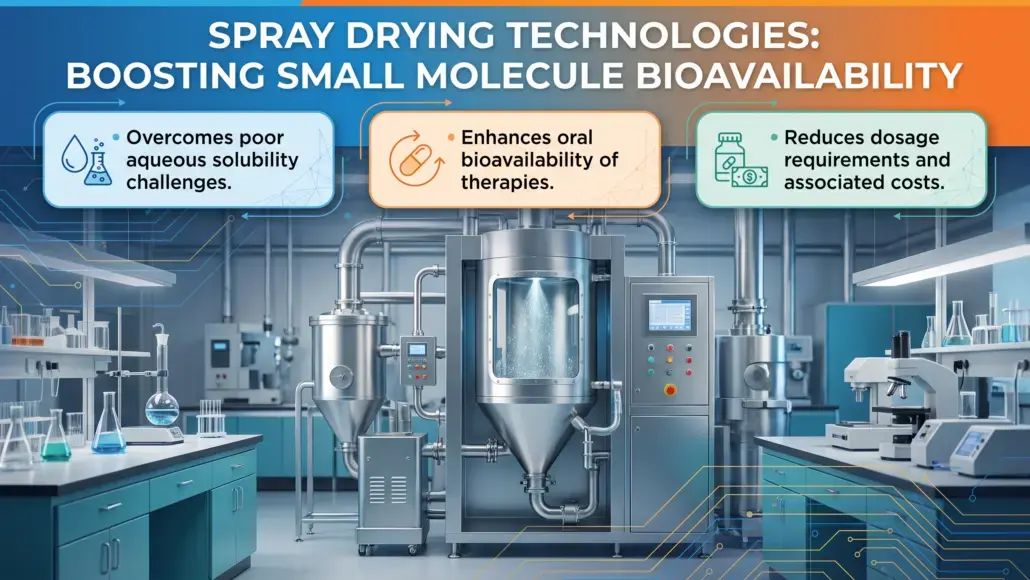
The pharmaceutical industry faces a persistent challenge in the development of new small molecule therapies, as a high percentage of candidates exhibit poor aqueous solubility. This characteristic significantly limits their oral bioavailability, often requiring higher doses that can lead to increased side effects and manufacturing costs. To address these limitations, manufacturers are increasingly adopting spray drying technologies as a primary method for solubility enhancement. This technique allows for the rapid conversion of a liquid feed into a dry powder through the use of a hot gas stream, resulting in particles with controlled size, morphology, and physical state. By creating amorphous solid dispersions, these advanced methodologies can dramatically improve the dissolution rate and systemic absorption of hydrophobic drug substances, providing a more reliable therapeutic profile for patients.
Formation of Amorphous Solid Dispersions via Spray Drying
The creation of an amorphous solid dispersion is one of the most effective strategies for increasing the solubility of Class II and Class IV compounds under the Biopharmaceutics Classification System. In this state, the drug molecules are randomly distributed within a polymer matrix, preventing the formation of a crystalline lattice. These specialized platforms are uniquely suited for this purpose because they involve an almost instantaneous transition from a solution to a solid, which kineticly traps the drug in its amorphous form. The selection of the polymer carrier is critical, as it must not only be compatible with the drug but also provide sufficient stabilization to prevent recrystallization during storage. Scientists utilize advanced thermal analysis and spectroscopic techniques to evaluate the glass transition temperature and molecular interactions within these dispersions.
The process begins with the dissolution of both the drug and the polymer in a common organic solvent or solvent blend. This solution is then atomized into fine droplets within the spray dryer, where they encounter a high velocity stream of heated nitrogen or air. The rapid evaporation of the solvent leads to the formation of solid particles that are collected via a cyclone or filter system. The technical advantage of this approach lies in its ability to produce highly uniform particles with a high drug loading capacity. Additionally, the process is continuous and highly scalable, making it suitable for both early stage clinical batches and large scale commercial production. The precision offered by modern equipment allows for the fine tuning of particle properties to meet the specific requirements of the final dosage form. The implementation of specific gas flow rates and nozzle configurations facilitates the creation of unique particle architectures that can protect sensitive payloads from environmental factors. These engineering capabilities are particularly important when dealing with molecules that are prone to oxidation or moisture induced degradation. By creating a physical barrier within the particle itself, manufacturers can extend the shelf life and maintain the potency of the drug product. The ability to control the density and porosity of the particles also provides opportunities for designing delivery systems that can be easily reconstituted or integrated into specialized inhalation devices. This versatility is a primary reason for the widespread adoption of these methods across the pharmaceutical sector.
Particle Engineering for Enhanced Downstream Processing
Beyond solubility enhancement, spray drying technologies provide significant benefits in terms of particle engineering and downstream manufacturability. The physical characteristics of the resulting powder, such as flowability, bulk density, and compressibility, are vital for successful tableting or capsule filling. Traditional milling processes can often lead to irregular particle shapes and wide size distributions, which can cause issues during high speed manufacturing. In contrast, spray drying allows for the creation of spherical particles with a narrow size range, which naturally exhibits superior flow properties. By adjusting parameters such as nozzle type, atomization pressure, and feed concentration, engineers can design particles that are optimized for their intended application.
The ability to control the surface composition of the particles is another significant advantage of this technology. For instance, hydrophobic drugs can be encapsulated within hydrophilic shells to further enhance their interaction with gastric fluids. This level of particle architecture is essential for developing high performing oral solid doses that meet stringent quality standards. Additionally, the dry powders produced are often highly stable and easy to handle, reducing the risk of material loss or contamination during transport and storage. The integration of real time particle size analysis within the spray drying system allows for continuous monitoring and adjustment of the process, ensuring a high degree of consistency between batches. This focus on particle quality is a key driver of efficiency in modern pharmaceutical development.
Thermal Management and Stability of Heat Sensitive Molecules
One of the common misconceptions regarding spray drying is that the high temperatures involved may degrade heat sensitive drug molecules. However, the actual temperature experienced by the drug particles is significantly lower than the inlet gas temperature due to the cooling effect of solvent evaporation. This unique characteristic makes spray drying technologies suitable for a wide range of sensitive compounds, including certain biologicals and complex small molecules. By carefully managing the residence time and the outlet temperature, manufacturers can ensure that the drug remains chemically stable throughout the process. Sophisticated heat balance models are used to predict the thermal profile within the drying chamber, allowing for the optimization of operating conditions.
To further protect sensitive materials, many modern spray dryers are equipped with closed loop systems that utilize inert gases and low temperature configurations. These systems allow for the safe handling of flammable solvents and oxygen sensitive materials, providing a highly controlled environment for drug processing. The ability to process heat sensitive molecules with high efficiency is a critical requirement for many modern therapies, particularly those involving advanced delivery systems. Additionally, the rapid drying time minimizes the exposure of the drug to potentially degradable conditions, further enhancing the overall quality of the product. The continuous advancement in thermal management systems is expanding the applicability of spray drying to an even broader range of pharmaceutical ingredients. This increased flexibility allows for the processing of biological substances and other macromolecular structures that were previously considered unsuitable for thermal drying methods. The use of cryogenic cooling systems and specialized drying chambers can further reduce the thermal stress on these delicate molecules, preserving their structural integrity and biological activity. This expansion of capabilities is enabling the development of new therapies that were once thought to be technically unfeasible. The focus on preserving molecular stability while achieving high throughput manufacturing is a hallmark of modern pharmaceutical engineering. As the pipeline of complex drugs continues to grow, the demand for these sophisticated drying solutions will only increase.
Scalability and Global Manufacturing Integration
The transition from laboratory scale development to commercial manufacturing is a critical phase in the drug development lifecycle. The spray drying technologies are inherently scalable, with equipment available ranging from benchtop units for feasibility studies to large industrial systems capable of processing several hundred kilograms per hour. This scalability reduces the risk of process failure during tech transfer and ensures that the quality attributes established during early development are maintained at scale. Leading CDMOs are increasingly investing in global spray drying networks to provide their clients with a reliable and flexible manufacturing solution. This integration allows for a more streamlined supply chain and ensures that life saving medications can be delivered to markets around the world with minimal delay.
The implementation of Quality by Design principles in spray drying processes is essential for achieving a high level of regulatory compliance. By establishing a well defined design space and utilizing advanced process analytical technology, manufacturers can demonstrate a deep understanding of the factors influencing product quality. This proactive approach to quality management is highly valued by regulatory agencies and helps in accelerating the approval process for new drug applications. In addition to technical benefits, the high efficiency and low waste associated with spray drying contribute to the overall sustainability of the manufacturing process. The ability to produce high quality, stable powders in a single step reduces the need for multiple intermediate processing stages, further lowering the cost and complexity of pharmaceutical production.
Innovation in Solvent Recovery and Environmental Impact
As the pharmaceutical industry places a greater emphasis on environmental sustainability, the management of organic solvents used in spray drying has become a primary focus. Modern industrial configurations incorporate advanced solvent recovery systems that allow for the safe and efficient recycling of these materials. These systems utilize condensation and distillation techniques to capture evaporated solvents from the exhaust gas, reducing the overall environmental footprint of the manufacturing process. In addition to environmental benefits, solvent recovery leads to significant cost savings by reducing the volume of new materials that must be purchased and the amount of waste that must be treated.
The development of water based spray drying processes is another area of active research, which aims to eliminate the need for organic solvents entirely for certain applications. While this remains challenging for many hydrophobic drugs, the use of specialized surfactants and solubility enhancers is making this approach more viable. The ongoing commitment to green chemistry and sustainable manufacturing is driving the continuous improvement of spray drying equipment and processes. By focusing on both technical performance and environmental responsibility, the pharmaceutical industry is ensuring that spray drying remains a vital and responsible technology for the future of drug development. The transition toward more sustainable manufacturing practices is not only a regulatory requirement but also a critical component of corporate social responsibility for modern pharmaceutical organizations.