














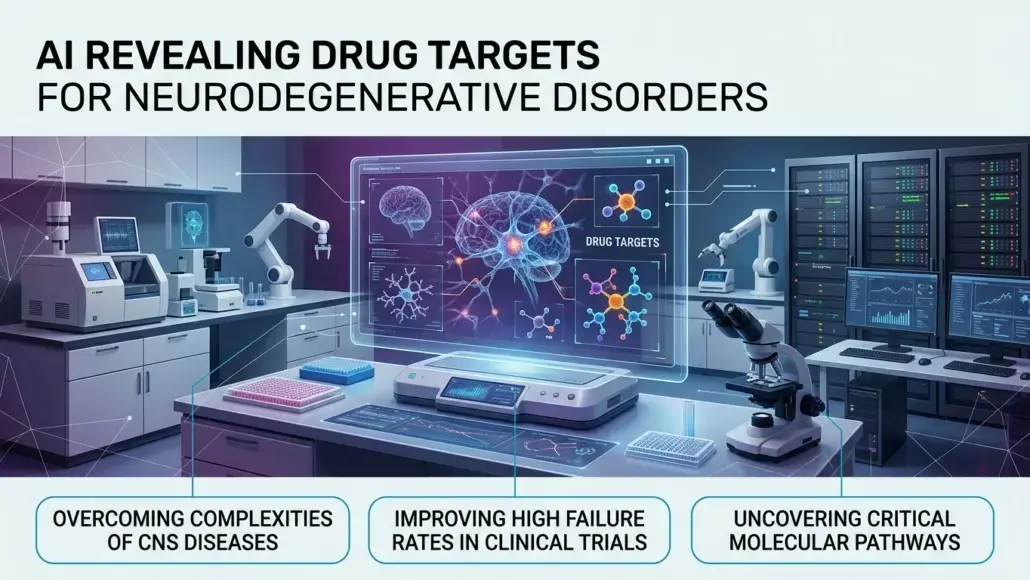
The pharmaceutical industry has long struggled with the immense complexity of conditions affecting the central nervous system. For decades, the high failure rate in clinical trials for Alzheimer’s and Parkinson’s disease has been a source of frustration for researchers and a significant financial burden for investors. The primary challenge lies in the intricate and often poorly understood molecular pathways that drive the progression of these conditions. Traditional research methods, which often focused on a single protein or pathway, have frequently failed to account for the systemic nature of the disease. However, the introduction of advanced computational modeling is providing a new path forward. The implementation of AI Revealing Drug Targets for neurodegenerative disorders is allowing scientists to map the internal workings of the brain with unprecedented clarity.
Central to this advancement is the ability to process and synthesize vast amounts of diverse biological data. From genomic and proteomic profiles to specialized imaging of the brain, the volume of information is far beyond the capacity of human analysis alone. Artificial intelligence systems can identify the subtle correlations between genetic variants and the early stages of disease progression, highlighting potential intervention points that were previously invisible. This shift toward a more holistic and data-driven approach is a fundamental requirement for the modern pharmaceutical sector as it attempts to address the growing global burden of neurodegenerative disorders.
Mapping Complex Molecular Pathways in the Central Nervous System
The human brain is perhaps the most complex structure in the known universe, and its molecular pathways are equally intricate. In the context of neurodegenerative disorders, the failure of traditional research has often been due to an incomplete understanding of how these pathways interact and cross-talk. Modern analytical platforms are now being used to create high-fidelity digital models of the central nervous system, allowing researchers to simulate how different molecular events trigger the onset of disease. These models do not merely show the final state of the disease; they provide a dynamic view of how it evolves over time, highlighting the specific targets where a drug might be most effective.
Furthermore, the integration of these models into the early stages of discovery ensures that the resulting research programs are focused on the most viable biological hypotheses. By identifying the critical nodes in a molecular network that, if modulated, could halt or reverse the disease, pharmaceutical firms can prioritize their investments. This strategic focus is vital for improving the return on investment in a sector that has historically been defined by high-risk and low-success rates. The ability to provide a clear and data-driven justification for every new project is essential for earning the trust of the scientific and financial communities in the current environment.
Decoding Protein Folding and Misfolding in Brain Health
One of the defining characteristics of conditions like Alzheimer’s and Parkinson’s is the accumulation of misfolded proteins, such as amyloid-beta, tau, and alpha-synuclein. The process of protein folding is one of the most fundamental and complex events in biology, and its disruption is a primary driver of neurodegeneration. Artificial intelligence, particularly through advanced structural prediction tools, has revolutionized our ability to understand how proteins fold into their three-dimensional shapes. By modeling the physics of these interactions, AI can predict how specific genetic mutations lead to misfolding and the subsequent formation of toxic aggregates.
This capability is essential for the identification of new drug targets that can prevent or reverse the misfolding process. Instead of simply attempting to clear the aggregates after they have formed, researchers are now looking for ways to stabilize the healthy state of the protein. AI allows for the screening of millions of small molecules to identify those that can bind to a protein and prevent it from adopting a toxic conformation. This proactive approach to drug design is a significant technical shift, providing a new level of precision in the search for effective therapies for neurodegenerative disorders. The commitment to understanding the fundamental physics of the disease is what will drive the next generation of medical breakthroughs.
Identifying Novel Targets for Alzheimer’s and Parkinson’s Disease
The search for effective treatments for Alzheimer’s and Parkinson’s has been characterized by a narrow focus on a few well-known targets, such as the amyloid hypothesis. While these efforts have yielded some progress, it is increasingly clear that a more diverse range of targets is needed to address the heterogeneity of these conditions. Artificial intelligence is now being used to identify entirely new classes of drug targets by analyzing the molecular signatures of patients at different stages of the disease. These analytical tools can highlight the role of neuroinflammation, mitochondrial dysfunction, and lipid metabolism in the progression of the disease, providing a wealth of new opportunities for therapeutic intervention.
By correlating these diverse biological factors with clinical symptoms, AI can help researchers identify the specific subtypes of patients who are most likely to respond to a particular treatment. This is a vital component of the move toward precision medicine for neurodegenerative disorders, ensuring that the right patient receives the right drug at the right time. The ability to identify these novel targets and validate them in silico before moving to the laboratory is a major technical advantage that is accelerating the development of the next generation of neurotherapeutics. The focus remains on creating a dynamic and responsive research environment that can adapt to the growing complexity of the field.
The Future Strategic Landscape of Neurotherapeutics
As the pharmaceutical industry continues to advance, the role of data-intensive research will only grow in importance. The successful implementation of AI Revealing Drug Targets for neurodegenerative disorders requires a fundamental reorganization of the research and development process. This involves the integration of data scientists and computational biologists into every stage of the discovery cycle, from target identification to clinical trial design. The focus is no longer just on the biology of the brain, but on the ability to turn that biological information into actionable therapeutic insights.
Looking ahead, the coordination of global research efforts through shared data platforms will be essential for addressing the most difficult challenges in the field. By breaking down the silos that have traditionally separated research institutions, the industry can leverage a much larger pool of data to identify new targets and develop more effective treatments. The commitment to transparency and professional collaboration is a key factor in the long-term success of the efforts to treat neurodegenerative disorders. The ultimate goal is the creation of a global research ecosystem that can deliver on the promise of effective therapies for every individual suffering from these devastating conditions.


