



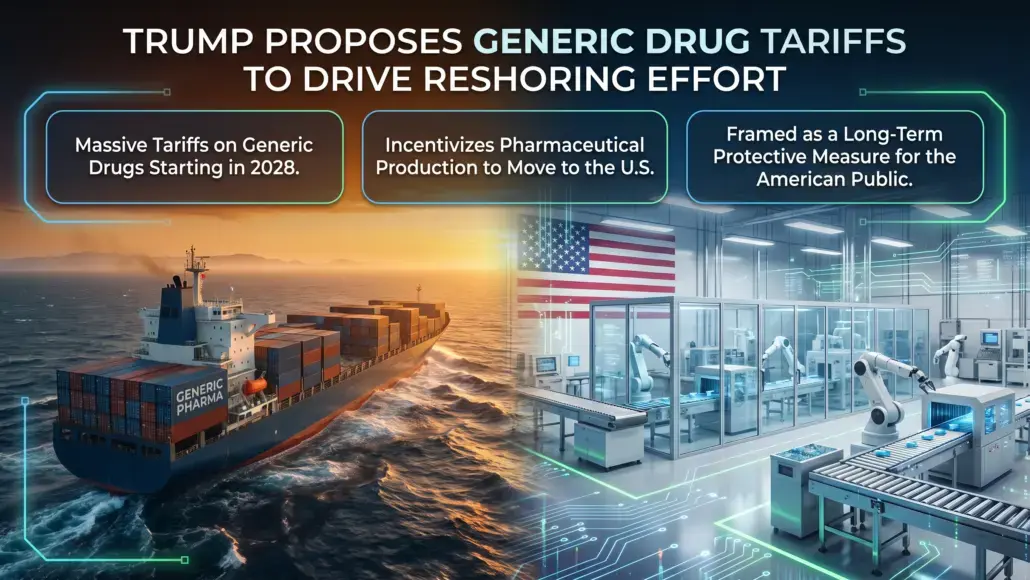
President Donald Trump announced plans to implement massive generic drug tariffs starting at 100% in August 2028, scaling up to 200% in August 2029, in an effort to incentivize the pharmaceutical industry to move production to the United States.
The proposed policy imposes a timeline that extends beyond Trump’s current term in office. Describing the measure as a protective policy for the American public, Trump outlined the initiative as a direct measure to penalize companies that do not establish infrastructure within the country during the designated timeframe.
“This is done in order to RESHORE Generic Pharmaceutical Production into America, with a penalty to those Companies that decide not to build Plant and Equipment within the stated period of time given to them. The objective of this Policy is to protect the people of the United States,” Trump stated in a post.
Supply Chain Vulnerabilities and Market Realities
Generic medications represent the vast majority of prescriptions filled by American patients. Currently, these essential medicines are predominantly manufactured overseas, particularly in India, while relying heavily on raw active ingredients sourced from China. This heavy international reliance has raised bipartisan concerns regarding potential disruptions to the critical medical supply chain during geopolitical conflicts or international crises.
However, industry analysts highlight significant operational obstacles to reshoring this sector. Unlike brand-name producers, generic drugmakers compete primarily on price and generate profits through high production volume. Consequently, many generic drugmakers maintain tight profit margins, leaving limited operational room to absorb steep import taxes.
Industry Impacts and Market Dynamics
Under the proposed generic drug tariffs, manufacturers would face four primary strategic options: absorb the added tariff costs, pass price increases onto consumers, invest significant capital into U.S. domestic manufacturing, or exit the American marketplace entirely. The administration has not yet detailed specific product lists or potential exemption frameworks, leaving uncertainty around whether companies have sufficient predictability to commit to long-term facility investments.
Rena Conti, an associate professor at Boston University’s Questrom School of Business who researches the pharmaceutical industry, analyzed both the potential benefits and risks of the strategy.
“This brings capacity manufacturing capacity back into the United States, and there’s going to be firms that are going to be able to do it,” Conti noted. “But on the on the flip side, there are drugs that are really only made external to the United States by pretty low-cost producers and exits from the U.S. market can create conditions for shortage or will push people to use much more expensive brands.”
Broader Policy Context and Trade Strategy
Because generic companies operate on lower margins than brand-name manufacturers and only enter the market after patent protections expire, smaller firms specializing in low-margin products may struggle most with compliance costs or forced expansion into domestic manufacturing.
While the administration contends that expanding domestic capacity will secure the nation’s healthcare supply chain, analysts caution that immediate cost pressures could trigger market shortages or elevate drug prices if firms cannot absorb the tariffs.
“Having more investment in American in resilient supply of generics is absolutely mission critical for the U.S.,” Conti said. “But threatening firms and countries with very significant tariffs without a consistent on ramp for investment is not necessarily the best way of getting of getting serious investment.”
The proposal represents the latest trade directive aimed at pressuring drug companies to expand their domestic footprint. While several major brand-name manufacturers previously committed to building U.S. facilities alongside negotiations tied to the “most favored nation” policy—which exempted compliant firms from tariffs for three years—few generic producers have followed suit. Trump stated that policy efforts surrounding branded medications will continue, adding, “Pharmaceutical Facilities are being built, at a level never seen before, all over the United States of America.” Analysts suggest the announcement may serve as an initial negotiating stance to engage generic manufacturers in formal discussions.