









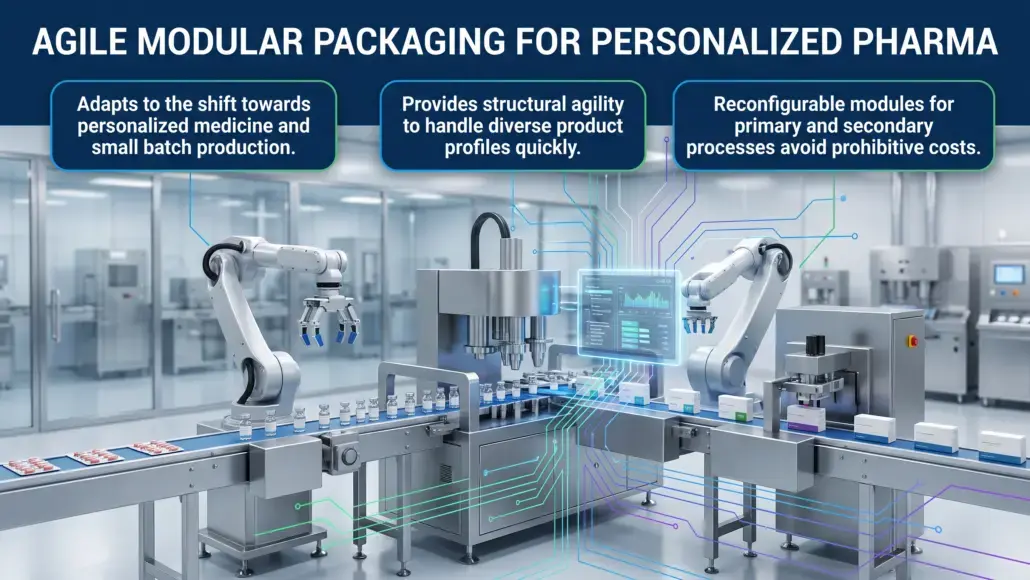
The pharmaceutical manufacturing sector continues to experience a significant shift toward personalized medicine and smaller batch sizes, which places immense pressure on traditional production lines. This trend has led to the adoption of advanced systems that provide the structural agility required to handle diverse product profiles without the prohibitive costs of dedicated lines. By utilizing interchangeable modules, manufacturers can reconfigure their primary and secondary packaging processes to accommodate different blister sizes, vial dimensions, or carton formats. This design philosophy focuses on the decoupling of mechanical functions, allowing specific units to be swapped or upgraded without necessitating a complete overhaul of the existing infrastructure. The integration of these systems facilitates a more responsive manufacturing environment where the time between production runs is minimized, directly impacting the bottom line. Technical implementation of modularity often involves standardized interfaces and plug-and-play components. When a facility needs to transition from a solid dosage blister pack to a liquid fill syringe, modular packaging machinery allows the operator to exchange the feeding and sealing units while retaining the core transport and control systems. This versatility is essential for Contract Development and Manufacturing Organizations (CDMOs) that must remain ready to serve multiple clients with varying packaging requirements. Beyond the physical hardware, the software governing these machines must also be adaptable, featuring recipe-based control systems that automatically adjust parameters such as temperature, pressure, and speed based on the module installed. The result is a highly synchronized operation that maintains consistent quality standards across all formats, ensuring that regulatory requirements for packaging integrity are met regardless of the specific product being processed.
Facilitating Rapid Format Changeovers in Multi-Product Facilities
One of the most significant barriers to high productivity in pharmaceutical packaging is the downtime associated with format changeovers. In conventional setups, changing a line to accommodate a different product could take hours or even days, involving manual adjustments and extensive cleaning protocols. These flexible systems address this bottleneck by standardizing the changeover process through tool-less adjustments and pre-validated modules. Operators can quickly remove one assembly and replace it with another that has already been calibrated for the new product. This capability is particularly advantageous in facilities handling high-potency drugs where cleaning validation is stringent, as dedicated modules for specific products can prevent cross-contamination risks while keeping the main machine base operational. The reduction in changeover time does not only improve throughput but also enhances the overall equipment effectiveness (OEE) of the packaging suite. By streamlining the mechanical transition, manufacturers can increase the frequency of production cycles, which is vital for maintaining lean inventory levels and responding to sudden market demands. Additionally, formable pharmaceutical packaging materials play a vital role in these transitions by ensuring that the equipment can handle various substrate thicknesses and shapes without mechanical failure. The synergy between flexible materials and the machinery creates a resilient ecosystem where innovation in drug delivery can be matched by equally innovative packaging solutions. This flexibility ensures that the investment in capital equipment remains relevant even as the product portfolio evolves, providing long-term value and stability for the organization.
Standardization Strategies for Global Manufacturing Networks
For global pharmaceutical companies, maintaining consistency across multiple manufacturing sites is a complex logistical challenge. The adoption of this technology provides a framework for standardization that simplifies training, maintenance, and spare parts management. When the same modular architecture is deployed across different regions, technical teams can share best practices and troubleshooting protocols more effectively. A technician in one facility can provide guidance to a peer in another country because the underlying mechanical logic and interface are identical. This uniformity reduces the learning curve for operators and ensures that packaging quality remains consistent whether the product is being packaged in Europe, North America, or Asia. Additionally, standardization through modularity allows for more efficient capacity planning. If one site experiences a surge in demand, modules can theoretically be transferred between locations to balance the workload, provided the base machines are compatible. This level of operational flexibility is rarely possible with bespoke, fixed-format machinery. The ability to scale production up or down by adding or removing modules also aids in managing the lifecycle of a product. During the initial launch phase, a small modular setup can handle low volumes, and as the product gains market share, additional modules can be integrated to increase output. This staged investment approach mitigates financial risk and allows for a more controlled expansion of manufacturing capabilities, aligning capital expenditure with actual revenue growth.
Validation and Regulatory Compliance in Reconfigurable Lines
Maintaining a validated state is a non-negotiable requirement in pharmaceutical packaging, and modular systems introduce unique considerations for compliance. Each module must be independently validated and then verified as part of the total system configuration. Equipment manufacturers are increasingly providing comprehensive documentation and pre-validation packages to assist their clients in this process. By treating each module as a discrete unit with defined inputs and outputs, the complexity of system-wide re-validation is significantly reduced. Changes to one part of the line do not necessarily require a full re-qualification of the entire system, provided the interfaces remain within the established specifications. This modular approach to validation accelerates the time-to-market for new products and simplifies the management of change controls. Regulatory bodies like the FDA and EMA require strict adherence to Good Manufacturing Practices (GMP), which include the assurance that packaging equipment does not adversely affect the drug product. Modular designs facilitate easier access for inspection and cleaning, which is essential for maintaining a sanitary environment. The use of advanced materials such as pharmaceutical-grade stainless steel and high-performance polymers in module construction ensures that the equipment can withstand rigorous sterilization procedures. As the industry moves toward more complex biopharmaceuticals and cell therapies, the ability to maintain a sterile environment within a modular framework will become even more critical. The flexibility offered by these systems allows manufacturers to adapt to new regulatory guidelines quickly, ensuring that their packaging operations remain compliant and their products remain safe for patient use.
Cost Analysis and Total Cost of Ownership
The financial justification for investing in these advanced systems extends beyond the initial capital expenditure, requiring a detailed analysis of the total cost of ownership (TCO) over the equipment’s lifespan. While modular systems may carry a higher upfront cost compared to fixed-format machines, the long-term savings in maintenance, spare parts, and downtime often result in a much lower TCO. The ability to share modules across different lines and facilities further enhances the return on investment (ROI) by maximizing equipment utilization. Manufacturers must also consider the cost of floor space, as modular designs often allow for more compact and efficient layouts. By reducing the need for multiple dedicated lines, companies can significantly decrease their utility consumption and overhead costs, contributing to a more sustainable and profitable operation. Additionally, the reduced risk of technological obsolescence is a critical factor in the financial appeal of modularity. In a rapidly evolving pharmaceutical market, the ability to adapt to new packaging requirements without replacing the entire infrastructure is a significant competitive advantage. The modular approach allows for incremental investments in new technologies as they become necessary, spreading out the capital expenditure and aligning it with revenue growth. This staged investment strategy is particularly beneficial for small to mid-sized pharmaceutical companies and biotech startups that may have limited access to capital but need to maintain a high level of manufacturing flexibility. By carefully evaluating the long-term financial benefits of these designs, organizations can make more informed decisions about their packaging strategies and ensure their long-term viability in the global market.
Lifecycle Management and Scalability of Modular Systems
The long-term success of a pharmaceutical packaging operation depends on its ability to adapt to technological advancements and changing market conditions. The modular packaging machinery offers a sustainable path for lifecycle management by allowing for incremental upgrades. Instead of replacing an entire packaging line when a new technology emerges, such as advanced serialization or anti-counterfeiting measures, manufacturers can simply integrate a new module that incorporates the latest features. This ability to future-proof the equipment protects the initial investment and ensures that the facility remains at the forefront of industry standards. The scalability of these systems also allows for a more efficient use of floor space, as modules can be arranged in various configurations to fit the specific constraints of the production area. In addition to physical scalability, modular systems support the integration of digital technologies and Industry 4.0 principles. The use of smart sensors and data analytics within each module provides real-time insights into machine performance and product quality. This data can be used to predict maintenance needs, optimize energy consumption, and identify opportunities for further process improvement. The modular nature of the hardware is mirrored by a modular approach to data management, where information from different stages of the packaging process is aggregated to provide a comprehensive view of the entire operation. As the pharmaceutical industry continues to embrace digital transformation, modular packaging machinery will serve as the physical foundation for a more connected and intelligent manufacturing ecosystem, driving efficiency and innovation for years to come.