













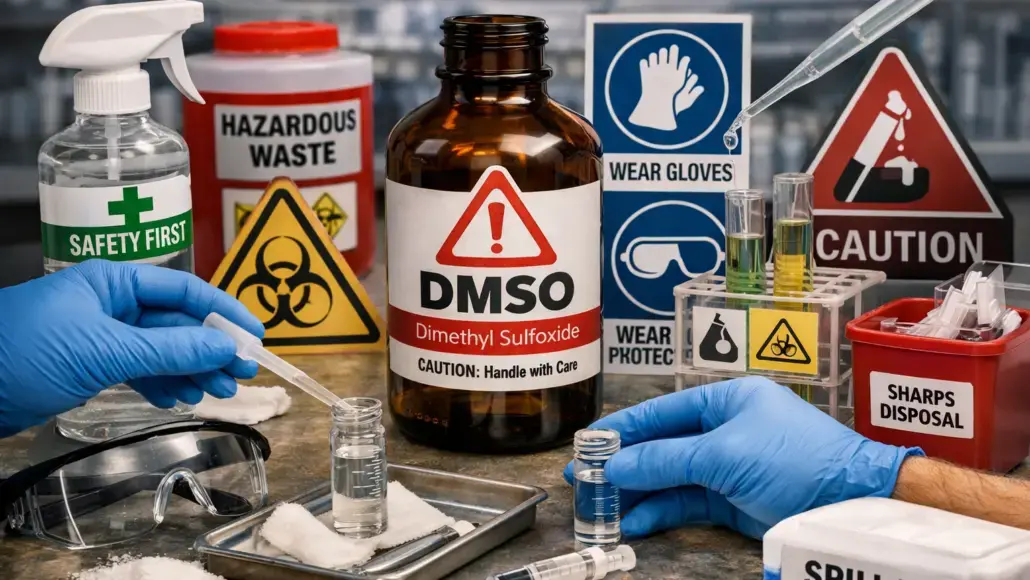
Dimethyl sulfoxide (DMSO) is one of the most widely used solvents in pharmacological research. Its ability to dissolve a broad range of organic compounds including many that are poorly soluble in aqueous media has made it a default choice for compound library preparation, high-throughput screening, and cell-based assays. Despite its near-universal adoption, DMSO is not a pharmacologically inert vehicle. It carries biological activity of its own, interacts with both biological systems and laboratory materials, and introduces specific sources of experimental error when used without adequate controls. Understanding these properties is a prerequisite for designing experiments in which DMSO-related variables are properly accounted for.
Why DMSO Is So Widely Used
The primary reason for DMSO’s prevalence is its solubilizing capacity. Many drug candidates and bioactive compounds belong to BCS Class II or IV they have low aqueous solubility that limits their direct use in water-based assay systems. DMSO dissolves these compounds readily, enabling preparation of concentrated stock solutions that can be diluted into aqueous buffers or cell culture media at the point of use.
In compound library management, DMSO stocks offer a practical advantage: most small molecules remain chemically stable in DMSO over extended storage periods, particularly at −20°C or −80°C. This stability, combined with compatibility with liquid handling automation, has made DMSO the standard solvent format in high-throughput screening operations.
A further property that distinguishes DMSO from many organic solvents is its ability to penetrate biological membranes. This facilitates intracellular delivery of dissolved compounds in certain experimental contexts. However, this same property has direct implications for experimental safety and data interpretation, as any co-dissolved contaminant gains the same access to the intracellular environment.
Biological Risks and Experimental Interference
Concentration-Dependent Cytotoxicity
The most frequently cited limitation of DMSO in cell-based research is its cytotoxicity at elevated concentrations. At or below 0.1% (v/v), DMSO is generally tolerated by most mammalian cell lines with minimal effect on viability or proliferation. Above 0.5%, cytotoxic effects become measurable in many systems, and at concentrations of 1% or higher, significant cell death and disruption of normal cellular function are commonly observed.
The practical consequence is that final DMSO concentration must be held constant across all experimental conditions treated wells, vehicle controls, and any reference compound groups. If DMSO concentration varies between groups, its own biological effects become a confounding variable. This is particularly relevant in dose-response experiments, where higher compound concentrations may inadvertently introduce higher DMSO concentrations unless stocks are normalized.
It is also worth noting that DMSO sensitivity varies between cell lines. A concentration tolerated by one cell type may produce measurable toxicity in another. For any new cell model, empirical determination of the acceptable DMSO range is advisable before compound screening begins.
Effects on Proteins and Enzyme Activity
At concentrations above those typically used in cell culture, DMSO can alter protein conformation and disrupt non-covalent interactions that maintain enzyme and receptor structure. In biochemical assays particularly those measuring enzyme kinetics, receptor binding, or protein-protein interactions residual DMSO in reaction mixtures can affect the measured parameters independently of the test compound.
This is especially relevant in assays involving kinases, GPCRs, and nuclear receptors, where structural integrity of the binding site directly determines assay readout. Published data on DMSO tolerance should be interpreted with caution when applied to assay systems that differ from those in which the tolerance data were generated.
Interaction with Plastic Consumables
A less frequently discussed but experimentally significant issue is DMSO’s interaction with polymeric laboratory materials. DMSO is a powerful aprotic solvent with high solvating capacity, and at elevated concentrations it can extract processing additives including plasticizers, antioxidants, and mold-release agents from plastic consumables into the sample.
Polystyrene (PS), commonly used in standard microplates and storage tubes, shows measurable susceptibility to DMSO-mediated leaching, particularly at DMSO concentrations above 10%. Polypropylene (PP) offers better chemical resistance and is the preferred material for DMSO-containing sample storage. Beyond leaching, prolonged contact between high-concentration DMSO and incompatible plastics can cause dimensional changes or compromise seal integrity in capped tubes, with consequences for long-term storage reliability.
For researchers sourcing consumables for DMSO-based workflows, material compatibility data should be requested from suppliers. Suppliers operating under certified quality management systems such as ISO 13485, which governs medical device manufacturing and encompasses raw material traceability and production consistency are better positioned to provide validated material specifications and batch documentation. Selecting laboratory plastic consumables from qualified suppliers reduces the risk of introducing uncharacterized chemical variables through the container itself.
Hygroscopicity and Concentration Drift
DMSO is strongly hygroscopic. Exposure to ambient air during handling causes progressive water absorption, which dilutes stock solutions below their nominal concentration. In quantitative experiments particularly those establishing concentration-response relationships this introduces a systematic downward bias in effective compound concentration that is easy to overlook.
Practical Handling Recommendations
Concentration discipline: Maintain final DMSO concentration at ≤0.1% (v/v) in cell-based assays where possible. Include vehicle controls at the same concentration as the highest treatment group. For biochemical assays, establish empirically the concentration at which DMSO begins to affect the specific assay readout.
Stock management: Prepare DMSO stocks in sealed, single-use or minimal-use aliquots to limit atmospheric exposure. Avoid repeated freeze-thaw cycles. Store at room temperature only if above DMSO’s freezing point (18.4°C); compound stocks intended for long-term use are typically held at −20°C or −80°C in sealed format.
Material selection: Use polypropylene consumables for all applications involving DMSO concentrations above 10%. Verify compatibility specifications before introducing any new consumable format into an established DMSO-based workflow. Document lot numbers for consumables used in regulated or reproducibility-critical experiments.
Occupational safety: DMSO’s membrane-penetrating capacity extends to human skin. Gloves made from butyl rubber or neoprene provide adequate protection; latex gloves do not. Any compound dissolved in DMSO presents a dermal absorption risk proportional to its toxicity, and this should be reflected in the risk assessment for the specific compounds being handled.
Conclusion
DMSO occupies an effectively irreplaceable role in contemporary pharmacological research, but its utility depends on disciplined use. Cytotoxicity at higher concentrations, interactions with proteins and plastic materials, and hygroscopic concentration drift are all well-characterized phenomena that introduce measurable error when not controlled. None of these issues is insurmountable; each can be managed through experimental design decisions made before data collection begins. Treating DMSO as a passive vehicle rather than an active experimental variable is the most common source of avoidable error in DMSO-dependent assay systems.