









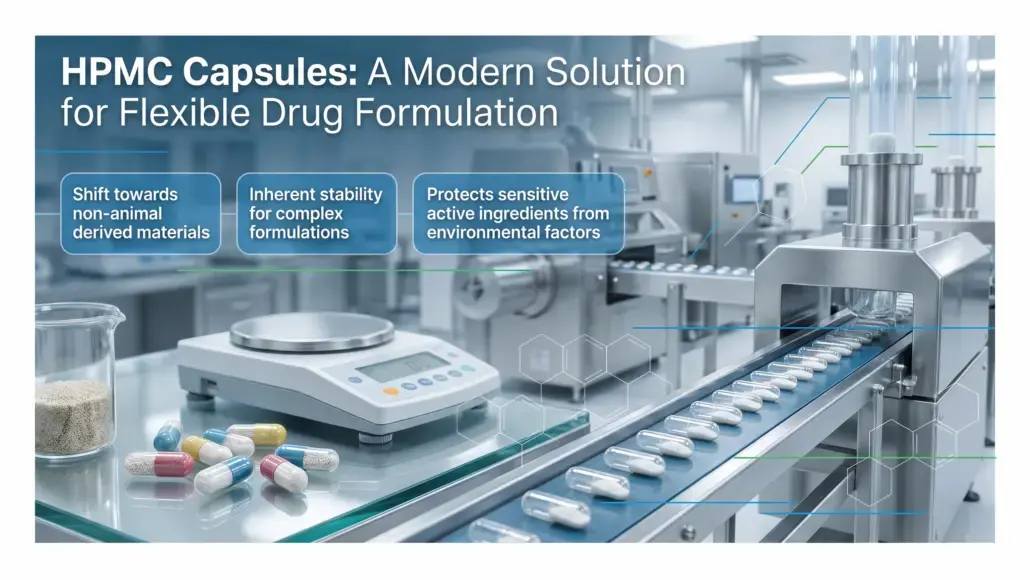
The pharmaceutical industry has seen a clear shift toward the use of non-animal derived materials in oral solid dosage forms. Among these innovations, the adoption of hydroxypropyl methylcellulose capsules has emerged as a preferred solution for complex drug delivery challenges. The technical advantages of HPMC capsules supporting flexible oral drug formulation are rooted in their inherent stability and their ability to protect sensitive active pharmaceutical ingredients from environmental factors. Unlike traditional gelatin capsules, which are derived from bovine or porcine sources, HPMC is a plant-based polymer that offers greater chemical inertness and resistance to cross-linking. This makes it an ideal choice for a wide range of chemical entities, particularly those that are sensitive to moisture or require precise dissolution profiles to ensure therapeutic efficacy.
The versatility of this polymer allows formulators to address a variety of manufacturing hurdles that often derail the development of new therapies. For instance, many modern drug candidates are highly hygroscopic, meaning they readily absorb moisture from their surroundings. Traditional gelatin shells contain a significant amount of water as a plasticizer, which can migrate into the fill material and cause degradation or instability. By contrast, the moisture content of hypromellose shells is significantly lower, providing a much safer environment for moisture-sensitive molecules. This characteristic of HPMC capsules supporting flexible oral drug formulation ensures that the integrity of the medication is maintained from the point of manufacture through to the moment of patient administration, even in humid climates where shelf-life stability is a major concern.
Chemical Stability and Cross-Linking Resistance
One of the most significant technical hurdles in capsule manufacturing is the phenomenon of cross-linking, which can occur when certain functional groups in the drug substance react with the amino acids in a gelatin shell. This reaction leads to the formation of a water-insoluble film that prevents the capsule from dissolving properly, thereby delaying the release of the medication and potentially reducing its bioavailability. Because HPMC is a synthetic cellulose ether, it lacks the proteinaceous components that trigger these reactions. This chemical inertness provides a stable platform for formulating drugs with aldehydes or other reactive groups that would otherwise be incompatible with animal-derived shells.
The absence of cross-linking also simplifies the process of regulatory validation and shelf-life testing. Manufacturers can be confident that the dissolution rate of the capsule will remain consistent over time, regardless of the chemical nature of the fill. This reliability is essential for maintaining the Quality Target Product Profile and ensuring that patients receive the correct dose at the intended rate. The use of this technology thus reduces the risk of late-stage clinical failures caused by unforeseen shell-drug interactions. By providing a stable and predictable delivery vehicle, these capsules allow research teams to focus on optimizing the therapeutic performance of the active ingredient rather than troubleshooting packaging issues.
The manufacturing process for these capsules also involves a sophisticated thermo-gelling technique that eliminates the need for secondary gelling agents in some formulations. While earlier versions of hypromellose capsules required the addition of carrageenan or gellan gum to facilitate the setting process on the pin bars, modern advancements have allowed for the production of pure HPMC shells. This is achieved through precise temperature control, where the pins are heated before being dipped into the polymer solution. As the solution comes into contact with the hot pins, it undergoes a thermal gelation, forming a uniform film without the need for additional chemicals. This process ensures a cleaner ingredient profile and avoids potential interactions between the gelling agents and the drug fill, further enhancing the stability of the final product.
Additionally, the moisture vapor transmission rate of these materials is a critical parameter. Although HPMC has higher permeability to water vapor than gelatin, its lower initial moisture content often offsets this factor. The use of desiccants or specialized coatings can further mitigate moisture ingress. This technical control allows for the successful encapsulation of highly sensitive molecules. The data-driven approach to selecting the appropriate shell material ensures that the final dosage form meets all stability requirements throughout its shelf life.
Mechanical Resilience and Global Supply Chain Efficiency
The mechanical properties of hypromellose capsules provide significant advantages during the manufacturing and distribution phases of the product lifecycle. These shells are less prone to brittleness in low-humidity environments compared to their gelatin counterparts. In high-speed encapsulation machines, this resilience translates to lower rejection rates and fewer mechanical failures, as the capsules can withstand the physical stresses of the filling process without cracking or deforming. This durability is particularly valuable for global manufacturers who must ship products through diverse climatic zones, where fluctuations in temperature and humidity could compromise the structural integrity of more sensitive dosage forms.
Additionally, the plant-based origin of the material simplifies the process of achieving international regulatory approval. As global health authorities increase their focus on material traceability and the risks associated with Transmissible Spongiform Encephalopathies, the use of a synthetic polymer eliminates these specific biological concerns. This makes it easier for pharmaceutical companies to enter new markets without having to reformulate their products to meet local cultural or dietary requirements. The strategic application of HPMC capsules supporting flexible oral drug formulation enables a more streamlined approach to global product launches, reducing the time and cost associated with regulatory compliance while maintaining the highest standards of product safety and quality.
Optimizing Dissolution and Bioavailability Profiles
Achieving the desired release profile for a medication is a complex task that requires careful consideration of the physical and chemical properties of both the drug and its delivery vehicle. Hypromellose capsules offer unique opportunities for tailoring these profiles to meet specific therapeutic goals. The dissolution of these shells is less dependent on pH compared to gelatin, which can be influenced by the acidic environment of the stomach. This independence allows for more consistent performance across a wide patient population, regardless of individual variations in gastric physiology or the presence of food in the digestive tract.
Formulators can utilize specialized HPMC grades to create modified-release profiles, such as enteric or sustained-release mechanisms. By incorporating these features directly into the shell, manufacturing complexity is reduced. The ability to fine-tune drug release timing is essential for medications requiring specific absorption windows. Through these specialized shells, companies develop sophisticated therapies that improve patient compliance by reducing dosing frequency. This flexibility drives innovation in new chemical entities and generic alternatives.
The dissolution performance of these capsules is another area where significant research has been conducted. Unlike gelatin, which can exhibit a lag time in dissolution due to the need for the shell to hydrate and rupture, HPMC capsules tend to dissolve more linearly. This characteristic is particularly beneficial for immediate-release formulations where a rapid onset of action is required. By adjusting the molecular weight and the substitution pattern of the hydroxypropyl and methyl groups within the polymer chain, manufacturers can customize the dissolution rate to match the pharmacokinetics of the drug. This degree of molecular engineering provides a level of precision that is simply not possible with natural animal products, allowing for the creation of highly optimized dosage forms that meet the needs of modern medicine.
Additionally, the compatibility of these capsules with a wide range of fill materials, including liquids, semi-solids, and non-aqueous solutions, expands the possibilities for oral drug delivery. The ability to fill capsules with oil-based formulations or lipid-based drug delivery systems is a significant advantage for poorly water-soluble APIs. These systems can enhance the solubility and absorption of the drug in the gastrointestinal tract, leading to improved bioavailability and reduced dose variability. The structural integrity of the hypromellose shell is maintained even when in contact with these complex fill materials, ensuring that the capsule does not leak or become soft over time. This versatility is a major factor in the growing popularity of the technology among formulation scientists.
Sustainability and Market Acceptance Trends
The shift toward sustainable and ethical sourcing is a growing trend across all areas of healthcare, and the choice of excipients is no exception. Patients are increasingly aware of the ingredients in their medications and often prefer products that align with their personal values, such as those that are vegetarian, vegan, or free from animal-derived components. By adopting HPMC technology, pharmaceutical companies can meet this demand without compromising on the technical performance or safety of their products. This alignment with consumer preferences can be a powerful differentiator in a crowded market, helping to build brand loyalty and trust among a diverse patient base.
The long-term outlook for this technology is one of continued growth and refinement. As manufacturing processes for the polymer itself become more efficient and cost-effective, the price gap between HPMC and gelatin continues to narrow. This economic factor, combined with the technical and regulatory benefits already discussed, makes a compelling case for the wider adoption of synthetic capsules across the industry. The ongoing development of new grades of hypromellose with enhanced properties will further expand the range of applications for this versatile material. Ultimately, the commitment to utilizing HPMC capsules supporting flexible oral drug formulation reflects the industry’s dedication to continuous improvement and its focus on delivering the best possible outcomes for patients around the world. The integration of these advanced materials is a strategic investment in the future of pharmaceutical manufacturing and patient care. The ongoing transition toward these synthetic solutions is a testament to the industry’s ability to adapt to new challenges and embrace innovative technologies that improve the quality and accessibility of healthcare. As the global regulatory environment continues to evolve, the advantages of using stable, non-animal materials will only become more apparent, solidifying the position of these advanced capsules as a cornerstone of modern pharmaceutical formulation and production. The ability to provide safe, effective, and patient-friendly medications depends on the continued exploration and adoption of such advanced delivery systems, which represent the forward-thinking approach of contemporary drug development strategies.