











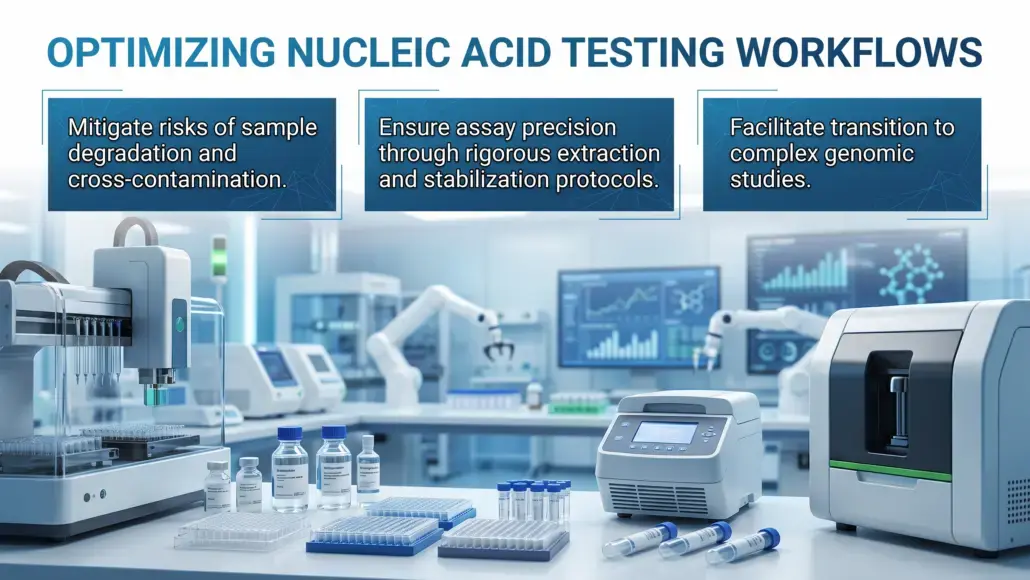
Pharmaceutical laboratories are currently standardizing nucleic acid testing workflows, strengthening molecular research to mitigate the risks associated with sample degradation and cross-contamination in high-throughput screening environments. The precision of molecular assays depends entirely on the quality of the starting material, requiring rigorous protocols for extraction and stabilization before analysis. As research centers transition toward more complex genomic studies, the necessity for reproducible and efficient purification methods becomes a primary operational requirement. These workflows integrate automated extraction platforms with high-purity chemical reagents to isolate genetic material from diverse biological matrices without compromising molecular structure. By establishing a robust foundation for nucleic acid isolation, researchers can ensure that subsequent analytical steps, such as quantitative polymerase chain reaction or next-generation sequencing, yield data that is both accurate and representative of the biological state. The adoption of these standardized procedures is essential for maintaining the integrity of clinical data and accelerating the development of novel therapeutic candidates in the pharmaceutical pipeline.
Automation and Integration of Molecular Diagnostic Platforms
The future of nucleic acid testing workflows is deeply tied to the automation and integration of molecular diagnostic platforms across the entire research spectrum. Automated systems reduce the variability introduced by manual handling, ensuring that each sample is processed with the same level of precision and care. These platforms often combine extraction, amplification, and detection into a single, enclosed unit, minimizing the risk of environmental contamination and improving laboratory safety. By integrating these units with laboratory information management systems, researchers can achieve a seamless data flow from the moment of sample collection to the final analysis. This digital integration also facilitates the use of advanced analytics to identify trends and optimize workflow efficiency in real-time. As the technology continues to advance, the miniaturization of these platforms will allow for their deployment in a wider range of settings, including point-of-care diagnostics and field-based research. The continued drive toward automation and integration will ensure that nucleic acid testing remains a cornerstone of pharmaceutical innovation, providing the high-quality data needed to drive the next generation of medical breakthroughs.
Emerging Technologies in Next Generation Molecular Testing
Ongoing developments in nucleic acid testing workflows for molecular research are focused on the integration of emerging technologies that offer even greater sensitivity and specificity. For example, the use of nanopore sequencing and other single-molecule detection methods is providing new insights into the structure and function of nucleic acids without the need for amplification. These technologies allow for the detection of epigenetic modifications and the direct sequencing of long RNA molecules, providing a more complete picture of the transcriptome. Additionally, the development of biosensors and paper-based diagnostics is creating new opportunities for low-cost, decentralized molecular testing in resource-limited environments. By adopting these next-generation tools, pharmaceutical researchers can expand the scope of their molecular research and address new challenges in global health. The commitment to exploring these emerging frontiers is essential for staying at the leading edge of molecular science and ensuring that the industry remains capable of addressing the most complex medical problems. As these technologies mature, they will become integral components of the standard molecular research workflow, further enhancing the power and precision of nucleic acid testing.
Strategic Implementation of Laboratory Quality Management Systems
A primary driver for the success of nucleic acid testing is the strategic implementation of laboratory quality management systems that govern every aspect of the molecular testing process. These systems provide a structured framework for the management of personnel, equipment, reagents, and data, ensuring that the laboratory operates with the highest level of efficiency and integrity. Quality management involves the regular review of operational procedures and the implementation of corrective actions whenever deviations are identified. This proactive approach to quality ensures that the molecular testing workflow remains resilient in the face of changing research requirements and technical challenges. Furthermore, the use of key performance indicators allows laboratory managers to track the efficiency of the workflow and identify areas for improvement. By prioritizing quality management, pharmaceutical organizations can build a more scalable and sustainable molecular research platform that is capable of delivering high-quality data over the long term. The integration of quality systems with advanced molecular tools provides the necessary foundation for achieving excellence in the modern pharmaceutical laboratory, supporting the development of safe and effective medicines for patients worldwide.
Collaborative Networks and Knowledge Sharing in Molecular Research
The expansion of nucleic acid testing is also supported by the growth of collaborative networks and knowledge-sharing initiatives within the global scientific community. Pharmaceutical research is increasingly a multidisciplinary effort, requiring the coordination of expertise across genomic, proteomic, and clinical disciplines. By participating in pre-competitive collaborations and open-science initiatives, organizations can share best practices and accelerate the development of new molecular testing standards. This collaborative approach allows for the pooling of resources and the sharing of high-value data sets, leading to more robust and representative molecular insights. Furthermore, the exchange of technical expertise through professional societies and scientific conferences ensures that the latest innovations in nucleic acid testing are rapidly adopted by the wider research community. The commitment to collaboration and knowledge sharing is essential for addressing the most complex challenges in human health and ensuring that the benefits of molecular research are shared broadly. By fostering a culture of openness and cooperation, the pharmaceutical industry can achieve a more rapid and efficient translation of molecular discoveries into life-saving therapies. The integration of collaborative networks with advanced molecular workflows provides a powerful framework for driving innovation and improving the lives of patients around the world.
Optimizing DNA and RNA Extraction for Maximum Yield
The first stage of nucleic acid testing workflows involves the selection of extraction chemistries that maximize both the yield and purity of genetic material. Modern pharmaceutical R&D relies on specialized technologies to navigate the complexities of cell lysis and protein removal while preserving the delicate structure of long-chain polymers. These silica-based or magnetic bead-based systems are engineered to bind nucleic acids with high affinity, allowing for the removal of inhibitory compounds that could otherwise interfere with enzyme-driven reactions. The choice of extraction method is often dictated by the specific requirements of the downstream application, with some protocols optimized for rapid processing and others for the recovery of ultra-pure material from limited sample volumes. In the context of drug discovery, the ability to consistently recover high-quality RNA is particularly critical, as transcriptomic data provides vital insights into the mechanism of action of small molecules and biologics. By refining these extraction processes, laboratories can significantly reduce the incidence of assay failure and improve the overall throughput of their molecular research programs.
Implementing Rigorous RNase Control for RNA Stability
A critical component of nucleic acid testing is the strict adherence to the basics of RNase control and the maintenance of an RNase-free environment. Ribonucleases are exceptionally stable and ubiquitous enzymes that can rapidly degrade RNA samples, leading to false-negative results or distorted expression profiles. Pharmaceutical scientists must employ a combination of physical barriers and chemical decontaminants to ensure that laboratory surfaces, pipettes, and reagents remain free of these destructive proteins. This includes the use of certified RNase-free plasticware and the regular application of specialized surface inhibitors designed to neutralize RNase activity on contact. Additionally, the integration of protective agents directly into the lysis buffer helps to stabilize intracellular RNA at the moment of cell rupture, preventing degradation during the early stages of the extraction process. By treating RNase contamination as a systemic threat to data quality, research organizations can protect their investment in high-value samples and ensure that their molecular insights are based on intact, high-fidelity genetic information.
Enhancing qPCR Reliability through Contamination Mitigation
To improve your qPCR process, nucleic acid testing workflows must address the potential for carryover contamination and the presence of PCR inhibitors. Quantitative PCR is an extremely sensitive technique capable of detecting single copies of a target sequence, but this sensitivity also makes it vulnerable to trace amounts of contaminating DNA from previous reactions or the environment. The use of cleanroom standards, unidirectional workflows, and specialized enzymatic treatments, such as uracil-DNA glycosylase, are standard practices in pharmaceutical labs to prevent the amplification of unintended targets. Additionally, the removal of reagents used during extraction, such as ethanol or high-salt buffers, is essential for maintaining the activity of the DNA polymerase. High-purity elution buffers and thorough wash steps ensure that the final template is compatible with the most demanding qPCR master mixes. When these contamination controls are combined with optimized primer design and thermal cycling parameters, the resulting assays provide the high level of sensitivity and specificity required for regulatory-grade molecular analysis.
Standardizing Downstream Analytical Performance
The final validation of nucleic acid testing workflows involves the assessment of downstream analytical performance across multiple experimental batches. Consistency is the hallmark of professional B2B molecular research, and utility operators must demonstrate that their workflows produce reproducible results regardless of the operator or the day of the week. This is achieved through the use of internal controls and reference standards that monitor the efficiency of both the extraction and the amplification phases. Digital PCR and other absolute quantification methods are increasingly used to calibrate these workflows, providing a precise baseline for the assessment of sample quality. Additionally, the implementation of electronic laboratory notebooks and automated tracking systems ensures that every step of the process is documented, facilitating the troubleshooting of anomalies and the optimization of resource allocation. By treating molecular research as a structured engineering process, pharmaceutical companies can build a more resilient and scalable platform for the discovery of life-saving medicines. The integration of high-performance extraction technologies with stringent environmental controls provides the necessary framework for achieving excellence in the modern molecular laboratory.