








A New Era of Biopharma Production with AI
The biopharma industry is undergoing a transformation as it capitalises on the potential of artificial intelligence (AI) to revolutionise production processes. Manufacturers are currently facing the most significant challenge in history: the production of high-quality products at scale and with efficiency, in response to the growing demand for biologics and next-generation therapeutics. In this scenario, a new paradigm of biopharma manufacturing with AI emerges, in which intelligent systems optimise operational efficiency, optimise resource consumption, and ultimately improve patient outcomes. The integration of AI into biopharma manufacturing is not merely an industrial advancement; it represents a paradigm transformation in the development and production of drugs.
The Growing Demand for Biopharmaceuticals
The international biopharmaceutical industry is estimated to grow over $500 billion by 2027, as per Grand View Research. The growth is fueled by the rising incidence of chronic diseases, advances in biotechnology, and a move towards personalized medicine. Consequently, the industry is under pressure to innovate and increase production while keeping up stringent standards of quality.
Traditional biopharma production methods, which heavily rely on empirical approaches and manual monitoring, often lead to inefficiencies, longer development timelines, and increased costs. The complexity of biologics, derived from living cells, introduces inherent variability, making process optimization crucial. Herein lies the importance of integrating AI into production workflows as part of a new era of biopharma production with AI.
AI in Process Optimization
AI technologies allow biopharmaceutical companies to examine huge volumes of data created during the course of the manufacturing process. With the help of machine learning algorithms, businesses can detect patterns and optimize parameters to improve yield and quality.
For instance, predictive analytics can anticipate potential process deviations by analysing historical data and real-time monitor metrics. By implementing this anticipatory strategy, producers can address conditions before they become problematic, thereby reducing waste and improving efficiency. AI has the potential to increase production yields by up to 15% and reduce the time required for product development, as per a report submitted by Sanofi.
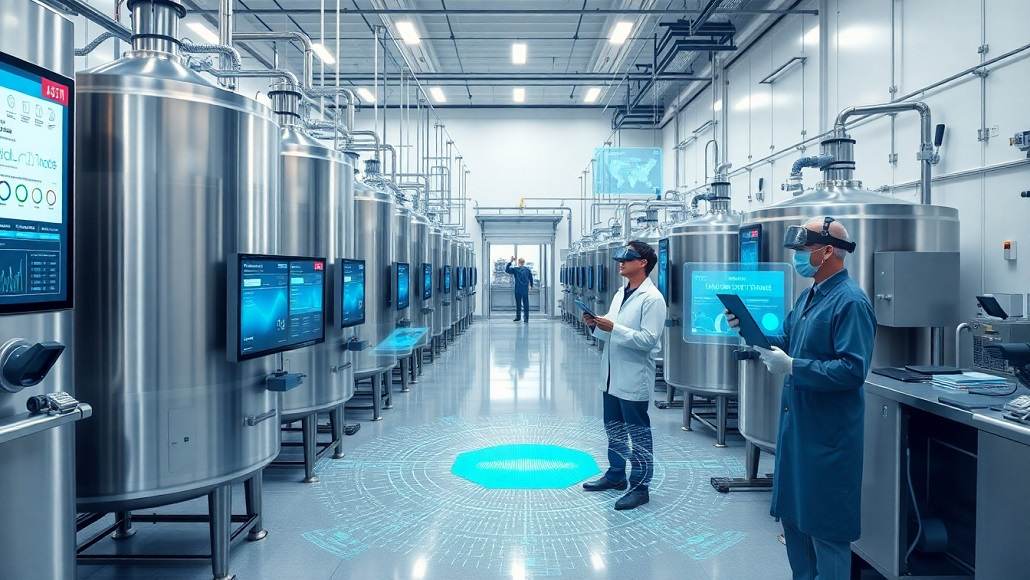
Furthermore, bioreactor management can be automated by AI systems to have the best possible conditions for cell culture growth. Amgen and Genentech have already seen significant improvements by adopting AI-based process controls, achieving improved consistency and increased potency of biologics manufactured.
Enhancing Quality Assurance and Compliance
Quality assurance during biopharmaceutical manufacture is not negotiable. Starting a new biopharma manufacturing era using AI signifies that quality control procedures can be greatly improved with automation and advanced analytics. AI-based technologies facilitate continuous monitoring of CQAs, and products are guaranteed to meet efficacy and safety standards.
Digital twins, virtual copies of physical manufacturing operations, enable real-time simulation and testing. With digital twins, businesses can test new methods of production or changes to their processes without jeopardizing actual batches and ensuring regulatory compliance. Regulatory bodies like the U.S. Food and Drug Administration (FDA) are also becoming aware of the utility of AI and digital twins in aid of regulatory submissions.
In addition, AI can help ensure meticulous and thorough documentation necessary for compliance. In order to effectively manage regulatory documents, monitor changes, and guarantee that each stage of the production process adheres to rigorous guidelines, natural language processing (NLP) technologies are employed.
Accelerating Innovation in Biopharma Production
The integration of AI in biopharma manufacturing is not only a means of improving current processes, but also a gateway to innovation.The emergence of personalized medicine, which individualizes therapy based on the genetic profile of each patient, requires flexible and responsive manufacturing approaches. The new wave of AI-backed biopharma manufacturing accommodates this movement by allowing quick adaptation to manufacturing processes.
With AI technologies installed, producers can rapidly examine data from low-volume runs and rapidly shift protocols to achieve new therapeutic targets. Such agility is essential in an age when patient demands are fragmenting and changing, especially with regard to new health challenges.
Moreover, automated intelligence cuts down on the need for manual labor, enabling highly qualified professionals to stay engaged in key decision-making and innovation work instead of mundane activities. Not only does this enhance the efficiency of operations but also encourages a climate of innovation and teamwork in organizations.
The Future of AI in Biopharma Production
As the biopharmaceutical environment continues to shift, a new generation of biopharma manufacturing with AI will be critical in defining the future of medicine. As biotech advancements in AI progress, potential further optimization and innovation come more clearly into focus. Technologies like federated learning and explainable AI hold promise to better protect data privacy and trust in AI-driven decisions, specifically resolving transparency and security concerns in biomanufacturing.
Furthermore, it is anticipated that investments in artificial intelligence will experience a substantial increase. In a recent survey conducted by Deloitte, over 65% of biopharma executives stated that they plan to increase their expenditure on AI technology within the next three years. The acknowledgement of the transformative value of AI in biopharma manufacturing is further reflected in this commitment.
Conclusion
A new age of biopharma production with AI is not a trend; it is a core transformation in the way industry manufactures biologics and complex therapies. By adopting AI technologies, biopharmaceutical firms can streamline manufacturing processes, increase quality control, and speed up innovation, ultimately resulting in improved patient outcomes.
With the industry evolving to deal with the changing healthcare environment, the role of AI will be imperative in making biopharma manufacturing robust, efficient, and responsive to the demands of patients. The potential of AI is not just to address immediate needs but also to provide the momentum to shape the future of biopharmaceutical manufacturing and open the door to an era of unprecedented efficiency and capability.