












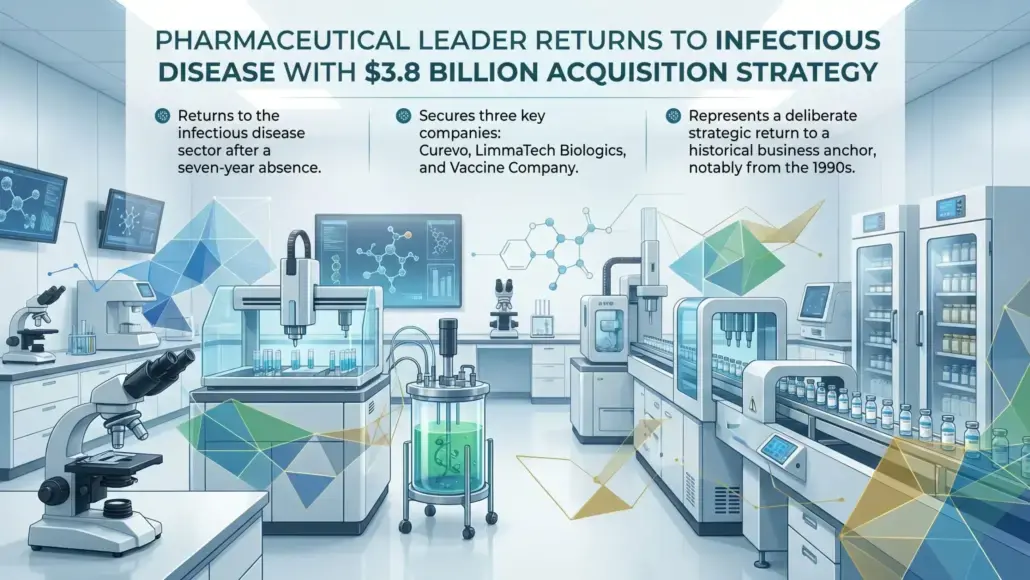
After a seven-year absence from the sector, Eli Lilly is returning to the field through a trio of corporate purchases valued at more than $3.8 billion. This infectious disease M&A activity secures Curevo, LimmaTech Biologics, and Vaccine Company, firmly positioning the pharmaceutical organization within the vaccine development arena. The transactions represent a deliberate return to a segment that historically anchored the business, notably during the 1990s with the high-performing antibiotic Ceclor.
Previously, numerous pharmaceutical entities exited this exact space due to challenges in securing a reliable return on research and development funding. However, the organization’s recent strategic investments yield candidate treatments that target severe viral pathogens associated with long-term oncological and neurological risks, alongside bacterial pathogens that present ongoing prevention and treatment difficulties.
This infectious disease M&A strategy introduces multiple early-stage and clinical assets aimed at disrupting current market standards. According to Daniel Skovronsky, president of Lilly Research Laboratories, decades of clinical evidence demonstrate that common infections are linked to conditions that emerge years later, including infertility, cancer, and neurological disease. The acquisitions reflect a strategy focused on preventing disease at the source rather than treating downstream consequences.
To address prevalent viral pathogens, the company agreed to pay up to $1.5 billion in cash for Curevo. This secures amezosvatein (CRV-101), an adjuvanted subunit vaccine engineered to prevent shingles in adult populations. The candidate is currently undergoing a head-to-head phase 2 trial against the established market leader, Shingrix. Curevo notes that the injection is designed to limit tolerability issues associated with existing options, such as pain at the injection site, chills, and fatigue.
Additionally, the acquisition of Vaccine Company introduces an in vivo nanoparticle platform technology to the vaccine development portfolio. This platform aims to match the efficacy of virus-like particle candidates while bypassing complex manufacturing challenges. While these assets have not yet reached clinical trials, the lead program targets the Epstein-Barr virus, which causes glandular fever and is linked to various cancer forms and multiple sclerosis.
The $780 million transaction for LimmaTech Biologics provides a portfolio targeting bacterial pathogens that pose significant public health challenges due to antimicrobial resistance.
- The lead program, LTB-SA7, targets Staphylococcus aureus and has entered phase 1 testing.
- Additional preclinical efforts focus on Neisseria gonorrhoeae and Chlamydia trachomatis.
Supported by escalating sales of obesity and weight-loss therapies, these strategic investments complement an already extensive 2026 acquisition spree. Other major transactions this year include a $7 billion purchase of obesity and diabetes developer Kelonia, a $7.8 billion acquisition of sleep disorder specialist Centessa Pharma, a $2.4 billion bid for in vivo CAR-T therapy developer Orna Therapeutics, and a $1.2 billion takeover of immunology-focused Ventyx Bio.